Thursday, 17 December 2009

Gallery Artwork from Issue 5 (2009)


I was so overwhelmed by the amazing art submitted earlier this year for the Gallery in Issue 5.
I want to re-post the work here to share the work further than the pages of the zine could reach.
I love each and every one of these artists. Thank you for being a part of COTL5 :)


Ali Aschman (Brooklyn, NY)


Amber Seegmiller (Whittier, CA. USA).


Kate Pugsley (Chicago, USA)


Brandi Milne (USA)


Colette Rosa (London, UK)


Ellara Woodlock (Melbourne, Australia)


Elise Towle Snow (Salem, Massachusetts, USA)


Emily Cunningham (Chicago, USA)


Freya Harrison (London, UK)


Memo (Leeds, UK)


Jen Oaks (Berkeley, CA. USA)


Julianna Swaney (Portland OR. USA)


Katie Hanratty (Wirral, UK)


Kristyna Baczynski (Leeds, UK)


Laura Berger (Chicago, USA)


Lisa Linnéa (Sweden)


Liza Corbett (New York City)


Lucy Player (Essex, UK)


Maria Gil Ulldemolins (aka Nosideup) (Oxford UK)


Megan Whitmarsh (Los Angeles, USA)


Meryl Donoghue (London, UK)


Miso (Melbourne. Australia)


Miss Led (UK)


Nancy Mungcal (Los Angeles, USA)


Nikki Stavin (Chicago, IL, USA)


Nina Nijsten (Hasselt, Belgium)


Sarah Lippett (UK)


Suzanne Coady (Santa Fe, NM, USA)


Ulla Saar (Tallinn, Estonia)

Thursday, 29 October 2009

Erika Lopez Interview


Erika Lopez


Location: San Francisco, CA
How would you describe your art? My art? Like a little kid left in a cave with her school pack.
Currently working on: A book and a movie. I think this is the last you'll hear of me right here. I’m out of my league.
Day job (if applicable): None. Yet...
3 Likes: Music, James--my best friend, and my cat
3 Dislikes: Liars, scared people, anything too institutionalised
Daily Inspirations: To change the world and show another way to be a superfreak without burning out. Not sure I’m succeeding today, though.
People & artists you admire: James--my best friend, thich naht hanh, Kurt Vonnegut
Favourite album(s) to listen to when working: Changes on depending on my work. Metallica used to be fun before the "scared people; anything too institutionalized" dislike kicked in.

http://www.erikalopez.com/

http://clog.erikalopez.com/


Interview date: June 2009


Hi Erika, how are you? What are you up to at the moment?
I’m having a rough day. A bolt of inspiration made my previous book idea irrelevant. And now I have to scrap previous idea and start anew.
I’m exhausted.
But I get weary because I’m so idealistic and feel like I’m born into a cheap world so often.

How did you get started with art, and how long have you been creating art, embracing your creativity, and working towards developing your current style and output?
I was born observing. It’s often hell. I understand what crappy entertainment is for now: to forget how crappy life can be. To feel is often exhausting.
I’m not in a good mood.
It’s been a rough seven years. I think I broke a mirror somewhere.
But I get hits of bliss which make it all worthwhile...
Ay!

I have heard you say that when you were young, cartooning got yr mum’s attention. What were those early cartoons like and about, and what led you to continue creating and developing them?
They were funny because humour would get her attention. And I still "lap dance for mommy" today.
My humour is what gets attention. I have to slog through the despair to get to the funny.

Were your artistic endeavours encouraged from an early age, perhaps giving you a sense of perspective over your productivity and its worth?
Yeah, when people laughed, that was a high.
Addicting.
That was its worth and still is for me.

Your illustrative work merges many different styles: porn, cartoon art, clip art, with traditional American narratives (road tales, love and hurt, etc)
You have also worked in many mediums: literature, illustration, film, comics, spoken word.
In looking at all of this and thinking of influences, is there any one particular artist or style you admire?

No. So many. I love people who do too many different things. Steve Allen. Shel Silverstein. etc.

Where do you create? Do you have the space to create all the kind of art you want to?
Oh no, I live in about 400 sq feet with James, my best friend, James. I call him 'thames.' have no idea how that came to be.

You went to art school – what did you learn from this experience that you still incorporate into your work, or that still influences you today?
I learned to finally finish things. And now I like epic projects. I learned tenacity. And I learned to love other artists. Visual artists don't much get writers. But visual artists feel like home wherever I am.

What role does artistry and creativity hold in your current everyday, day-to-day life?
Unfortunately a major all-the-time role. I kill any deal that is otherwise. I pay dearly for this privilege.

I am very interested in how and where women gain access to their own confidence, and self-belief -- especially in terms of how they are able to produce and create with a sense of assurance, belief and certainty.
What is your personal relationship with confidence?
It lurches up and down. In the end I see how I feel inside. Most people try to diminish us just to control us so they get what they want. It’s just "wild kingdom" out there. It’s just natural.

How has your approach to carrying out your creativity changed since moving between illustrated books to reading your work, and illustrating it through live performances?
My creativity hasn't changed. Just my audacity and standing up to my beliefs with my own face. That’s hard not to hide behind art or words. To own it. To stomp.

In most of your books, the layout of and the actual hand written text functions as a form of illustration. Would you say that this is the same with the use of your voice in performance – that your voice is the illustration?
Oooh. Nice. Like that!

When working on spoken word/written projects, do you miss cartooning?
No. Cartooning is very private. I don't need to publish. When I perform, I feed off many people.

You are employing a DIY style of self-publishing and spoken word now (no longer tied to publishers or others’ schedules or expectations of promotion)
Are you enjoying having full creative control over your production?

Yes. Too much. That’s the problem.

There seems to be a reoccurring theme in your art – that of reworking Latina stereotypes to give them female agency, self-possession, and sexuality on their own terms. As such, interrogating and revising Latina stereotypes and Latin cultural icons.
Alongside reclaiming Latina stereotypes, there appears to be further examples of reclaiming female visual images in general in your work.
By depicting sexualised, rad, strong women there’s a divergence from fixed social norms on femininity – especially from within the comix field where traditionally “female comics” and comics aimed at girls and women were filled with heteronormativity and fixed traditional roles of quaint uber-femininity for the characters.

Has it been a conscious aim for you to queer femininity norms & female (self)-representation, and disrupt gender and gendered norms within your work by depicting other truths and ‘our’ norms?
Absolutely! Couldn’t have said it better myself.
I think our life depends on diverging from social norms.
Suicides speak to that. Cut up faces and arms and white knuckling it into our upper ages.
It’s tragic.

I once read you say:

“I do want to hear about people – especially younger ones – reading my stuff and feeling like they can be more of who they are […] It’s not sexy to be your dorky self and there’s nothing out there that encourages you to […] to be oneself is to sign up to a lifetime of embarrassment, dorkiness, many come-to-jesus talks about fitting in “or else”, and many family fights.”


To what degree therefore do you wish for your work to be seen as acceptance of others’ unique lives, and a way for alienated people to find a form of self-assurance via your depictions of non-mainstream or “non-traditional/unacceptable” lives? Setting yourself up as a dork/outsider for others to believe in and aspire to?
Is it important to you that your work have a constructive, positive, inspiring role for women readers?

I don't want anyone to emulate me, as much as see the paste up lines of doing it your way because everyone works and copies each other to make it all look so easy. To make it up as you go along is hard. There’s no map.
I want to show what THAT looks like so others feel more confident. Whatever they're doing. It doesn't matter. All that matters is individuality, integrity, honour. Then we won't be unhappy and be vampires to others' souls. And we recognize when others do that with us.

Your most recent project is the Welfare Queen. What is this all about?
Could you explain to me where the ideas for this come from, how you are presenting this project, and why you personally wanted to document welfare queens in your work at this time?
Well, I did the welfare queen as a show a few years ago when I was on welfare after having a flourishing book career. I was so full of despair, I finally laughed. And it became a cartoon. Then a dare to do a show. Then I toured it.

Helen Musselwhite Interview


Helen Musselwhite

Location: Southern edge of Manchester, UK
How would you describe your art? Paper Sculpture that’s colourful, bold and whimsical
Currently working on: orders for independent shops, commissions through my website and 2 exhibitions
3 Likes: small birds, reading blogs, the smell of roses
3 Dislikes:
inconsideration, Turkish delight, plastic carrier bags
Daily Inspirations: The flora and fauna I see when dog walking
People & artists you admire: Picasso, Emile Zola, Alexander Mcqueen, Madonna
Favourite album(s) to listen to when working: I go through phases. Lately I’ve been listening to White Chalk by PJ Harvey, Fleet Foxes, and I like to have a blast of Witchita Linesman by Glen Campbell to send a tingle down my spine. I also listen to Radio 4 a lot


http://www.helenmusselwhite.com/

Interview date: March 2009.


Hi Helen, how are you? What are you up to at the moment?
Just getting used to working in my new glasses! It’s the first time I’ve had to have them and it feels quite odd!

First things first I guess I’d like to ask about the sorts of stuff you like; what images keep you company in your studio / place(s) of work, for inspiration?
I’ve got lots of reference books and back issues of interior/style magazines.
On the wall next to my desk is a collection of cards, postcards (some bought by me some given to me), magazine cuttings, bits of work that didn’t quite turn out as I wanted that might work on another piece, images printed from the internet a picture of a flamingo by my godson which I particularly like. It’s an ever-expanding collection.

What is your artistic history? How did you get started, and how long have you been creating art, embracing your creativity, and working towards developing your current style and output?
I did an art foundation course followed by an OND and Hnd in graphic design and then worked in a design studio for a few years.
I also used to make and decorate small pieces of furniture from MDF which I sold to independent shops.
I then spend a few years working for a jeweller making rudimentary sliver and gold jewellery and as an art technician in a school.
Then in 2006 after relocating to Manchester paper really began to work for me.

Where did your skills and interest in paper engineering come from?
Whilst making jewellery, I used to make paper models of some of the pieces I wanted to make and I was also in charge of the widow displays at the jewellers which I made from paper too.
I quickly realised that paper was a fantastic medium and a lot cheaper than gold and silver!
I made a couple of box frames and assembled an all white woodland scene with a stag, a doe and an owl and a group of butterflies around a flower took them to local shop and the rest is history!

Were your artistic endeavours encouraged from an early age, perhaps giving you a sense of perspective over your productivity and its worth?
Yes, more than anything I used to love getting a new pad of paper and a pack of 30 felt tip pens (which I had to arrange in colour order starting with black which was my favourite and finishing with yellow) My mum was always making things when I was young from a bookcase to clothes to furniture for my Sindy house and I think her creativity and originality inspired me from a very early age. Ours was a “making” house.

What role does artistry and creativity hold in your current everyday, day-to-day life?
It is the majority of my waking hours!

The majority of your art takes nature as its main subject, whether this be flowers, hedgerows, woodland, birds, plants, rabbits, etc.
There’s something very ‘British’ about your work, in this sense; documenting everyday native scenery.
Do you think your current environment, as well as the environment in which you grew up influenced this subject matter?

Yes very much.
I grew up in the countryside; my dad was a farm worker so it always surrounded me.
I did go through a teenage rebellion phase when I hated it for a few years but after art college in the city I gravitated back.
Now we live with 1 foot in suburbia and 1 in the countryside which seems to work very well, although I do have a yearning for a cottage on the edge of a village which is where I began!

You have stated that your work is influenced by Folk art and Mid-century design. Where did your interest in such art forms come from, and what in particular moves you about them?
What correlations do you personally see between your own work and these design and art forms?

My interest started at art college learning about art and design history.
Once I discovered The Bauhaus and the movements that came afterwards it all clicked.
I like the simplicity of mid century design and the ornate/decorative nature of folk art and the connections which exist between them. I have a love for both and like them to exist together
In my work albeit subtly.
I admire the beauty of simple, intelligent design but I can’t resist colour and pattern. I try to reflect this in my work but I have a leaning towards decoration so simplicity often loses!

How important do you think it is to include and represent traditional art forms like Folk Art in contemporary art work?
Its really important because folk art is a form of social history and it’s universal in the stories and tales of life it portrays. Every country has them, and they need to be kept alive.
They are often intricately linked with the countryside and the seasons and use simple materials.

I am very interested in how and where women gain access to their own confidence, and self-belief -- especially in terms of how they are able to produce and create with a sense of assurance, belief and certainty.
What is your personal relationship with confidence?

It came to me in my early thirties I think, when I had been working for myself for a few years, doing something I loved and believed I was relatively good at and its grown over the years.
I also have to say that the encouragement and belief that my partner Andrew has had in me
Has definitely helped to boost my confidence.

How would you describe your artistic techniques and materials; what processes does your work go through to reach a ‘finished product‘?
And how long would it take to complete a typical scene?

It’s hard to say how long a typical piece takes as there are always distractions and I quite often go back and add things.
I start with a little sketch and quite often enlarge that.

With the time it takes to create each individual, one off piece, what strategies and techniques have you learned or adopted in order to keep motivated, maintain concentration, enthusiasm and momentum, and be self-disciplined? As I for one know that keeping perky and focussed on long projects can be tough!
I write lists all the time and when it all gets a bit too much I take my dog for a walk to clear my head and think about what I have to do, the most important thing I discovered not to do is panic!

What are your interests in fairytale mythologies, and why did you decide to weave these ideas into your artistic work?
I like fairy tales and folktales because they are fanciful, slightly dangerous, from a more simple age and have a morality and message which is universal and relevant today.
I like the idea of escaping into a world like that, not forever, just at certain times.

How important is the role of ‘story telling’ in your artwork, especially due to this element of fiction, fairytale and folk tales?
I make up little stories when making some pieces and I’d like the viewer to do the same.

How prolific an artist are you?
Do you find creating work to order, or to meet specific deadlines creatively useful, or restricting?
I seem to be very prolific at the moment, I have lots of ideas that I draw quickly and sometimes use straight away or store for the future.
I do like deadlines as they make me work more efficiently and effectively.
It can be frustrating though when I have a new idea and have other work to finish before I can start on the new idea. I have lots of ideas that often take months to manifest into work I’m happy with and had envisaged when I first had the idea.

What are your thoughts on the nature and exclusivity/inclusiveness of ‘art’ -- Do you believe everyone can be creative in their own life?
Art and creativity has many levels and is a very personal thing.
Every one has some it just manifests its self in different ways, whether it be professional or a hobby.

You are a member of the Manchester Craft Mafia. How and why did you become involved with this?
I became involved primarily to meet other like mined people in the area and to meet periodically, it’s a loose collective of people but we’re there for moral support, professional help and a social time too!

A lot of your work is sold in local, independent galleries and stores.
Do you feel that such independently owned stores, spaces & settings are more suited/more fitting for your artwork?

Yes definitely. My work is the antithesis of mass production but at the same time quite commercial and I find that independent shops and small galleries and their customers understand this and actively seek out original work.
Local is important too but I do sell all over the world which is important in raising my profile.

Do you enjoy exhibiting in group shows?
What have your experiences of exhibiting nationally and internationally been like in general?
I have exhibited in lots of small group shows and I like the diversity that comes with a group.
I have always had good experiences with the shows I’ve done.
The galleries and their customers have been very positive, especially in America!

What is your favourite part of artistic creativity? Why do you keep on going and doing what you do?
I just like to make/create. I like the whole process really, I get immersed into it and get annoyed when life gets in the way!
I had a hiatus a few years ago when I got a proper job for a few years and I really think it helped me to focus on my work now and realise how important it is to keep making and evolving my work.

Heidi Burton Interview


Heidi Burton

Location: Cambridge, UK
How would you describe your art? Illustrative in a light-hearted and quirky way, sometimes escapes to the sombre side..
Currently working on: A magazine cover, website banners, an ongoing personal project of overheard conversations, various collaborative illustration projects, and my entries for the International Moleskine journal exchange.
3 Likes: Thunderstorms, tea-drinking, shipping forecasts on the radio.
3 Dislikes: Insomnia, pigeons, things that reduce in size while increasing in price.
Daily Inspirations: Observations, everything I see and hear plays some part.
People & artists you admire: Tove Jansson, Haruki Murakami, Sylvia Plath, David Attenborough.
Favourite album(s) to listen to when working: Yann Tiersen ‘Goodbye Lenin’, The Coral ‘The Invisible Invasion’, Kimmo Pohjonen ‘Kielo’, The Zutons ‘Who Killed The Zutons’.

http://heidiburton.wordpress.com/

Interview date: March 2009.


Hi Heidi, What are you up to at the moment?
Hello! At the moment I’m procrastinating, drinking tea, looking forward to a psychedelic barn dance at the weekend, and brainstorming ideas for a project.

First things first I guess I’d like to ask about the sorts of stuff you like; what images keep you company in your studio / place(s) of work?
I have a wall of over 20 illustrations depicting many different things sent to me by various fantastic artists, along with a notice-board covered in postcards (for virtual escapism), and a mini washing line with all kinds of ideas on paper pegged to it.

Where do you work from?
I work from home, currently a cosy, creative corner of a room, with a desk, laptop, drawers of art materials, and the all-important tea-making facilities.

What is your artistic history? How did you get started, and how long have you been creating art, embracing your creativity, and working towards developing your current style and output?
Studying and practicing art never really seemed like a decision to make, it was my natural direction at any opportunity (school, college, university) so there was no real ‘start’ as such. How and what I draw/paint reflects my personality, although over the years my styles have become more defined due to getting to know myself better, and with advancements in technology I can work digitally now. It’s a bit tricky because I have two main working styles and they are polar opposites, cartoons with sweet/funny characters contrast hugely with my illustrating poetry by writers such as Sylvia Plath that tend to involve sombre paint styles. I guess there are many facets to the mind; mine seem to involve both the child-like and depressive hemispheres! When people ask me to create something for them, the first thing I ask is ‘which style are we going for here?’

Were your artistic endeavours encouraged from an early age, perhaps giving you a sense of perspective over your productivity and its worth?
My mother always said my work was great, no matter how bad it was, and my father was a bit more constructively critical – this provided a good balance of both encouragement, and a need to push myself further. My father used to draw blank comic strips for me and photocopy them, so as a child I spent a lot of time drawing, constructing narratives, and creating characters. My mother used to get me involved in all kinds of craft activities from making dolls house bits-and-pieces from clay, to sewing, and making candles. It led me to believe that creativity is an important part of everyday life, something I still believe!

Did having creative parents influence you and your pursuit of art?
My own creativity and pursuit of art is derived from both nature and nurture, I’m sure. My mother has always enjoyed crafts, dressmaking and designing, and my father is good at drawing, painting, and cartography. My parent’s home is host to (what I would describe as) a mini-library containing many arty books so as a teenager I enjoyed poring over the books about the golden age of Finnish art and the Pre-Raphaelites. Although my parents encouraged me to work hard on academic subjects at school, they saw art as an equal subject rather than an inferior one. Birthdays and Christmas always brought me new art materials (along with new socks of course). So I’d say yes, they did greatly influence my pursuit of art!

I have read you claim that you are mostly inspired by the simple things in life. How much of a role does the everyday play in your art, and does your art play in your everyday?
I’m quite analytical and observant; definitely one for details, so walking five minutes to the shop will more often than not give me some material to work with. Inspiration is everywhere, if I’m waiting at the bus stop with the same boring view, there is always something new to see if I look closely enough. These are the often over-looked details that I like to use in my work. I’m working on an ongoing project about overheard conversations, it’s amazing what people say in the girls toilets of pubs, shopping centres, changing rooms, etc. ‘Morris dancing and bestiality!’ being one of my favourite eavesdropped toilet snippets. Even when I’m not working on a project, my pocket journal is in my handbag, and if I forget to take it – I’m cursing the sketch I could have drawn, or the amazing overheard conversation I missed noting down. My camera comes everywhere too.

How crucial to your art is journaling; allowing yourself an on-tap way to capture your observations (observations that I read play a big part in your initial ideas)?
I use journals for different reasons. Some are for catching observations (see above), and some are like a sketchbook for doodles and ideas. I have one for writing interesting words, quotes, and poetic snippets, another especially for overheard conversations. Sometimes I just write about what I can see and hear. The crucial part is looking back at the journals and picking out the interesting bits. Sometimes a sentence written five months ago will spark a visual image that needs to be explored. There are things written that were insignificant at the time that are pure gold when looking back!


You hold a diploma in fine art & an illustration degree. Does your art education play a key role in the artworks that you create today?
How crucial do you think arts education is to creativity, and yours in particular?

Education has definitely shaped the work I create today, partly due to how it has shaped me as an individual, and also by forcing me to focus on researching and producing defined projects. The great thing about these courses was being around creative people all the time, and also learning new skills such as printmaking, book-binding, web design and animation, methods of illustration I may not have encountered otherwise. We had great writing workshops, life-drawing sessions, and art theory also. I believe that although an arts education was right for me, there should be less focus on gaining a degree, and more focus on the experience itself.

Some of the greatest works that you produce, in my opinion, are the altered Moleskine notebooks that you create. (I am also aware that you are part of Moleskine exchange projects alongside other artists, and that one of your personal journals was exhibited at Moleskine's very own exhibitions in London and Tokyo.)
What does creating such pieces afford your work that is not satisfied by working on and with ‘traditional’ art mediums such as canvas?

Journals, particularly Moleskine journals/notebooks, are like little canvases to me. I think the brown card covers are a platform for alteration, as with manilla envelopes. Unlike the traditional canvas, journals are portable, and functional, they are sometimes private too, like a diary. They make nice little gifts because most people could do with a handy notebook, and they can be customised for the recipient for a personal touch. Altered journals are also an affordable way of owning original artwork. What I love about altering the journals is to cut a hole in the cover and adding a surprise element inside, not something attainable with a canvas!

You have also created many greetings cards of your illustrations. In these smaller pieces of your work being affordable and designed to be shared, sent, and given to others, do you think such art works and products act, by their very nature, as an avenue for more people, worldwide, to own or find out about your art?
What other roles does the creation of greetings cards hold for you that inspires you to make and sell them?

I started making prints of my work and realised their limitation is due to the nature of them being purely for display purposes. I was illustrating many events and celebrations throughout the year just as a means of personal expression, and people would ask me if these images were available in greeting card form. I decided to comply with these suggestions and create artwork for sharing, and I’m a huge fan of mail art, so it made good sense. Postcards are seen by people all the way from post-box to letterbox, quite a journey! I do believe that using different formats for illustration promotes work to a wider audience, because some people are specifically searching for a greeting card, and stumble upon an entire gallery of work.

One of the things that I love about both your Moleskine pieces, and your cards, is your use of simple pen ink to create such beautifully crafted illustrations.
What are your favourite materials and tools to work with?

I used to find pen and ink work to be daunting, a level of confidence is needed for bold, inerasable lines. I now realise it’s ok to make mistakes, because nobody else needs to see them! Also my line drawings, once scanned, can be edited digitally. Other than pens, I love to paint with acrylics, inks, watercolour, and to draw with pencils, as well as anything else that can make a mark. Digital illustration using Photoshop is high on my list of tools at the moment, and the scanner has its place.

Having been the recipient of some of your work, I know first hand that you go to great lengths creating special packaging for customers; they’re practically artworks in themselves!
Is it important to you to ‘spoil’ your customers? Or is more that you can never cease being creative – even when it comes to envelopes?!!

When selling work through an online (handmade) marketplace I think it’s important, but mostly just nice, to send something personal to the recipient. I wish for people to smile upon receiving their order, it is a good first impression, but mostly I just love drawing on everything. A customer once said that although their order was a gift for someone else, it was like receiving a present of their own - that made me happy. Having worked for the postal service in the past, I know it brightened my day to see the odd illustrated envelope travelling through the system. Everyone’s a winner!

Would you say that you were part of any art communities, in Cambridge, or elsewhere?
If so, what does being part of such a community provide you with, and are there any individuals in your community who inspire or encourage you, or whose work you are particularly fond of?
I took part in an exhibition here in Cambridge last year that brought together local artists, and would love to do that again. My university was a college purely for art students, so there was a great community of artists on a variety of creative courses. This was fantastic for bouncing ideas back and forth, and also for crossing over into different mediums. I was inspired by the work of my peers, especially in how differently they each responded to the same set brief. Some would take the safe option while others really pushed the boundaries, it was great to learn from a variety of individuals, and be a part of the group.

I read you state, “Imperfect drawing has so much more character and energy than that of accurate perspectives and flawless shading. You can try TOO hard. Draw now, think later!”
Is ‘perfection’ and ‘elitism’ in art something that concerns you and your practice?

For a long time I believed that the best artists produced photo-realistic work, because it requires a lot of skill and talent to capture a subject realistically. Although I still admire photo-realism (a style I personally find very difficult and laborious), I realised that quick and subconscious artwork has a perfection of its own because it captures something raw about the subject, I don’t see this kind of work as inferior at all. Elitism isn’t something that concerns me, each to their own taste!

I am very interested in how and where women gain access to their own confidence, and self-belief -- especially in terms of how they are able to produce and create with a sense of assurance, belief and certainty.
What is your personal relationship with confidence?

During my degree I was lacking in confidence due to the high standard of work being produced by my peers, and the expectations of my own work. Lack of self-belief would show in my concepts, my images, and the way I discussed my work. Now there is a lot pressure, there is nobody to disappoint but myself, and over time this freedom has helped build my confidence. When it comes to the ‘carrot or the stick’ as methods of achieving success, I’m definitely one for the carrot approach!

I read you say that, “With all the serious issues plaguing our planet, I believe it is important to be as silly as possible when 'appropriate' - to remain light-hearted and positive”
Would you say that this a mantra that guides your artistry?!

I wouldn’t say it’s a mantra exactly, my child-like spirit needs to be expressed somehow, and it wasn’t long ago that it was silenced (by myself) through fear of being frowned upon by ‘serious’ folk. When people started to embrace it I figured it’s ok to let a little of the eccentric out into the world, and I’m certainly not the only one. Take Willy Wonka for example “A little nonsense now and then is relished by the wisest men”. He knew what he was talking about.

What is your favourite part of artistic creativity? Why do you keep on going and doing what you do?
When something is in-built, it’s part of everything you do, that’s why I keep doing what I do. My favourite part of artistic creativity is in the ‘doing’. Also after labouring over a piece of work, to see the finished piece is a satisfying conclusion.

Wednesday, 28 October 2009

Morwenna Catt interview


Morwenna Catt


Location: Bradford, West Yorkshire
How would you describe your art? Authentic
Currently working on: stitched canvas work for exhibition, a commission project for a library
Day job: Part time lecturer in college
3 Likes: endless cups of tea, my cat, seeing a surprise badger in the countryside
3 Dislikes: getting up on dark, early mornings / cracked earth / art openings
Daily Inspirations: friends, optimistic people, sunshine, radio, blogs, films, books, conversations overheard, lots of things
People & artists you admire: Friends, people who do incredibly brave things for just causes, artists like Annette Messager, Louise Bourgeois, Christian Boltanski, Francesca Woodman, the Chapmans, Will Self, Powell & Pressburger, Peter Greenaway, Derek Jarman, too many to list.
Favourite album(s) to listen to when working: I listen to Radio 4 mostly when I’m working because you can zone in and out at will. If I do listen to an album it’s something like Superwolf – Bonnie Prince Billy, Grinderman, anything involving Jack White or at the other extreme my Disco fever compilation or a bit of Abba.


http://www.morwennacatt.co.uk/

Interview date: March 2009


Hi Morwenna, What are you up to at the moment?
Hi, I have 3 shows in the next few months so I’m working towards those. I’m painting and working on some 2D stitched canvasses which are an extension of my recent 3D textile sculptures and drawings. I’m fitting that in around a commissioned work for a library, community projects and my teaching.

First things first I guess I’d like to ask about the sorts of stuff you like; what images keep you company in your studio / place(s) of work?
We’ve just moved into our third studio in four months, this one’s at the top of an old theatre. At the moment the wall over my desk is bare because we’ve got a load of plastering and painting to do. I find it difficult to work without my usual mess of images and objects cluttering up the space in front of me. My last studio was a disparate collection of old photos, bits of embroidery and text, artist postcards (I can remember some; Albert Oehlen/ Caroline Broadhead/ zhao bandi along with a postcard of a squirrel and a pine marten) and objects I’ve found or been sent, catalogues, invites, tins and boxes of ‘useful’ things, bunches of hair, old spoons, bits of leather strapping, festering coffee cups….. I tend to end up working in a midden when left to my own devices. I like to be surrounded with fabrics and textures so at the last place I ended up with gold, embroidered sari drapes and masses of big black fur balls hanging on chains that were reclaimed from some shop window display.

What is your artistic history? How did you get started, and how long have you been creating art, embracing your creativity, and working towards developing your current style and output?
I’ve drawn as long as I can remember, If I ran out of paper I’d pull the fly leaves out of books or pull a bit of wallpaper back. I didn’t go to Art College till I was 26. Before that I lived in a squat that stayed open for several years, then went off to live in a van at the time of all the free festivals, I made money ‘pavement’ drawing huge copies of Caravaggio paintings and Pre- Raphaelite women on carpet underlay and working on them in the South coast seaside resorts like Brighton and Eastbourne, sometimes I got a jobs from that, designing CD covers or painting a mural. I ended up living in a field in Sussex for about 3 years and finally got a job in a theatre in Kent, helping backstage with scenery and props and putting up exhibitions in their gallery. It was putting up other peoples work that made me realise I should really stop drifting around aimlessly, so I got my portfolio together and did a degree in Art and Design. Since then my works evolved pretty organically, I began as an illustrative painter and realised pretty quickly that I needed to expand into other media and experiment to be happy with what I’m doing.

Were your artistic endeavours encouraged from an early age, perhaps giving you a sense of perspective over your productivity and its worth?
Yes and No! Most of my childhood was spent reading and drawing and I was encouraged to carry on doing that but as a recreational thing rather than a serious career option. I didn’t take art as an option at school even at O’ level because ‘why would you do art when you can do chemistry or languages?’ This opinion was reinforced by the school and my art grades which were never that great, if I’d been more manipulative I should have thought more carefully and failed chemistry. My Grandfather was an artist, he was a fantastic draftsman but his family couldn’t afford to send him to college so he worked for most of his life painting lorries with logos and images in the days before transfers. My Grandparents house was full of his paintings, objects he’d constructed and folios of drawings. He died when I was 10 but I’m certain he would have encouraged me more seriously. I do think about him sometimes when I’m working and wish he’d had the opportunities I’ve had.

What role does artistry and creativity hold in your current everyday, day-to-day life?
I work a lot of hours most days. The days I don’t work long hours, I sleep a lot and kick myself for not being productive. At the moment I have a lot of community projects on and a public commission to finish. If I’m honest I sometimes resent the amount of time I spend on those paid creative jobs rather than on my own practice, my studio work has evolved into something which I’m personally happy with that isn’t necessarily commercial or going to sit happily on someone’s wall so I’ve compromised in other areas to make a living and keep the authenticity of my own work. I have a kind of balance now and I’m lucky that all my work requires creative thought, quite often I will get something surprising from working in the community which does inform my practice.

I am very interested in how and where women gain access to their own confidence, and self-belief -- especially in terms of how they are able to produce and create with a sense of assurance, belief and certainty.
What is your personal relationship with confidence?

For a long time I had no confidence at all, I was painfully shy as a child and the worst kind of sullen teenager, probably because I felt I was always compromising to try and fit in with what I was expected to be and never coming up to scratch. I had to break away from everything I knew and to an extent reinvent myself to gain any confidence as an adult. Art’s been a vehicle for that, I feel more confident now, I don’t care so much what other people think and if I make compromises then its to benefit me and not others. If I like what I’m doing then I’m happy to show it. I still don’t like talking about my own work in public and I don’t like openings, but I’ve done it enough to know that it doesn’t kill me and teaching and working on so many community projects also helps with that public stuff.

How would you describe your artistic techniques and materials; what processes does your work go through to reach a ‘finished product‘?
I start off by collecting together bits and pieces I might use, I print images/ text onto fabric, gather together visual material from notebooks/scrapbooks, if it’s a painting I’ll probably have reference images / photos. I do working drawings on scraps of paper or the backs of envelopes because I like to keep those separate from my sketchbooks. I tend to work in a kind of patchwork, I have an image in my head but no set route to arrive at it so a lot of stuff gets discarded along the way.

Is ‘perfection’ and ‘elitism’ in art something that concerns you?
I ask this, as whilst you work professionally, there is an element of the ‘skewed’ within your work (especially some of your textiles work) due to its rough authenticity and hand made nature. Indeed, you have claimed yourself that, ‘modern life requires that everything is clean and shiny and safe, kitemarked and numbered, my work is the antithesis of this – it’s slightly grubby, pitiful in its handmade grotesqueness, the threads hang loose and needles project dangerously from stitched mouths’
Or, for you does this aesthetic have less to do with perfection and elitism, and more to do with evoking audience interaction, involvement, and connection?
It’s a combination of things. I try to stay true to the original idea or intent behind the work. I find perfection in art clinical. I engage much more with work which shows the artists hand, I look for those details and work which is ‘clean and shiny’ leaves me slightly cold. On the other hand I love design and can be spellbound by a beautifully designed, over-priced chair. The media are constantly bombarding us with paranoid nonsense about grime, bacteria, having the right type of this and that, getting old, spending too much, spending too little, drinking, eating, smoking etc etc. Kids have always had toys and loved them till they’re falling to pieces and I do think that people who engage with my work will do so because it looks like its had a life, that it is slightly battered by experience.

What are your interests in fairy tale mythologies, and why did you decide to weave these ideas into your artistic work?
I started to use Fairy Tales in my work during the MA at Leeds. I’d started to use childhood imagery and was making my first Xrays. It seemed like another trigger that I could use to draw people into a narrative. Start with something recognisable and subvert the meaning. I’ve gone back to these tales recently to give my own take on the Red Riding Hood story. In my story Red Riding Hood is taking a basket of Librium, Cinzano and face cream to Grandma and the Wolf is a butcher with hidden depths.

You work in many different mediums, both in 2D and 3D, from textiles, painting, drawing, light boxes and installation.
How do you balance your artistic interpretations - which ideas form in your head as textiles ones, and which ideas come out in paint? Is that even a conscious or binary process for you?
One thing tends to flow from another and it’s not conscious. I usually have an immediate idea for a textile piece or a painting and it’s almost a process of working back from that visual to connect it. Sometimes I will think ‘I haven’t painted for ages’ and will just feel I need to do that but then it isn’t as successful to me as when I just work spontaneously on what comes to mind. Because I tend to work in series there’s a long period where I can be just sewing or just drawing and then I have to go to something else because practically my necks aching or my fingers are sore.

Many of your stitched pieces combine textiles and text within the pieces. I’m thinking specifically of sinister pieces such as ‘love light as a feather’ the x-rayed ‘secrets’ series, and the series of ‘phrenology heads’.
With reference to such pieces, how powerful do you find words and text within visual art can be?

Text has become very important in my work. Text is as subjective as image, with multiple meanings and responses possible. It’s a powerful medium that I don’t feel altogether confident using, I find myself self editing with text far more than with my images and I cut out more and more words throughout the process until I’m left with a bare skeleton framework which leaves the viewer to fill in the blanks and create their own narratives. I cut and paste together the overheard and the found with my own scribblings, often I’ll ask people for words or to write me a sentence about a particular thing. As I add text to an object the process becomes less about the words and more about how it fits into the pattern of the object, becoming part of the scarification of the piece. Aesthetically, I love the scrawl of text across a 3D surface and the way it adds visual layers and meaning to the image, handwriting is a very personal form of drawing and I like to play with text by embroidering it or typing it on an old ribbon type-writer.

How prolific an artist are you?
Do you find creating work to order, or to meet specific deadlines creatively useful, or restricting?

I love deadlines because I’m never as productive if I don’t have one. If I’m knackered and tempted to sleep a nice deadline can keep me working through the night. I go through phases of producing ridiculous amounts followed by a drought. I don’t usually feel ‘blocked’ and usually have no problem coming up with things I want to do but I do get tired out and just need time away from it.

You have claimed that your work tries to strip back to the bare bones of experience to uncover underlying truth using personal narratives; using the familiar and nostalgic as triggers.
What is your understanding(s) of the word ‘truth’ as employed in your work?
Mmm – yes, that sounds very overblown when it’s thrown back at you! Here I was particularly referring to the X-ray pieces, these were each created around a personal narrative that I tried to broaden out and create a wider resonance using trigger words alongside recognisable artefacts from childhood. A word I often use, possibly overuse, in terms of my work is authenticity and I think it’s that ‘truth’ that I want to convey. I would like people to relate on an emotional level with the objects that I make, for them to remember something from their past or think about something that’s happening to them right now. For that to work I have to put the emotion into the work to start with and it’s not always easy to expose your own fears or vulnerabilities.

What are your thoughts on the nature and exclusivity/inclusiveness of ‘art’ -- Do you believe everyone can be creative in their own life?
I sometimes feel excluded from ‘art’ or possibly the ‘language’ of art and I’m an artist. I do think everyone can be creative and there are some great projects around to convince people that art can be a useful tool for empowering people or just improving the environment. I don’t think art’s a religion that should be rammed down peoples throats with long preachy sermons and I don’t think Galleries are hallowed temples. I think more of an effort needs to be made to engage with people who are interested but put off by the stereotypical view of galleries and artists.

In response to your answer above; what is your motivation for teaching and workshop-ing art, and for creating art in the community?
What is your specific involvement, and what groups do you most regularly work with?I would never have imagined myself working as a public or community artist in my 20’s. The thought of standing up and talking to all those groups of people would have sent me off to a field to hide. Now I enjoy helping people to produce something they’re proud of, people are full of ideas, there’s a lot of interesting discussion, it widens your view of the world and you get to meet some great people. On a financial level it allows me to keep a studio, pay the bills and carry on with my own practice. I work with lots of different groups, this year I’ve worked with, a women’s project, a primary school, a youth inclusion project and a Hindu Elders group as well as Health workers. I teach mostly teenagers, some with behavioural or learning difficulties.

Do you enjoy exhibiting in group shows?
Yes, It’s interesting to see the curators vision come together and its good to see the dynamics in the gallery. when different artists works play off each other

What have your experiences of exhibiting nationally and internationally been like in general?
I’ve been involved in some really varied projects, some really fun artist run events in Slovenia and London, where artists from all over Europe got together and gave art away to bemused local people - through to ‘Pricked’ at the Museum of Arts and Design in New York. There’s a vast difference between throwing some prints and textile bits into an IKEA bag and jumping onto a plane and the reverence and white glove treatment your work gets in a big museum. It’s all good.

What is your favourite part of artistic creativity? Why do you keep on going and doing what you do?
I can work into the early hours of the morning on something and not realise the times passed its so spontaneous and easy or I can spend all night fighting with an object that refuses to do as it’s told and want to cut it into small pieces and burn it. Really each thing is different. I like seeing the work finished – I like the moment when you can photograph it, see it through a lens and separate yourself from it. I hate openings and dread them. I keep going because I enjoy the thought processes involved, I enjoy working with the materials and making my little Frankenstein monsters, I feel connected to the work and although it sounds corny they are part of me and seeing them all grown up and sitting in a gallery does give me a sense of having done something worthwhile. Every now and then someone emails or leaves a comment that they were touched by or related to something and that’s really the best you can hope for.

Abigail Brown interview


Abigail Brown

Location: London, UK
How would you describe your art? Soft, comforting, happy, naïve, playful
Currently working on: Hmmm…gosh, what am I not working on?! A window display, exhibitions for the year, ideas for a music video…on and on…
Day job: Very lucky to be scraping a living from my art, both the textile work and illustration
3 Likes: cakes, smiles, bed
3 Dislikes: negativity, grey skies, currently that there’s no hot water in my flat
People & artists you admire: Anyone pushing themselves to live their dreams, people with big imaginations, people brave enough to do with their lives what they want, but not at the cost of others.
Favourite album(s) to listen to when working: I have a selection of compilations made for me by friends and these are my favourites!

www.abigail-brown.co.uk

Interview date: February 2009.

First things first I guess I’d like to ask about the sorts of stuff you like; what images keep you company in your studio / place(s) of work, for inspiration?
Children’s books are for me the biggest source of inspiration. I collect them from all over the world and have bookcases overflowing with them. I love Japanese design and animation. I like vintage packaging and textiles…I keep little snippets of all sorts around me.

What is your artistic history? How did you first become interested, and get started with creating art, embracing your creativity, and working towards developing your current style and output?
I’ve done it since I could do anything. My baby book states ‘sticking and snipping’ as my first favourite activity!
I studied at Art College, took a degree in Surface Decoration and Printed textiles, and only then when I’d finished did I free myself to create what I wanted to. I didn’t find the right place for myself during my degree and didn’t really get onto a track with my work. The drawing style is the same and the things that inspire me and attract me but I feel like I’ve established things for myself in the years afterwards. I’m working in ways I didn’t allow myself to at university…I wish I hadn’t put so much pressure on myself at the time and just enjoyed it, but, I’m enjoying it now!

Where did your skills in textiles come from?
I ask this, as I know that you have studied art and textiles at University, yet you primarily learned your craft through absorbing the seamstress techniques around you as a child, techniques that you cobbled together without specific training.
I guess my question is; to what degree do you think formal training has impacted upon your artistic practice, and to what degree have you taught yourself your main skills, techniques, and abilities in a way that education never could have?

What I studied has had no impact on the art I create in honesty, the illustration side of things and the design work has been informed by my degree and in that case I feel my degree was necessary, but the craft work wasn’t a part of it.
My housemate at uni studied Decorative Artefacts and I was always so envious of what she was working on, I almost changed to her course but felt really I had those skills and didn’t need to study that degree, sticking with what I was already studying would be a better path for me at the time. It lead me to graphic design for fashion and interiors, to greetings card illustration and then onto illustrating children’s books and I do think my degree helped me get to where I am with that stuff.
But it was my own pursuits after uni that lead me to where I am with the textile art, and the skills I use for this work weren’t studied, these are the natural skills I just picked up over the years with my Grandmother. I was always sewing little clothes for dolls, or making cushions for my friend to use when I put her on the back of my bike, or making little fabric collages as birthday cards. Really it’s just the effects of 22 years of working with those materials…and I like it like that, it’s free and unrestrained, there’s no right or wrong way, just how I feel, and you can’t study that sort of thing. What I could have done with is the teaching of how to work in the field, how to operate as an artist, this is something I’ve had to learn myself, often by messing up!

Were your artistic and creative endeavours encouraged and appreciated from an early age, perhaps giving you a sense of perspective over your productivity and its worth?
Difficult one, my Father is a scientist and was worried that making a living from art wasn’t going to be easy and encouraged me not to restrict myself just to art. I had the belief in myself because of my teachers, because of my parents, despite that, and from friends. So it helped knowing people thought I had talent and yes, then, perhaps that’s why I pushed myself to do something with it. Perhaps if I hadn’t been so encouraged then I wouldn’t have…I don’t know!

What role does artistry and creativity hold in your current everyday, day-to-day life?
The hugest! From the films I watch to the exhibitions I might go to, roaming the city looking at things, conversations with friends, or just that if I am sitting still for 5 minutes I’m itchy to be making something somehow. That’s a problem actually; I’m a bit of a workaholic.

I am very interested in how and where women gain access to their own confidence, and self-belief -- especially in terms of how they are able to produce and create with a sense of assurance, belief and certainty.
What is your personal relationship with confidence in and of your work?

There’s a fine line for me between self belief and self doubt. Whilst I can sail for ages in a positive belief in my abilities as an artist, it can take very little to floor me and cause me to question what the hell I am doing.
But I must have had some level of confidence to push my work in the beginning, to approach galleries with it, to happily put it in the view of others…and with all honesty I can’t quite say where that came from. I’ve had issues with wanting to prove my worth, to feel praise, and so maybe the little bit of faith I had in myself coupled with my want to be appreciated for what I could create and they motivated me to do it all. Maybe.

How would you describe your artistic techniques and materials; what processes does your work go through to reach a ‘finished product‘?
And how long would it take to complete a typical creature?

A piece of work usually begins life as some scribble on a piece of paper somewhere and this will evolve, usually, into something different as I start to make it in fabric. My method is layering I guess, I just build things up until I feel it’s how I want it, working in different textures, fabrics, colours…sewing into it and making marks. And then at some point I just feel that’s enough.
It depends, sometimes I can make what I have drawn easily, the shape I start sewing replicates it well, and in those cases it might take me a few hours. But other times when what I have in mind is a bit more complex, and I don’t have the technical knowledge to make it, it will be a trial and error process of hours, days…sometimes these guys don’t even get finished. If I’ve got too disheartened with my inability to make what my mind sees then I’ll just give up, and that little being will just be forgotten about, gosh… I’m quite sad thinking about it like that…perhaps there are some forgotten creatures I need to give some love to!

You seem to have many projects on the go at any one point, with many strings to your bow; from creating hand made little ‘tweeter’ birds in matchboxes, making all manner of fabric soft-sculpture creatures, illustration work, digital and collage design work, partaking in craft fairs, making the most beautifully intricate realistic bird sculptures – often specifically commissioned, creating one-off 3D canvas pieces featuring stuffed creatures, and beyond!
Is it important to you to have many strings to your bow? – Whether this may be in order to diversify for financial reasons, or to maintain your personal interest levels in your work, or to fulfil your personal creative urges and passions, or indeed in order to give as many things a go as you are able and talented to!

Yeah, this is an issue! I think for many of the reasons you list I have this wide array of areas I am working in, and it’s always been like that. At uni I couldn’t pick an area and ended up with a very disappointing show at the end because nothing had got anywhere.
I would like to consider limiting my range, and focussing myself and my work…I think that would be a challenge for me and I think some really wonderful things could come out of that.
The biggest issue is financial and for that reason it is currently essential for me to work in many areas in order to earn enough money.

There is a real sense of an atmosphere of calm created by your work – whether this be through colour, texture, pattern, medium, or characters presented.
This atmosphere could almost be described as a visual language evoking beauty, childhood, fables, and reassurance, without ever being childish.
To what degree does this ring true to your own thoughts on how you create and how you perceive your work?
Do you enjoy having a craft that enables you to have an escape from reality and adulthood, and connection to childhood once in a while?!

Yes I love that about it, I love the feeling of being a person whose job is to make small fabric birds, to create little beings and give them names. It does feel very much like I’m just acting out my childhood still. I feel at my happiest in this world, it is safe and reassuring and it’s innocent and positive. I’ve suffered with lots of periods of emotional upset and doing all of this somehow is a therapy, it focuses me on the happy things this world can offer. Yes it’s very important to my emotional well-being that I escape, as often as possible!!

How important is storytelling to your art?
It hasn’t played a huge part in things so far but I would like it to at some point.

I once read you say of your focus on animals within your work that,
‘Animals give comfort. The comfort I find in nesting away in piles of fabric and tangles of thread.’
If art and creating provides you your comfort, and if that which you depict is also that which gives comfort, how do you manage and navigate artistic or creative burnout, stress, or frustration – when the very thing that is your comfort becomes uncomfortable? Where else do you go for comfort?

Hmmm…yes, difficult. Sometimes you just have to know when to quit and give yourself some space. That’s not always easy when there are deadlines and financial shackles but it’s essential to step out and let go of things, return a bit later. I like to head outside, see some nature, be with friends, eat cake! It’s impossible to avoid these things sometimes so I just have to learn to treat myself kindly and know when I need a break.

I love all the different ways in which your pieces create interest. Why do you like creating with different fabrics and textures, integrating found and unique pieces, and combining materials and mediums?
That’s a process I do without much regard so it’s a deep rooted reason I think. The origins of it all, back to my Grandmother, the raggy bag!...this was just full of, and indeed made itself from, scraps of whatever there was at hand. So without realising it that’s possibly at the core of it all. But I’ve always been drawn to artists whose work has layers to it, where there’s texture and mark making and where signs of hand processes are visible. I just like that.

The majority of the art I have seen from you has been three-dimensional. What does working in this way offer you as an artist that making and creating in 2D would not satisfy?
The 3D work is like creating life, these little beings evolve into something real that I can hold and that feels really special.

You specialise in hand crafting unique, one off pieces (or very limited edition runs).
With the time it takes to create each individual, one off piece, what strategies and techniques have you learned or adopted in order to keep motivated, maintain concentration, enthusiasm and momentum, and be self-disciplined? As I for one know that keeping focussed on long projects can be tough!

Essentially I have to really love what I am making, and how I am making it. Mostly sewing is for me very relaxing…but under time constraints it’s less so. To keep me working and stop me from wandering off finding anything else to do I watch films! or I sing to music or I plan little breaks and make myself work till that time when I can do that fun thing. But yes, I do really struggle with concentration!

How prolific an artist are you?
Do you find creating work to order, or to meet specific deadlines creatively useful, or restricting?

A mix. I think working to deadlines makes me work faster but I do feel it can restrict my creative juices and make the work more formulaic. I need to find a way of working around that issue so I don’t feel it can be so negative.

What are your thoughts on the nature and exclusivity/inclusiveness of ‘art’ -- Do you believe everyone can be creative in their own life?
I ask this, partly, as many people may be crafters and makers already, yet not necessarily view this creativity as their art.
I like to view art as an expression of the self, and that if the person is true to themself then the thing created is their art and no one has any right to say otherwise. Whether their ‘art’ will appeal to others or be held with any regard is another matter entirely!

Kind of linked to the above question, I read that in the past year you contributed to a collaborative crafting book by submitting step-by-step advice on card making, with ‘how to’ instruction.
Is it important to you to be able to pass on technique, skill, and knowledge, with the purpose of furthering or advancing others confidence in and knowledge/practice of crafting?

If I can have positive effects on others with what I am doing then that just makes it all the more wonderful. Creating breeds so much positivity, and that is very important to me.

A lot of your work is sold in local, independent galleries and stores.
Do you feel that such independently owned stores, spaces & settings are more suited/more fitting for your artwork (and how you can display/promote/market yourself and your creatures)?

I think it does sit best in that sort of environment. Those small places have such character and it’s those environments I like to shop in. I want to feel warmth and to know I am welcomed and that what I am looking at is crafted with love and care, and that’s what you get in the independent outlets. That sort of place represents me and my creative ethics too.

Do you enjoy exhibiting your work?
What have your experiences of exhibiting nationally and internationally been like in general?

I’m quite shy when it comes to being with my work, and so I’m reluctant to ever be on display with it. But on the whole the experience is always positive, except for a couple of ignoramuses I’ve had the displeasure of enduring. People’s faces light up, they smile, they want to touch the work and that’s lovely to see, really, it makes it feel wonderful to be doing it all.
When the work is sent off to galleries it’s varied in response. Sometimes lots will sell, other times barely anything. So if you haven’t been to the show then you can’t ever know if it was the display or that it didn’t work with the other artists work. I’m not very good at chasing galleries for feedback, in case it’s too disheartening!
But I will say positive on the whole, it’s always lead on to something else, eventually.

What is your favourite part of artistic creativity? Why do you keep on going and doing what you do?
I couldn’t not do! Ha, I really don’t know what I would do if I didn’t!
I love the feeling I get whilst I am making, but obviously the end result, when it’s one to be proud of makes you strive for more.

the interviews: issue 5


By Karoline Rerrie
xox

Introduction to issue 5

Introduction to Colouring Outside The Lines issue Five.

Colouring Outside The Lines started life in 2004. The zine interviews female artists and includes reproductions of their art, giving the artists the power and voice over their own creativity. When I started writing Colouring Outside The Lines there wasn't much media writing about, or crediting the women creating the sort of art that meant something to me. I kept reading about artists part of an ‘art world’ that worships at the feet of certain, celebrated (mostly dead) artists that don’t necessarily hold any relevance to me as a mid- to late- 20 year old living in 2004-present, with a history in feminism, punk rock, diy, self-publishing, and queercore. I wanted to (re)address this absence in representation, so decided to make a zine to try and counter what people could get their hands on. I wanted to know about and hear from female artists that I loved and that said something to me, but whom I couldn’t find much information on, or wasn’t aware of that much documentation of their individual voices.

The zine came from my will to celebrate women, document their lived-histories as artists, and crucially inspire and encourage others’ interest &/or others’ creativities that I believe we all have but are either bashed out of us by a society that would rather criticise than encourage, or our lack of self-confidence, or the belief that art is only for ‘certain’ people. I wanted to make a zine to show women that we can ALL be artistic and creative within our everyday lives - a collection of interviews to inspire and encourage and let women know that their contributions are important, worthwhile, and wholly valid.

The zine was constructed from the position of 'amateur', from the position of 'uninitiated'. I didn't study art, don't speak 'art-speak', and certainly don't know as much as maybe I should – but that's kind of the point… I am a firm believer in smashing the amateur/expert dichotomy that keeps so many women at a distance from their potential, from expressing their creativity, or from viewing and learning about others'.

I have been fortunate, as a result of the small success of the zine, to work collaboratively on further art projects; co-curating a small art exhibition and auction benefit for The Truth Isn’t Sexy anti-sex trafficking organisation (2007); curating the Female Comics Zine exhibition at the Women’s Library, London (2009); writing for the American women’s arts publication, Art XX; and excitingly this issue is launching at the first ever Colouring Outside The Lines exhibition – an opportunity to raise awareness of and showcase some amazing home grown female talent. I almost can’t believe it!
All of this has led me to work with, and to promote and share the work of so many amazing female artists. Varied, individual artists working in many different mediums, creating all different kinds of ‘art’, on their own terms. I have had the pleasure, whilst working on these projects, to be introduced to the work of amazing artists, to meet amazing women, and to be fed contacts for further connections with yet more amazing creative women. It’s reaffirmed my belief of the ever-present, amazingly diverse and exciting web of female creativity out there, for the touching!
But, trust me. Believe me. If I can do this, so can you. I am nothing special. My part is tiny. There’s always room for more of us to stand up and be vocal, be creative, to organise, to make and produce and express.

I recently read writer Daphne Gottleib speak of the collaborative writing projects she leads, saying that:

‘I guess what I want and need to believe is that a rising tide does move all boats – that we can do things as a community that we can’t do alone, that we can offer each other opportunities that we wouldn’t find in isolation. I’m delighted to be able to showcase other writers.’

When I read this my heart swelled, as I’d love to think of this zine in a similar sort of way. I am *delighted* to showcase the artists in this zine – whether it be the interviewees, or the gallery artists. I think there’s something really special in bringing the work of so many women together in one place – creating an artistic community that has a wealth of skills, knowledge, talent, contacts and communication to offer and share with each person involved in, or reading the zine - with potential ripple effects beyond the zines’ pages. Furthermore, I love the thought that the rising tide of these women’s creativities being collected together in the form of a zine has the ability to move the boats beyond established artistic ones; i.e. that of each and every one of our everydays. Through the idea of a web of female creativities being exposed and opened up comes the idea of there being more to take personal inspiration from. Inspiration that may not have been actualised in isolation from such a powerful collection of creative female talents.

I read a blog post by Pip of ‘Meet Me At Mike’s about singer, Leslie Feist. Reflecting on an interview Pip had read with Feist, she blogged of her understanding of Feist’s creative song-writing processes, ‘sharing her ideas was the most important part of her creativity’. ‘Her creative life revolved around gathering up like minded people, and creating something great.’ ‘She’s all about evolving things together and bouncing off a constant stream of exciting, ever-changing collaborative options.’ Considering this perspective of collaboration Pip continued:

‘As far as I can see, we all have plenty untapped goodness to offer, and we need to be on the lookout for others and share the ride with them because of [the potential for] ingenious ideas and fabulous friendships and untapped opportunities and amazing realisations! To sum it up, when you share your life and ideas, good things happen!’

By collaborating, sharing the creative process, you get to see all the unexpected, unplanned, fantastic, fun, satisfying, and exciting things that can occur through shared inspiration and ideas; i.e. you get to see all the great stuff others have to share. And that’s why I make this zine – showcasing others as a form of collaboration, cuz jeez do these women have a lot to share. I hope you enjoy the ride with them!

Melanie Maddison
Leeds, UK
June 2009

www.myspace.com/colouringoutsidethelines
www.cotlzine.blogspot.com

Friday, 25 September 2009

Where are they?

I'm in the process of (temporarily?) removing a few selected interviews from this blog site, in preparation for something I'm working on...
Apologies in the interim.
Bear with me, more news soon
xox

Wednesday, 15 July 2009

Issue 5

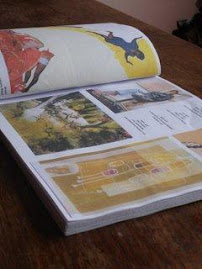
Oops, this issue has been out over a month and I never got around to blogging about the fact!


Interviewees include:
GB Jones, Erika Lopez, Mel Stringer, Morwenna Catt, Helen Musselwhite, Caitlin Shearer, Abigail Brown, Christa Donner, Heidi Burton, Karoline Rerrie, and Irana Douer.

+ Cover artwork by: Zoe Darnell, Karoline Rerrie, and Sara Hansson

+ Gallery artwork from: Sarah Lippett, Amber Seegmiller, Nikki Stavin, Ellara Woodlock, Julianna Swaney, Kate Pugsley, Kristyna Baczynski, Nancy Mungcal, Miss Led, Miso, Jen Oaks, Megan Whitmarsh, Ulla Saar, Ellara Woodlock, Liza Corbett, Lucy Player, Katy Hanratty, Elise Towle Snow, Brandi Milne, Laura Berger, Lisa Linnea, Maria Gil Ulldemolins, Nina Nijsten, Freya Harrison, Emily Cunningham, Ali Aschman, Suzanne Coady, Meryl Donoghue, Memo, + More!

Available at: www.cotl.etsy.com

Saturday, 27 June 2009

Sarah Maple interview


Sarah Maple

Location: Crawley (UK)

How would you describe your art? Light-hearted, funny, political

Currently working on: Just been working on some new photographs for a group show at Scream Gallery

Day job: Bookshop

3 Likes: The Apprentice, Dinosuars, Kate Moss

3 Dislikes: Money, holidays, Kate Moss

Daily Inspirations: Things people say

People & artists you admire: My Tiger My Timing, Sophie Calle, Stella Vine, Charlie Brooker, Chris Morris, Patrick Wolf

Favourite album(s) to listen to when working: Anything by The Smiths

www.sarahmaple.com
Interview date: May 2008


Hi Sarah, how are you? What are you up to at the moment?
Really great, Just had a group show at Salon gallery in Notting Hill, another coming up at Scream Gallery in Mayfair and my first in New York next month!

I’ve dithered a little bit with this interview cuz I’ve been a bit disappointed in myself; but I realised I must suck it all up and write these questions regardless... You see, despite knowing just why the discussion of race and ethnicity (or lack of thereof) in contemporary art is so important to discuss and raise and challenge, I have done so little of that within this zine in the past, and I feel so shitty that it’s with a Muslim artist that I begin to ask questions about race and ethnicity - why haven’t I been able to do this with white artists??
Anyway, less of the guilt, and more of the discussion -- is it important to you that by its very nature your art challenges, and raises awareness of race and ethnicity within (largely white) contemporary art circles?

This isn't something that I aimed to do when I made the work, I made the work for me because it was what I wanted to do at the time. Now I can see what it is doing in the art world. I think it has opened people up to not make an assumption about someone because of their race etc. A lot of people are surprised that I was raised Muslim. I think people are so scared of Islam and are surprised that I make light of things that people are taking very seriously.

Your work, whether the self-portraiture, or the representation of yourself as a Muslim woman, or indeed your representation of yourself as a female subject all quite clearly pinpoint the importance of Identity within your work.
How important is representing identity in your artworks and to your artistic practice/production?

Again this is not something I actively seek out to do - it always seems to creep it's way in there. I think people are obsessed with their identity and self image and this is important because we all want to know who we are and where we come from. In my work I am the subject but I become different people, different identities. I think we all have different parts of ourselves that we are almost unaware of. They lie beneath the surface. I've always thought of my art self as another person, like an alter ego, like it's a character, but then I think that that part of me has come from me somewhere so it must be part of who I am. Different people/circumstances etc bring out different parts of us I think.

Aside from the politics of ‘representing’ identity, it seems clear that it is important to you to *challenge* pre-conceived, or prejudicial notions of what it means to be identified as ‘Musilim’, or ‘female’, or ‘an artist’, or any number of other identifiers.
To what degree with your work are you wishing to provide alternative viewpoints, and provide a less blinkered understanding of what modern-day diverse ‘identity’ means.
(I’m thinking here of your Burka photographs taken on Brighton pier, enjoying deckchair and mermaid fun!)

I think we all make assumptions about other people based on race, looks etc. My friend was showing me her university pics and showed me a picture of this Muslim girl in a headscarf and said 'You wouldn't think it to look at her but this girl is really funny'. I found this hilarious as it was almost as if she thought I would presume this person completely dull because she had a headscarf on. I think the humour in the work I made with the burkas is that the burka is such an eastern symbol and to see it teamed with western icons (e.g my painting 'blue, badges, burka') just looks very odd, almost wrong. In a way I suppose this is symbolic of the difficulties in combining extreme eastern influences with western culture, and the impact this has on Muslim kids that end up going all nutty and extremist because they can't find a happy balance between the two.

I am very interested in what you have written in ‘artist statements’ etc about how some of your work represents the confusion Muslims do, or may, feel between the cultural attitudes of Islam, and those of western societies and environments. You have claimed that your work questions ‘what makes a ‘good’ Muslim, especially in a western society’.
Something that is keenly obvious to me is that this questioning is made all the more challenging when the subject in question is a *female* subject.
Is this part of the reasoning why you use yourself, a British, female, Muslim, as the focus of many of your pieces?

Not necessarily...I suppose in a sort of confessional way, the work came from my own experience and feelings about this. I found the headscarf amusing after a while because it seemed many women began to wear it to make a point, like they were scared to lose their identity or it made them feel more holy. I always felt bad for not wearing one and thought how much better these women were then me. Then one day I suppose I thought thinking that way was bollocks and then I did all this art.

I guess, linked to the above question is the notion of (tongue in cheek?) ‘deviancy’, or ’subversion’ in your artwork.
To what degree do you think using female, or Muslim subjects and points of reference helps you to explore (and ridicule?) the politics of ’appropriateness’?
I’m thinking here of your triptych, ‘Signs’ which has images of yourself in more ‘sexual’, ‘assertive’, and ‘confrontational’ (for whatever these words mean) guises than some would find “comfortable” being expressed by a Muslim woman. (Bleugh!)

I used the words ‘deviancy’ and ‘subversion’ and ‘appropriateness’ above and not the word ‘controversial’, or the term ‘offensive’, because I’m hugely aware that as a Muslim yourself you are not aiming for your Islamic based art to be offensive in any way. Have you received any feedback from people who have not understood this, and your own personal connection to your subject(s)?
Some people thought I was just trying to be really offensive when I first started out. But I think more people know about me now and just accept what I do or want to pretend I don't exist, haha! I have been called all sorts of things which I'm totally used to, it's just if they attack the work itself without giving it any thought, that really annoys me. What I want is for people to think. I think I get away with a lot because the work is playful. If it was aggressive in anyway I think I would be in a lot more trouble.

Alongside identity, within your work there seems to be a discourse around the nature of ‘art’ and what it means to be an ‘artist’.
I’m thinking of pieces such as your paintings, ‘I can paint. Where’s my fucking medal’, your photograph ‘art is crap’, and your piece, ‘I am talentless. I do not have the answers’.
Does being ‘an artist’, studying art, and the whole realm of the ‘art world’ sit somewhat uncomfortably with you in the sense that these pieces would make me think?

I find the art world absolutely baffling and it makes me feel quite uncomfortable, I would like to live in a cave and make all my work and have someone else deal with all that business and wanky stuff. Art is a business which is a fact. but I just want to stay in a romantic world where creativity and actual appreciation of art is the most important thing, not just money. I found art school quite hard as well because people were always talking arty bullshit and I couldn't really understand what they were talking about. This has fed a lot into my work like you mentioned above and with reference to money - 'Minimun' for example which is a white board that simply says 'I am £10,000.'

Last year you [quite deservedly] won the Saatchi/Channel 4 ‘4 New Sensations’ art prize.
What will, or what has winning this Saatchi award already granted you? (whether in terms of exposure, or luxuries, or space, or whatever else!)
I think the connections I made were great and being able to put Saatchi's name to me is a head start a new graduate can only dream of really. It's amazing what a name can do for you.

A large portion of your work depicts cultural subjects and pop culture icons.
How obsessed with Kate Moss are you, really!!??

Haha!! It's not so much HER I am interested in, I am fascinated by her as an icon. I fascinated by the fact she goes wrong all the time, but still gets it right. Like her tripping up all the time makes her all the more perfect. She can do no wrong, she is an icon and everyone bloody loves her.

Is your focus on pop culture celebration, or subversion?
Umm......both! We cannot hide from it's influence.

I have fallen head over heels for pieces that take a tongue-in-cheek look at sexuality. Pieces such as the ‘have you wanked over me yet’ photograph, or the pieces featuring melons and tampons!
These three pieces are great examples of your use of humour to tackle tough conceptual and political ideas.
To what degree does your work require you to have a sense of humour, and require the same of your audience in tackling such strong and complex issues?

It is obviously very important to have a sense of humour when looking at my work, some people totally miss the point which is also quite funny. Some people do not get it at all. It's needed in equal measure because I'm not sure people would get the point without getting the humour first. I'm also lucky because even if people don't really care for my point, they still got something from the work in terms of a giggle.

A huge aspect of your work involves use of your self within your art. As a young, Muslim women, parallels are obviously going to be drawn between yourself and the subjects you portray. To what degree is your work portrait and autobiography?
I think it is very much autobiography because I base it all on things I am thinking and experiencing but I think I am quite good at detaching myself also. So it's not always traced back to me. Even though it came from me. If that makes sense!

How much do you enjoy the dressing up and performative aspect of your work and artistic process? Looks like hella fun to me!
I bloody love dressing up, I didn't realise how much so until I did it for my art. I love choosing quirky things that I think will look great in a picture, it's just finishing touches like a pair of pants or earrings then can make or break an image I think e.g self portrait with Kate Moss (I'm wearing 'I heart England' pants!). I definitely become a different character when I'm in front of the camera, i think that's why even though they are all pics of me, they don't get boring because I'm a different person in each one.

Parts of the British media have been dubbing you the “heir to Tracey Emin’s throne”. As such, sitting on your throne, who would you knight, and whom would you throw to the lions?
Hmmm.........I could not possibly say!!!

Sara Rahbar interview


Sara Rahbar

Location: New York (right now)

How would you describe your artwork? A mirror image of my life

Currently working on: A new flag series & a new photo series

Day job: Full time artist

Daily inspirations: Life

People & artists you admire: Too many to mention, just to mention a few; John Luc Godard, Sylvia Plath & Mona Hatoom

Favourite album(s) to listen to when working: No favourites, I listen to everything. I usually obsess over one song and play it over and over again until I can’t stand it any more, or until I have finished the piece I am working on, which ever one comes first.


www.myspace.com/sararahbar

Interview date: May 2008


Hi Sara, how are you? What are you up to at the moment?
I am well Melanie, wonderful in fact, getting over a broken heart but stronger than ever and happy. I am currently working on 2 or 3 solo exhibitions and some other stuff, new work, always new work.

How long have you been making and creating art, and how did you first become interested in art and develop the skills that you currently employ?
As far back as I can remember. It became a bit more serious as I got older, but it was always with me at a very young age. I just always wanted to make things, to transform things, challenge things by changing their shape and colour. And maybe by creating a new context, I rebirth it and as a result create a new perspective, a new way of looking. I always saw the world through my own personal filters, and as life occurred and time passed, I picked up different skills with every new experience. Although I don’t always know exactly what I am doing when I start a new project. My idea comes first then I figure out the best medium that suits the idea. I do not like to limit myself in any way, shape or form. If I don’t know how, I will figure it out. I recently made a chandelier out of bullets and crystals, and I want to return to Iran and learn carpet weaving, new, always new ideas and mediums.

Your art work clearly has a footing within activism, humanitarianism and within the realm of human rights. Why is such activism important to you, personally? And why did you decide to use art as a medium for your humanitarianism?
I am by no means an activist. And being an artist was not something that I choose to do; it was just always a part of my being. I always had a lot to say, and a view that I wished to express, and by no means did I want to be involved in politics, or become an activist, so it was just an organic progression for me to express myself and take on bigger issues through my work. I am not political. I address current events and political issues through my work. I am an artist first, and this is my interpretation, my perspective, it is how I view the world. In the end I think that that is all any of us are doing, communicating our perspectives. Whether we may be artists or politicians.

As a global citizen, how important to you is breaking down barriers [through your work, and otherwise] between countries and cultures - to look at the identities of global citizens as *Human Beings,* without the lines-in-the-sand and borders that separate, divide, and create difference between people and communities?
A lot of my pieces focus on just that concept of breaking down barriers. My work addresses identity, and the notions of invisible borders, whether they maybe cultural or geographical. I question the concept of belonging, as I don’t believe in the borders created by the devotion towards a flag, a country, or, a religion, so than what do we belong, or not belong to when its all imaginary and made up by us. Through my work I want to remind people that we have built these imaginary borders, and only we have the power to take them down.
One of the challenges at hand is that we have made our personal identities so important and supreme above all. We believe that it is our countries, our nationalism, our religions, our cultures, our beliefs and so on, that make us who and what we are. And this has become eminent above all to the point that we are terrified of giving any of it up as we feel we would no longer be special, individual or important, and so we divide, separate, and label, and as a result give more fuel to the fire.

In reference to the above question, you have stated that intention and the driving force of your work ‘is to focus on our similarities rather than our differences’. Whilst I understand the need to break down the barriers [commonly understood as ’differences’] that challenge our understandings of each other, globally; and the need to see others as human beings, not flags, or armies, or stereotypes, or as ‘other’, I wonder whether by wishing to focus on ‘similarity’ you think it has the potential to unify at the expense of maintaining and protecting cultural and social difference that makes each individual & culture unique and special?
This is not about killing off our cultures, it’s about seeing that at the core we are the same, our foundations are the same, we have all come from one place and we are all returning to the same place. It’s about returning to the simplicity of things. It’s not about erasing our uniqueness; it’s about unifying and coexisting as opposed to tolerating, separating and dividing, because of our cultural and social choices and differences. And I say choices because I always believe we have one, we are not victims to all of this, and the second that we all realize and acknowledge just that, things will begin to shift.

One of your exhibitions was entitled ‘Continuity and Change: Islamic tradition in contemporary art’. In thinking about such a provocative title, [addressing both continuity/permanence and current changes occurring and needed], to what degree does your work as a Muslim artist confront ’tradition’ without diminishing or offending your ’traditional/cultural’ identity as a Muslim? Are such concerns important to you, or do you see forward movement and challenging traditions more important?
I in no way consider myself Muslim, or believe in organized region in any shape or form. The cultural background that I was born into is Iranian and Muslim and there for it plays its role in the background of my work, as my work is a direct reflection of my life; my geographic locations, my history, my present, my environments, and my memories

Alongside your photographic/painting/and textile work addressing and approaching areas such as war, identity, Islamic tradition, politics, divisions, roles, experiences, freedoms, perspectives, and communication, you have also created documentations on the youth culture in Iran. What youth cultures has your work specifically focused upon, and why was it important to you to focus on the current young citizens in a tumultuous, changing country that is part of a very fragile world?
Because 70% of the population of Iran is under 30 years old (The Youth), and they are the future of Iran. And we all know from experience and from history that one countries fate can affect an entire world, it’s like a domino effect.

Your work has been seen as art that ‘challenges current clichés and stereotypes about Islamic practices’, and evoking ideas of ‘the complex life in present-day Iran, countering the western media’s one-dimensional portrayal of the country’. Firstly, to what degree do you wish to present a multi-dimensional portrayal of Iran to communicate to the world ideas about how we view each other, and to present a multitude of realities about Iran, to create alternative perspectives on how Iran could be viewed. Secondly, how do you see your work as specifically and directly challenging current perspectives and stereotypes?
This all stems from ignorance, and brain washing by the media which is controlled by our governments. Iran is a very misunderstood country, and it has been interpreted, analyzed and used by all, in the end the only thing that Iran is, is what you say it is. In order to find truth, we must go above and beyond the filters, and find our own personal truths. Its quite sad that it has come to this that I have to paint a multi-dimensional portrayal of the Iranian people in order for people to see it as that, when all they need do is look in the mirror, we are not so different, only our circumstances are.
Also the mere fact that my background is Iranian and Muslim, yet I do not necessarily fit into the clichés and stereo types, that factor in it self challenges clichés and stereotypes about Islamic practices and the western media’s one-dimensional portrayal of the country and its people. Lets not forget about its people, its seems that these days we are so focused on countries and labels, that we have forgotten about the people, the human beings. And that without them none of these things would matter or even exist, things are a lot simpler than we would like to see them.

An article was written about you in the media, entitled, ‘Sara Rahbar: Addressing the personal, cultural and political’. With humanitarian art work such as yours, do you see differences and divides between ‘the personal‘, ‘cultural‘, and ‘political‘, or are they all combined/intertwined; your work itself a product of the ways these three aspects are inherent in of your life, without distinction?
It is not so much that I am purposely choosing to be political, cultural, and personal and specifically attempting to break down perspectives and clichés. This is only an outcome of the work. Through my work I address subjects that move and inspire me, and that I am passionate about. The rest is just an organic bi-product of the work.

Another article in the media addressed you as, ‘Sara Rahbar: The Activist-Artist’. How difficult/easy have you found it for you and your work to be recognized as both?
I don’t really think of myself as an activist artist, I think because I tackle and challenge current events, politics, war, and such subjects, the word activist came about when referring to my work. But by no means do I picket or protest and I absolutely do not consider myself an activist. If my work challenges, educates, shifts perspectives and makes a difference, than I am happy. But again all of this is a bi-product of me taking on subjects that are important to me, and that I wish to focus on.

In your photographic series ‘The Veil’, you use images of draped flags covering individual’s heads and faces, and individuals using flags as headscarves. How does such work aim to confront the issue of visibility/invisibility?
Actually there is no “veil series”, my two photo series that you are referring to are called, Oppression series 1 and 2. There is a travelling exhibition that my work is a part of called, “The Veil: Visible and Invisible Spaces.” Oppression series 2, which consists of the draped flags, fabrics and half faces, that consists of 12 images, which actually are all me.
I used myself in all of my new work, its only mask series that is not me, and I used a model for. The work confronts and tackles so many issues, and has so many layers and levels to it, that “visibility & invisibility” is only a small fraction of the core of the work. I play with concepts of woman’s rights, Iran, human rights, current social and political states in Iran and America, visibility & invisibility and much, much more. It’s important for me not to reveal everything, and to simply start a thought process in the viewers mind.

You have claimed (or it has been claimed of your work) that, ‘we are all a collection of our experiences, our understanding of the self and perhaps the issues of worth are always intimately entwined, my work is a mirror image of my life; my geographical locations, my history, my present, my environments, and my memories’. In order to make questions and statements though your work [about the development and constructs of identity, the concepts of belonging, and changing common views and perspectives], how instrumental to your work-process is using *yourself* within your work? E.g. use of self-portraits, etc.
I never set out to use myself in my work. But because I was tackling so many personal issues in my mind at the time and my work is a direct result of my challenges, my perspectives and my everyday life. It seemed like a natural progression to use myself in my work, it was all quite organic.

Finally, what are your favourite aspects of being an artist?
Creating the work.

Allyson Melberg interview


Allyson Melberg

Location: Harrisonburg, Virginia, United States

How would you describe your art?: Funny, gross, pretty, tricky, and maybe mysterious at times!

Currently working on: New drawings/paintings, small soft sculptures, new large-scale drawings, and a book with my husband Jeremy.

Day job: I am a professor of Studio Art Foundations at James Madison University. I teach 2 & 3D Design and Drawing.

3 Likes: Animals (especially cats), drawing, and sushi

3 Dislikes: Smoke, most television, and overall ignorance/intolerance

Daily Inspirations: My husband, my cat, the ocean (especially Rodanthe, Avon, and Sandbridge beaches), “Colors” book by Victoria Finlay, Haruki Murakami novels (I pretty much re-read them over and over again)

People & artists you admire: Jeremy Taylor, Louise Bourgeois, Catherine Stack, Fernando Renes, Raymond Pettibon, Kelie&Sto (Cinders), Lump Lipshitz, Barry Mcgee, Kiki Smith, Margaret Kilgallen,

Favourite album(s) to listen to when working: Anything by the Smiths, Belle and Sebastian, Best Friends Forever, Basically I like to sing along while I work. I also like to listen to movies while I work (my favorites are Pillow Talk & The Big Lebowski)


Some related websites:
www.cindersgallery.com They are my gallery representation in Brooklyn and are awesome awesome people! You can see our last show in “past shows” under September 2007
www.teamlump.org
www.allysonandjeremy.blogspot.com

Interview date: April 2008


Hi Allyson, how are you? What are you up to at the moment?
Hello, I am well thank you! I am working on these questions from our family’s home in Virginia Beach. We visit a lot. Its beautiful here, we are way out in the country very near the ocean. My Mom-in-law is an Art Teacher too and its really nice to visit her.

What is your artistic history? How did you get started, and how long have you been creating art, embracing your creativity, and working towards developing your current style and output?
I was born into a creative family. My parents met in college at the School of the Art Institute of Chicago. My Mom’s family is full of musicians and people who make things. So I never really thought that I would be doing anything else- My current style really started evolving in graduate school - Having a concentrated period of time to work and refine my ideas plus a focused dialogue with others really helped my work. This is also the time that I started collaborative relationships with my husband and Team Lump. I have had an active studio practice since I graduated from college. It is a part of life just like eating and sleeping.

Is creativity something that has been encouraged of you from an early age?
Absolutely, my parents each kept studios in our basement. My mom really involved my brother and I, getting us working with clay and drawing/painting very early. She made large ceramic vessels and would glaze them in a kiddy pool in the basement – when I was kid that seemed like magic. I really wanted to learn how to make everything! I still feel that way.

How would you describe your illustrative techniques and materials; what processes does your work go through to reach a ‘finished product‘?
I like to work out of a ground so brown/grey paper or a tinted surface are always part of beginning a piece. My technique as far as painting/drawing goes always starts out with pencil drawings. After that I work back in with walnut ink and a metal nib. If you ever feel the surface of one of my drawings you can feel that the nib has scratched all of the lines into the paper, so there isn’t much room for erasing. I like this because when I make a mistake I have to deal with it and work it in to the piece. The final step is adding egg tempera/coloring.
With soft sculpture/installation work I usually start with used/recycled fabrics and build from their individual characteristics. Most sculptures/installations are collaborative with Jeremy so we each bring our own sketches and choose materials together, then we both sew/embroider/silkscreen different parts before assembling.

I read that currently you’re working on a book project with your partner, Jeremy, about the use of non-toxic art materials. How and why is the use of non-toxic materials important to you, and your artistic practice, personally? Why do you think toxic materials aren’t questioned by many, and that alternatives aren’t sought (hence why toxic materials continue to be produced)?
Could you explain some of the books focus?

Its true! We are trying to finish it by June now that we have Archaic Mess in Richmond, (VA) putting it out. The use of ecologically sound and non-toxic art materials is important to me personally for a number of reasons. One being an educator and witnessing students who are careless with materials possibly endangering themselves or their studio mates only because they do not know better. Many instructors do not see this as a priority and set a very bad example. I do not allow the use of any toxic materials, paints, glues, etc. in my classes. Students have to be resourceful and find other solutions for making art and putting things together. In my mind if you really want to make something you will do it despite material limitations that you may find when you exclude toxic materials.
Several artists/teachers that I know have been physically affected by this but the most influential of all for me was Jeremy. He has always been an environmental/animal activist, and had been doing research on natural pigments throughout graduate school. During his assistantship in graduate school he was exposed to some toxic chemicals in the print studio and suffered irreversible lung damage which caused him to have multiple chemical sensitivities. He is a bad ass and has recovered from a lot of it, but it was a huge lesson and very scary. He was in the middle of his master’s thesis show when this happened and could not just stop making work so he used the research he was already doing on ecologically sound studio practice/natural pigments and put it to use in his work. All of his beautiful thesis paintings were made without solvents, heavy metals, or any toxic chemicals. They are biodegradable just like we are. It had a profound effect on me and was an inspiring, life-changing event. After learning about all of the things chemicals can do to your body, your environment, washing your cadmium red paint down the sink, etc. how could I possibly work with anything but natural ecologically responsible materials. Once you are cognizant of these things your conscience takes hold. It has been a really good change, I will always wish that I could take back Jeremy getting sick, but I am glad that we are making work the way we are.
I could ramble about this for hours! I guess that is why we are writing the book. We have shared a lot of this with our students at different schools, but we want the information to get out beyond that. We will be posting a PDF version of it on our blog as well.

You have worked with the band, Rainer Maria on the artwork of many of their releases. How did this collaboration come about, and is working alongside a band easier if you like, and are aware of their music (to creatively draw from, or to inspire your work, or merely to prevent your work being attached to something you aren’t comfortable with)?
My collaboration with the folks in Ranier Maria came about through our mutual friend Marshall Weber. We are all from Wisconsin! Its definitely easier to work with a band whose music you are already aware of. It felt very collaborative in the sense that we were both aware of each other’s creative work and had a very easy discussion about what they wanted and how it could relate to my art. So I felt like I was able to still make work that was natural for me and they got something really specific to their record. One interesting detail is that I didn’t hear the record for a while, I actually worked from their lyrics first so my images were based on the words not the music. By the time I worked on the music video for “Ears Ring” I knew the music well. They were really fun to work with and were extremely supportive and kind.

Your work has been published in magazines such as Bust and Venus. Is working with feminist and women-driven projects such as these important to you personally?
It was really exciting to work with these publications. It is very important to me to work with feminist projects as well as independently run projects. It was especially great to work with Venus because when I was a featured artist Sarah Silverman was on the cover! Its also great to work with women-driven projects because in some of my experiences it has really felt like a boy’s club – its nice to get outside of that.

You are a member of the art collective, Team Lump, who provide an artist-run space dedicated to exhibiting contemporary art exhibitions and projects from emerging and under-recognized artists.
How and why did you become involved with Lump?

Well, Lump Gallery is run by Bill Thelen (aka Lump Lipshitz), who is also a UNC Chapel Hill Alumni. Bill is from WI, where we had mutual friends, so when I came to graduate school at UNC we went to every Lump opening and got involved. After a year or so Jeremy and I got invited to work with Team Lump for a show called, “All Hail the New Flesh”, showcasing their newest artists. We worked with them pretty regularly after that. Lump is an amazing space, Bill works really hard to bring in challenging new work from all over.

It seems that Lump have created a great resource for artists. And in having the experimental attitude of an alternative space it appears to display diverse art in a very approachable way.
Do you think that being an artist-run space it has been set up in a way that is artist focussed, as much as art focussed?
As such is Lump supportive of all aspects of creativity, thus expanding its’ approachability on both the artist and viewers side, as a comfortable, non-elitist art space? I ask this, partly due to how alienating and ‘stiff’ some gallery and art spaces can be, and how off-putting that is.

I feel like what Bill/Lump is doing is really pure. He is supportive of the artist and the artist’s undiluted vision. Its definitely not a commercial gallery so there is so much freedom for him as a curator. He can have a show that is all wall painting or installation and he can take a lot of risks that a commercial gallery would not – which means he always shows really amazing work. I like Bill’s approach because the space definitely feels very non-elitist and welcoming while still being contemporary. Bill, who you will often meet gallery sitting on the weekends, is really approachable himself. He is this super sweet laid back guy.

Speaking of alienation in art spaces; access to viewing and thus appreciating art is often denied people (from certain economic, cultural, gendered, racial backgrounds) as much as access to and encouragement of our own creativities is, and thus the opportunities for our own artistic expression can be limited.
Have you ever encountered barriers to your creative access, or your access to art - whether as a creator or viewer?

I think spaces like Lump are really important in addressing the fact that art is not as accessible to people of all different backgrounds (economic, cultural, gendered, racial). This is why I believe that it is really important to support independent/DIY spaces. I have been extremely lucky to work with mostly independent spaces and with people who I like a lot. I also think that it is important as an artist to embrace non-capitalistic & non-gallery related ways of sharing your art with others. Personally, I have only faced one really bad situation as an artist because of my gender (and my age). I won’t name the museum but I will say it was surprising and disappointing and I had to fight to keep my show intact.

Are spaces, like that of Team Lump, something that you would have wished existed when you were first starting out in art?
Yes, of course. Lump is amazing! The fact that it is what it is and has been around for over a decade is something to be really excited about. I feel really lucky in Milwaukee, where I started out there was a really supportive and lively art community. Now that I live in a rural college town I am really missing that sense of community. We are definitely looking to move for that reason.

I am aware that your own work has appeared in exhibitions as part of Team Lump’s programme, as part of group shows. For you, what are the benefits (socially, culturally, artistically?) of being a part of group shows, over solo exhibits? Is collaboration and collectivity important to you?
In the last few years I have learned a lot about group shows since I have participated in many of them. To me they can be both good and bad. Group shows with Team Lump are really focused – we usually have a set concept so its not hard to follow through. My favourite show we did together was “Goodbye Says it All” at the Atlanta Contemporary Museum. We all stayed in an apartment together for a few days. It was so much fun and such a good show. All the group shows that I have been in with my main gallery Cinders, are really well curated so when they ask me to be in a group show I know it will be a good fit.
Group shows can be tricky though, especially if the theme is too far flung from your own content. I don’t want to be in a position where I am making work that feels unnatural to me, or contrary to what I am trying to say in my art. For example I have stopped saying yes to shows where everyone is using nasty paints in the space and spray painting all over the place because I don’t support the use of those materials- what they do to the earth and to the artists using them (even if I like their work visually). I am by no means a perfect activist, no one is! But, I do feel that I have a responsibility as an artist to say something and stick to my guns so when I get invited to a group show that is strictly based on cute animals or cool music or something I have to question it.
This is the first year we finally learned to say no to stuff that didn’t seem to fit – its really hard for me to say no to stuff because I always feel really honoured when people ask us to participate in their projects, so it has been an difficult experience, but I find that I am less stressed and making more work that is of better quality. We live in such a fast moving society, everyone is multitasking everything and most of my work just is not made that way. Realizing that and trying to get things under control has made a huge difference in my studio practice (and I actually get to sleep more!)
Solo shows can be great and allow for the further elaboration of a very specific idea/body of work. But I have often asked for collaborators in solo shows because I am not dead set on it being all MY work at MY show! I love working with my husband and when I had a residency at UVA which entailed 3 solo shows in 4 months at different university venues I made one of them into a Team Lump show and invited my students to collaborate as well. That was a great experience.

I viewed photographs from an exhibition that you and your partner were a part of, and your intricate and delicately lined work was displayed in a really fun, unusual way -- work roughly pieced and sewn together to form a giant triangle, or work pinned up under gaffer-tape signs, or pinned to a giant black thought-bubble backdrop, or on china plates, all of which presented your ideas in very approachable ways. It’s not the sort of art that I’d want to view from across an exhibition room, but would want to get up close to, bending and craning my head and neck this way and that to soak it all in, and participate in it; grinning as I went!
Your work is rarely displayed in the form of framed, polished, elitist artefacts. What are your thoughts regarding such notions of perfection and flawnessness within your own work, and the way that people can or may view your work?
Is ‘perfection’ and ‘elitism’ in art something that concerns you?

Well, I am most certainly not a robot so perfection is out! and I am very sentimental, I love mistakes and I love seeing them dealt with in resourceful and inventive ways. I like to see an artists ‘hand’ in their work and in my own work. I definitely want my viewer to feel comfortable to approach the work which, in many cases is small or had small details and needs you to come closer! I don’t want the work to be interactive (as in, I don’t want people to play with my soft sculptures as if they were toys!) but I want you to be comfortable and feel like you are participating in a dialogue. I want to share with viewers, the worst thing is going into a gallery space and feeling like you are not in the same league as the artist, that you almost couldn’t have a discussion with them even if they were right there in front of you; I welcome discussion, always. Jeremy and I also really want to create an environment for the work so that it all works together cohesively so wall painting, and hanging in a non-traditional way helps change things up. We really like to use the floor for soft sculptures so that you are not just looking at the middle of the wall for the art, its all over the place – you are in it.

How much fun is the laying out and exhibiting of your pieces (as described above) - creating an installation with your ideas?
It is a lot of fun and a lot more work than it probably seems. We make plans/sketches of possible install layouts months in advance and once we choose one stick to it pretty faithfully. We have friends who respond to a space when they get there- which can be amazing but, I guess we like to have a plan, to me that is less stressful, even if you make some adjustments while installing that change things, at least there is a sense of direction. Installing with Jeremy especially is fun. We are a good team. He always brings me tea.

The human form (in all its shapes, sizes, guises, and disguises) is something that is regularly depicted in your work, often in very truthful and realistic ways (that may be viewed as disturbing, or maybe a little grotesque in its honesty and frankness / or conversely surreal due to atypical truths). What is it about people that inspires your focus?
Being a human (and wanting to communicate things about humans to other humans) makes using the human form in my work a very easy decision. My inspiration comes from real live people, storybooks, and pictures of those who are ailing (skin disorders, tumours, etc). We have a collection of old lithographs depicting skin diseases/disorders which are beautiful and terrible. There is this sense of unapologetic grotesqueness in those types of images that is really appealing to me, the sitters look so proud. When I started making work about parabens and other endochrine disrupting chemicals in women’s body products using those images of skin diseases/tumours helped me give a form to my ideas. It also gave me a point from which to abstract and exaggerate, so that they were plausible and fantastic all at once. Disgusting and beautiful, sad and proud all at once. Using the human form makes sense to me because its what I am! And I think of it all as communicating so I figure people will understand and be able to relate to images of humans even if everything else in the image is completely surreal.

Finally, what is your favourite and most enjoyable thing about creating artwork, and being an artist that makes you continue?
For me the desire to communicate combined with curiosity about making things has kept art-making really satisfying and productive. Drawing makes me really happy. I feel like I am pissing my time away when I am away from that for too long (a few days!) It is my dream to be able to survive financially off of our art alone so that we can dedicate more of our time and get some of our bigger ‘dream’ projects made. Whether to continue or not isn’t a question, we are in this for life!

Lizz Lunney interview


Lizz Lunney

Location: Birmingham, UK

How would you describe your art?: Lots of different easy to digest cartoons, like sushi. Yum.

Currently working on: My next comic

3 Likes: Tea, dinosaurs, knitting

3 Dislikes: The num lock key, mornings, headaches

Daily Inspirations: Food, dreams, nightmares

People & artists you admire: Jeffrey Brown, David Shrigley, Art Speigelman

Favourite album(s) to listen to when working: Any Beatles, and Jeffrey Lewis.


www.lizzlizz.com

Interview date: March 2008


Hi Lizz, how are you? What are you up to?
Hello. I'm good thanks. At this very moment I’m drinking tea.

One of the things I really love about your art is the immediacy of it. It’s almost like breakaway art; art that needs to be created there and then, in biro and on the back of an envelope if necessary, rather than ascribing to high “art” notions of painstaking creation over time with a ‘perfect’ or laboured product. How important to you is the access you have to making your art in the here and now, as and where ideas come to you?
Ah I'd say its really important. If I don't draw ideas down right away I just forget them! Often the first scribbled drawing is the best, I'll draw them up so they are more polished but I always like the original sketched one most as it captures the original idea. I also try to carry a sketchbook round with me but it’s always when you don't have it that you think of something you really need to save so have to draw on a napkin/plate/leaf/cat or whatever.

Is placing and sharing your work on your website either as an ‘online sushi to eat in or take away’, or as your regularly updated ‘today’s special,’ linked to such ideas of immediacy at all?
Yeah definitely. My online comic is often the first original sketch of something that I then develop for my printed comics. So its a great place to look if you want to see my ideas right away varying from initial drawings to final cartoons. Its a bit like an online sketchbook for me.

Do you think such freeform creation of art, and comix art, often expressed as a doodle, or a line drawing, is widening out understandings of what ‘art’ is and can be, and widening out individual’s relationship to comix artistry and art work? I guess what I’m asking is, did you ever previously feel a sense when viewing similar work of “hell, I can do that too, and I can be waaay funnier!”, and is that sense of inspiration something that you’d like to inspire with your own work?
Ahem. Well... I think art in general is always like this, through all periods of art you will find artists that challenge the idea of what is "art" so comics are not doing anything new. I think the fact that everything is becoming more commercial and throw away encourages freeform creation of art be it comics or graffiti and such like. In a way it can be good but it also means all the bad stuff out there is also getting seen and so it can be hard to find the good stuff amongst all the rubbish- especially on the internet. I never really think much about other peoples work, there are a few select ones that I like but I don't actively connect it to my work. I just enjoy them for what they are.

What are your thoughts on your “simple” style of art in terms of audience accessibility, and in terms of generating a level of innocence, and thus humanity and heart within your comics.
[By the way with these questions I am in no way AT ALL inferring that simple=inferior. Quite the contrary. Who wants an oil painting by one of ‘the masters’ (gag!) when they could be loving the self-defined mastery of your cartoon instructions on how to knit a beard, the adventures of disco rabbit, or my mate primate? I sure know my stance on this!!]

I don't really think of them like that, its all about getting the idea across. I developed my style originally from drawing left handed (I’m right handed) and also with my eyes closed. These kind of drawings are always more dream like and disjointed as you can't labour away at them too much. Now when I draw I try to capture the characters and stories in the lines rather than worrying about making them perfect. To me, the imperfect lines are perfect. If that makes sense at all?!

I read that you studied animation at University. How long have you been drawing static comix, and what made you wanna shift from animation to cartooning? What other forms of art have you practiced/dabbled in/enjoyed/experienced?
Yes I studied animation but I have been drawing since I could hold a pencil! Animation was interesting but a bit of a mistake now I look back, I'd have been better studying illustration. Although it was good because I learnt about storyboarding. I felt that the actual animating destroyed the immediacy of my drawings that I talked about earlier as you need to redraw images hundreds of times slightly differently for each frame. It is not as exciting as it sounds. I've done most kinds of art- painting, pottery, sculpture, photography, music, life drawing, etc etc. I'm pretty good at life drawing which often makes me worry that people see my cartoons and think I can't draw when the reality is that I actually just choose to draw this way because I like the way it looks.

One of the joys I find in your work is the characterisation; characters such as Keith the Wizard, Leaning Rabbit, and especially Depressed Cat.
What part of your warped consciousness dreams these characters up!? And how central to your strips and books is the need for continuity of characters and character development, as opposed to one-off characters or one-off ideas?

I'm not warped! ha. No no, to me the characters don't seem that strange. They mostly just come to me right away, some are from dreams/nightmares that I develop into a story or character (eg. Gummy Cat in my mini comic YUM) and some are based on aspects of myself or people I know. But nothing direct or obvious. The characters seem kind of real to me. Not in a creepy way.
I think its important for me to have both types of stories that you mentioned- some characters are one off stories and you will never see the characters again. Others keep coming back again and again like the ones you mentioned and Hairy Midget Elf, Creep Garden Elf, Human Faced Cat, Dinosaurs on Holiday etc etc. It depends on the character, I don't really actively decide which I will lose and which I will develop- it just naturally turns out a certain way.

I find myself laughing at and feeling sorry for your characters in equal parts. Is it easy for you to convey your humour within your comics due to your characters being non-human? Is humour important to you as an artist?
Well, to me the characters are all human even if they are burgers, cats, pigeons etc.... I don't think much about the humour when I draw something because everyone has a different idea of what is funny. I usually test them on my brother to see what he thinks. I never try to be funny, it is all about the characters- if people want to laugh they can. If they want to read them with a miserable expression of doom and despair they can do that too. I just don't mind as long as they give me money! ha. No, really...I kind of think, if it makes one person laugh then its worth it. Even if that person is me, laughing like a maniac at my jokes... on my own... on a train....with people staring.

Your ‘Burger Love’ strip was short listed for the 2007 ROK comics humour competition. How did that feel to see one of your babies up there for an award?!
Hmm, well it was really cool but I’m not that precious about my characters. Its like... once they are on paper they are in the world on their own so if they do well it is their own merit not mine!

I am very interested in how and where women gain access to their own confidence, and self-belief -- especially in terms of how they are able to produce and create with a sense of assurance, belief and certainty.
What is your personal relationship with confidence towards your work?

I think every person has both confidence and uncertainty in their minds. I'd say in general I’m pretty confident about my work because, like I said, I’m not precious about it. But there are always times when I’ve left things to the last minute and have a comic due to the printers the next day and its 5am and I haven't thought of a title I like yet and I’m thinking "This will be so rubbish!! no one will like it!! another comic for the bin!!!" or that kind of thing.

Were your artistic endeavours encouraged from an early age, perhaps giving you a sense of perspective over your productivity and its worth?
Yeah, my Grandad and Mom were both artists and so the house has always been decorated with family paintings etc. So drawing and making things have always just seemed a normal things to do that were actively encouraged. Those were the days, when you could make something out of a rock from the garden painted with a face and taped up with bits of string for arms and legs and everyone would be saying "oh that’s so great, did you make that yourself? Wow!" I still do that actually, but people are not so impressed these days.

I first stumbled across your work when your comic, ‘Party Animals’ was included in the reference section of the ‘Cult Fiction’ comics exhibition; a terrific touring exhibition stopping off at art galleries countrywide, exposing the artwork of a host of ‘cult’ artists, (largely comics artists) to a larger audience. It featured not only hundreds of exhibited artworks, but also documentary notes on each artist, plus a huge ‘library’ section of comics, books, examples, do-it-yourself handbooks etc etc. plus a space with pencils and paper for people’s inspiration to overflow. How important do you think such spaces are for celebration, documentation, and encouragement of ‘alternative’ forms of art?
Very important, it means the public can discover things that otherwise would only be known of by people with a particular interest in comics. It was a great exhibition. I discovered loads of new work I hadn't heard of too. I think I went to the Walsall one a few times and then I saw it up in Leeds as well.

How and why did you get involved with the exhibition?
I went to the one in Walsall and saw a flyer to submit work. Then they accepted my comic and so it went touring with the exhibition. When I went to the one in Leeds was amazed by how many comics the resource space had accumulated. In Walsall there were about 5 and in Leeds there were like a million (approximately)

To what degree do you view your artwork, and your chosen ‘genre’ of art to be ‘cult’?
Um. Hmm. Erm. I think cult is something quite specialist with a small dedicated following so I’d say small press publications are quite often cult. However, I think something can get quite well known and still be considered as cult if it began in that way- like American Splendor or Ghost World. I'd still say these are cult even though both became mainstream films just because of the following they have and the way people view them. And the spin off merchandise too.

How important do you think it is that such ‘cult’ / ‘alternative’ / ‘lowbrow’ forms of art are increasingly exhibited within ‘high art’ spaces (here in Leeds the Cult Fiction exhibit was shown in the Leeds City Art Gallery next door to the Town Hall, rather than any independent gallery space).
Really important.

I read that you are taking part in this year’s ‘UK Web and Mini Comix Thing’ for small press publications and their distros etc. Last year (2007) you also participated in the ‘Thought Bubble’ comic book convention, featuring more mainstream, or ‘big time’ (gag!) artists. As a self-publishing artist what is your connection to, and thoughts on acceptance within both of these sorts of conventions?
I like them.

What is your motivation for being present at, and being a part of such events?
I like them.

Have you seen an increasing role of women and of female creators and audiences at such events?
Yes, well there is a good mix really. I guess audiences are mixed more than creators.

What is your favourite part of artistic creativity? Why do you keep on going and doing what you do?
I can't stop! Its always nice to get positive feedback and that encourages me to keep self publishing and updating my site so I’d say that is one of my favourite parts. I also like getting a comic back from the printers for the first time as its exciting to see your work finished.

Your work, alongside your online comics, has been published in three solo print collections (so far), ‘Party Animals’, ‘Tofu and Cats’, and ‘Waiting For Sushi’. How would you describe and explain each of these?
Waiting for Sushi was my first comic so it is an introduction to a variety of characters, many that reappear in Party Animals and on my Online Comic Sushi. Party Animals also has a few new characters and then Tofu and Cats was my attempt at two complete stories rather than lots of little ones. They are about cats, dinosaurs, burgers, tofu, monkeys, elves, unicorns, people, rabbits and more. They are all worth a read if you like that sort of thing.

How does online publishing differ to print publishing, for you and your work and creations?
Both have pros and cons, online is free and widely accessible so it is quicker and cheaper. However, actual comics can be sold and I always think its nicer to have an actual comic you can hold and carry with you, to read in bed/on the bus/in a tent/in the park, to caress the papery pages and talk to.

Animals and food seem to play a huge part in your artwork. Would you say that these topics are so prevalent in your work due to them being everyday, regular, local muses and inspirations - and as such it’s a natural progression for them to be such lynchpins in your work?
I just like food and animals.

Do you find that ideas and inspiration comes to you thick and fast, or is often much harder than people would think to be a prolific creator?
Nah. I work really fast, I can create a comic in a few hours if I’m in the right state of mind. I don't think this affects the quality either, often something I have spent a long time on doesn't have the same punch as something I have done late at night in a few minutes.

As well as other surrounding inspirations (food etc.) your locale has also inspired some of your artwork such as ‘Concrete Birmingham - a comic about post war architecture,’ which I think is fantastic.
Have the good people of Birmingham forgiven your critique yet?!

Birmingham is awesome!

What’s next up your sleeve?
I'm working on my next comic which I’m aiming to get done by May in time for Bristol Comic Con. It will be bigger and better than my other comics featuring all the regular characters and loads of new ones. I'm also working on Hairy Midget Elf toys. There are a few other things coming up, Threadless.com are releasing Tyger Tyger on a tshirt and I Dress Myself are doing a dinosaur T-shirt. I've also done some comics for the Topshelf website. So plenty of exciting things!

Meghan Murphy interview


Meghan Murphy

Location: Rochester NY USA

How would you describe your art?: Weird, cute, funky, sweet... and maybe a little more weird.

Currently working on: This week's Kawaii Not strips, and a couple of illustration commissions.

Day job: Freelance illustrator

3 Likes: Good books, good movies, shiny things

3 Dislikes: Black liquorice, ketchup on hot dogs, hairballs

People & artists you admire: Oh no, I don't think I could narrow that list down to less than 100. I am continually finding cool, new (or at least new to me) stuff to dig.

Favourite album(s) to listen to when working: I'm always mixing new playlists to listen to while I work. I'm fickle.

www.kawaiinot.com
www.murphypop.com

Interview date: February 2008

Hi Meghan, how are you?
Pretty good, thanks for asking.

I guess I’ll start by referencing one of your Kawaii-Not pieces that (naturally!) I adore… Why *does* scribbling outside the lines piss some people off?!!
Ha! You know what? I'm really not sure. I figure as long as there still some crayon to use, might as well keep on coloring.

For those who don’t know, what’s Kawaii, and where does Kawaii-Not fit into that mad ‘lil world?
Well, "kawaii" is a Japanese term that basically means "cute". In a larger sense, it stands for a particular culture of cuteness, probably best represented by Hello Kitty. To put the "Not" in Kawaii Not, I try to take the visual cues that represent this particular style, and mix them up with a little attitude... and often a dash of inappropriateness.

What’s your favourite Kawaii that you’ve seen?
I adore a cuter-than-cute t-shirt I saw with the slogan ‘Kawaii 5 – 0’!!

That is damn cute. My favorite kawaii-type stuff tends to be illustrations, but I do have a soft spot for cute cupcakes.

Is there a small part of you that gets frustrated with the endless, smug optimism of kawaii, and thus drives you to make the cute-go-bad (as the strip is subtitled)?
Frustrated? No, in fact I find that kawaii optimism in the face of everything really rather subversive in a way. But then again, I'm a little bizarre.

You have said of Kawaii Not that ‘when I get mad, or sad, or glum, I torture cute things. It’s such fun!’
Which moods work best for you to work in? Does your mood ever alter your strips?

Any mood will do! I've made happy strips, sad strips, and almost psychotic strips. I would have to say my mood is often a key factor in creating a Kawaii Not.

By putting a cute face on everything and anything within your ‘experiment in cheerfulness’ it seems that you can also get away with expressing the darker, or yuckier side of things, and life, right?? (I’m thinking of strips depicting burst bubbles, gone off food, jigsaws that don’t fit in, stabbity knives, gross and scabby plasters, etc…)
Absolutely I can get away with more by using the cute faces. It's amazing how humans react to just two dots for eyes and a line for a mouth. Brains are weird.

As an ‘experiment in cheerfulness’, how’s the experiment working out for you? It seems that the online strip is pretty well loved to me! What do you think?
I am continually flabbergasted, and eternally grateful, that other people find my strips funny.

By putting a cute face on everything and everything, and being a bit mischievous with it, must make ‘work’ a whole lot less miserable than it could be, right? How much do you enjoy doing what you do?
I enjoy it a ridiculous amount.

By working in adobe illustrator, and producing a webcomic, do you have square eyes or mouse-induced RSI yet from all your computer time?
I think my computer whispers threats to me in the middle of the night -- but besides that, everything's fine.

Following on from your visual arts degree, what led you to specialise in computer-based graphic design/illustration?
I was hoping the more specialized degree would make it easier for me to get a steady job, which it turned out it didn't -- but because I didn't get a "real job" right away I was kind of forced into focusing on freelance as a viable alternative.

Alongside Kawaii-not you also have MurphyPop, your website featuring your bold, fun and colourful illustrations. I can’t help but notice all the cute, colourful, kick ass girls you depict in your work. What inspires you to create such female images?
Because I think the world needs more cute, colorful, kick ass girls!

You work as an illustrator and designer, freelance. I once spoke to artist Sarah Dyer who’s currently working full-time freelance. She stated she was stressed and busy, but that was okay cuz busy is good when you’re freelance. Do you find you embrace the same kind of positives from busyness?
Oh yes. I get nervous when I don't have a couple projects brewing. I think that is just the freelance mindset.

How does working freelance allow you to fit art creation into your life, and have it as such a huge part of you?
Freelance demands that I fit art creation into my life, whether I feel like it at the time or not. Which I think is a pretty good position to be in, since I think the more you work at something, the better you get. Freelance makes me be more disciplined than I probably am by nature.

Does the process of kicking out (aprox) two Kawaii-Not strips a week on top of your freelance and illustration work ever knock the smile off your cheerful face?
I'd complain, but then I realize I am a lucky bastard -- so I tell myself to shut up and get on with it.

What is the process of getting an idea from your head to the published web-comic?
Some scribbling, a little research if I need to figure the best way to draw a subject, more scribbling, heavy doubt as to whether anyone anywhere would find this strip funny, scanning the sketches into the computer, snacks, creating the final work in Illustrator, doubting the humour again, fiddling with the wording, playing with my cats, fiddling with the wording again, and ta da! It's just that simple.

How important is the sketch-book process to your work? If you ever left one of your sketchbooks on a bus would the finder of it think you were nuts?!?
I usually have a couple different sketchbooks going at once, and they are pretty damn important to how I work. Hmm... if someone found one of the sketchbooks and I wasn't there to explain some of the weirdness? Oh dear, I would feel sorry for them.

Viewing your webcomic is one of the first thing I do every morning (well, apart from dragging myself out of bed!), because I know it’ll help set me up for the day in a laugh-out-loud kinda way.
In a world where 99% of people would rather slag something off than praise it, and in a culture where there’s so much to make people unhappy and miserable it must give you a fuzzy feeling inside to be counteracting all that with your artwork, right? Is that a conscious aim when coming up with your ideas?

Why thank you! I think most humor artists/writers are working at pushing back the bad stuff, and bringing out the awesome. It seems like a good way to spend my energy, anyway.

I once read an interview with artist Elisa Harkins, and an idea was generated that said perhaps one of arts’ most important ‘purposes’ (for whatever that means) is that it can provide the viewer with a form of enjoyment, and of light relief within this world-gone-mad.
Viewing art (such as yours) can help us to recharge our batteries, give us a break from the hells of life before we head back out there into the world again. That’s really important to our collective sanities, right?

That's what Kawaii Not is all about. There's nothing really deep in my strip, just some crazy stuff to make people giggle and enjoy themselves (hopefully). I figure it's either be crazy on the outside and get it all out, or be crazy on the inside and let it fester till it blows all at once.

What are your thoughts on the sceptical notion that internet-based ‘success’, appreciation and recognition means nothing unless it passes and crosses over into the “real” world, or the “real” art world?
The internet is the real world. And increasingly, it is the whole world.

Do you think working on web-art, and in digital artistic fields is a natural progression in the developing, tech savvy, increasingly computer-literate world; (i.e. comics and art being created in and of mediums that are the most readily accessible/read/appreciated)?
All I know is that Kawaii Not would have never happened without the internet. I never could have reached the audience I have.

Do you think it is a good thing that increasingly artistic ‘recognition’ is not being based on that in the big ‘A’ art world only?
Hell yes.

Do you believe that everybody is inherently artistic and creative and that we all have the potential to be artistic by our own value judgements (as opposed to the hegemonic, dominant judgement of arts’ worth by ‘higher’ parties)?
I think everyone can create and have fun. Now whether anyone else appreciates the results, I can not say and I can not control. You just got to do your own thing and enjoy it yourself, and maybe some other people will want to go on the ride with you.

Introduction to issue 4. July 2008

Colouring Outside The Lines.
Issue #4

Something really great has happened during the four years, and four issues of this zine’s existence. It’s something I hadn’t really expected, but a vibrant community of creative minds has developed around it, within it, and through it. I’ve had the opportunity to speak with many people off the back of this zine, and through the buzz and name it has created for itself; I’ve had the opportunity to include many people’s work in the zines’ pages who were able to contact me (or visa versa) and get involved; I’ve had the opportunity to support and champion work that not only means something to me, but that is of great importance to its creator(s); I’ve had the opportunity to have been invited to attend events and festivals with the zine, and further spread the word of the artists included within its pages, as well as encourage creativities; I get some of the most encouraging and inspiring mail from people who have been moved into action by reading and viewing the zine; I have had the chance to personally meet a number of the interviewees over the years at events, and connect in ways other than through the medium of an interview alone; Friends-of-friends have got in touch after finding this zine and discovering that it intersects with their own creative work, work that I‘ve then been able to access, promote, interact with, or become involved in; I’ve had exciting and excited emails from across the world from female artists excited by the project; I’ve made great friends and allies; I’ve been able to promote others’ projects as well as luckily being able to get involved with projects people have got in touch with me about - from websites, to blogs, to magazines, to interactive art projects, to mail art, to further zines; I have seen peoples’ creativities develop and flourish by keeping in touch with past interviewees and gallery artists; I’ve developed a net of individuals who I have been able to approach about other artsy projects; I have become aware of artwork previously unknown to me, and been completely bowled over by it; I have made links and connections with a wide network of people; I have made connections with people I never imagined I would; I have had interviewees say how stoked they are that so many of their friends and neighbours have featured in the zine over the years - while I was unaware that those people were linked and networked too.
In short, Colouring Outside The Lines has helped me feel connected to and via an ever developing community of interested parties, and has developed a great feeling that the vast world in which women are creative is a much smaller place - ever reachable, possible and accessible to us - and also that art and creativity not only has the power to bridge such geographical distances, but that it also has the power to breach borders - geographical and, crucially, otherwise.

The nature of community, and all that is has to offer a project such as this, is of such great importance to me as it means that the work I do here is not in a confined bubble. The art created by women out there is also not segregated. And the readers of this zine are not kept at a distance from either this zine’s production, art being made and spoken about, or crucially the creative opportunities out there that are available for us to access or interact with; Communally this whole project is about opening up and demystifying what art is, and can be to all of us through taking inspiration and confidence from those who are doing a great job at it and shining a flashlight on a yellow brick road for both us and them to continue along.

However, something else that has also developed over the past few years, as articulated to me via private emails and messages, is how this zine has had the potential to brush people up the wrong way. I was sending out a call-for-submissions for the gallery in this issue, sending the call out to women and female-identified folks. In doing so I got emails from some men who felt marginalised by the call-out, and the zine itself; a collection of artwork and creative expression by women alone. One particular email ended with a message along the lines of “fuck you for not being open to including women-friendly male artists like myself. I’m gonna go start my own magazine to spite you, and it’ll be for men only.” Such emails make me laugh with anger at how blinkered people can be; and like my ally, Paulina at Art XX magazine whom I told about such emails said: “I can't believe you got so much crap from guys, yeah my answer is : go ahead make a magazine for men artists, oh wait they already exist!”
There’s a song by Bongwater called ‘Power of Pussy’. Before the song’s intro kicks in a voice says, “Many people believe almost any darn thing they’re told; especially if it sounds like something they already believe.’ I keep thinking about this statement whenever I receive emails like the one mentioned above. Because the current coverage of female art in the press is enough already, right? There‘s absolutely no need for a zine such as this to exist, right?… Somebody’s saying this, and people seem to keep believing it. In this weekend’s Sunday papers there was an article about Louise Bourgeois - ”Oh no, ’they’re’ right, women are all over the press, and gaining all the plaudits they deserve. Why the hell should I dedicate a whole zine to female artists; I’ve been caught out“ but, ah, read again… Louise Bourgeois’ work was contained in that paper as part of a feature entitled (once again), ‘There’s Never Been a Great Woman Artist’. The fact that no-one writing such drivel ever looks beyond the High Art establishment, or alternative ways of viewing, creating, performing, or appreciating art, and the variety of transgressive artists who are unconcerned at such critique or establishmentarianism, gives me enough ammunition to diminish and rubbish such writing alone, never mind the ludicrously laughable things said about important artists such as Bourgeois (one classic line in the article reads, “only men are capable of aesthetic greatness“ !!!!)
Returning to that Bongwater speech, I’m reminded of Susan Faludi writing in ‘Backlash: The Undeclared War Against Women’ that through trend journalism, what suddenly turns a given idea into fact is the mere repetition of it. As I, the artists interviewed in this issue, and the supportive community that has developed around this zine would probably agree, representation of women in art publications, galleries, etc. etc. isn’t anywhere near as good as it should be (despite angry comments to the contrary written to me about how a zine such as this one excludes men who have numerous other avenues open to them, and in doing so supports the fact the publication is ’unfair’ to men. Ha! I‘ll show you unfair!) - and so, yes, I am going to make a zine featuring the work of women and women-identified artists only. It’s still really important to do so in order to support and honour these transgressive artists, champion them, and hopefully inspire others through the reproduction of artwork that may mean something extraordinary to readers, as much as it does to me; work that does not necessarily wish to fit within the art establishment mould, and if it does, will be doing so on its own terms. The women in this issue are *great* women artists in the view of a community of individuals who can see the power and importance, the humour and skill of their work outside of confines of belief about what a woman artist should be, or how “Great” their work is (in accordance to some rubbish repeated facts about male vs. female artistry and notions of ‘genius‘ (barf!)). For me, the women in this zine, and the power such a collection can hold to the community of people that I mentioned at the beginning of this introduction is unique. As Susan Faludi continues to state in Backlash, the false front that women are judged against ‘has encouraged each woman to doubt herself for not matching the image in the mass produced mirror, instead of doubting the validity of the mirror itself and pressing to discover what its non reflective surface hides’ (1992, p78. London: Vintage). That’s where the women here come in, I don’t believe a single one of them has ever failed to doubt the validity of the mirror Faludi refers to; each and every one of the ten artists interviewed here is producing work unique to herself, and in doing so is creating work that is able to communicate in a collective manner to a wide community of individuals drawn to it. Behind that mirror’s reflective surface lie the works of the artists featured here, and that work is tremendously challenging, important, stunning, and yes; great. And I’m gonna continue to shout about these artists from the rooftops!!

Melanie Maddison.
Leeds, UK.
8th July 2008

www.myspace.com/colouringoutsidethelines

Saturday, 13 June 2009

COTL exhibition - Opening Night

Just a reminder that the opening, preview night of the Colouring Outside The Lines exhibition is on Thursday 25th of June 5-7pm, and you're all invited...

Gallery II at the University of Bradford hosts a new collaborative exhibition of female artists working beyond the bounds of the cultural mainstream.

Gallery II and Colouring Outside The Lines zine invites you to the private view of Colouring Outside The Lines: The Exhibition & zine launch (issue 5).
Curators and artists involved in the exhibition will be in attendance at the opening.

The exhibition seeks to open the discussion of who has access to art - in terms of both curators and artists.

Colouring Outside the Lines: The Exhibition will feature artwork and installations by Abigail Brown, Heidi Burton, Morwenna Catt, Naseem Darbey, Carolyn Mendelsohn and Helen Musselwhite.

If you've never been to the University before you are probably best to just head to Bradford and follow signs to the University. Coming up Richmond Road Gallery II is directly opposite the University Sports Centre. There is a downloadable leaflet at: http://www.brad.ac.uk/booklets/findus.pdf with proper directions on!

After opening night, the exhibition then runs for a further month, from Friday 26 June - Friday 24 July 2009.
Opening times. Mon - Fri, 10am-5pm, Thursdays 'til 6pm. Or by appointment. Free entry


Also, we'll inform you about this nearer the time, but on Saturday 4 July 11am - 4pm we will be open and hosting a special opening and picnic, combined with a twisted storytelling event. More details TBC.

Hope to see you at the gallery!

Melanie & Rachel
xox

Tuesday, 26 May 2009

Further information: Colouring Outside The Lines - the exhibition

Running from Fri 26th June to Fri 24th July, 2009, Gallery II at the University of Bradford is to host a provocative group exhibition featuring British female artists working beyond the bounds of the cultural, or artistic mainstream.

The exhibition is the first curatorial venture of two young women, Rachel Kaye (Gallery II, University of Bradford) and Melanie Maddison (Colouring Outside The Lines zine), and seeks to open the discussion of who has access to art – in terms of both curators and artists.

The exhibition will feature work by established and developing artists – from a variety of ages and backgrounds, who work across a range of less conventional mediums.


26 June 2009 - 24 July 2009
Gallery II,
Located on the University of Bradford campus, Bradford, W. Yorks, UK
(http://www.brad.ac.uk/gallery)
Exhibition opening times [weekdays only, 10am-5pm, Thursdays until 6pm.] Or by appointment.
Free.

Colouring Outside the Lines: The Exhibition will feature artwork and installations by Morwenna Catt, Helen Musselwhite, Abigail Brown, Carolyn Mendelsohn, Heidi Burton, Louise Art & Ghosts, and Naseem Darbey. The exhibition aims to celebrate, highlight, encourage, and support female creativity in its diverse forms.

Morwenna Catt
Bradford based Morwenna produces work across a range of media including textiles, painting, drawing and installation. Playing with narratives and creating stories around the objects she makes she explores themes of childhood, family and innocence lost.
Morwenna will be exhibiting work from her ‘Phrenology’ series, including six hand crafted textile heads.
http://www.morwennacatt.co.uk/

Helen Musselwhite
Helen uses bold colour, strong graphic lines and handcut and scored paper to create highly individual work. Her art pays respect to all forms of mid-century design, folk and ethnic art as well as current and future trends. Influenced by the natural world each piece is manipulated to become an intriguing place, a glimpse into another world of fiction and fairy tale.
Helen will be exhibiting her work both as framed papercuts, and an installation of papercuts situated within glass domes.
http://www.helenmusselwhite.com/

Louise Art & Ghosts
Louise is a digital artist based in Manchester who works across mediums of collage and illustration. Her work immerses the viewer in an etheral sphere of spectres, dreams and childhood stories. Often gothic, sometimes disturbing, her work is strange and beautiful.
Louise will be exhibiting prints from her ‘Anomolies / Metamorphosis’ series.
http://artandghosts.typepad.com/

Abigail Brown
Textile designer and creature maker extraordinare Abigail uses colour, pattern and texture to create a visual language which is quirky and playful, reminiscent of a childhood that she holds very dear.
Abigail will be exhibiting a selection of hand created textile birds, and wall hangings.
http://www.abigail-brown.co.uk/

Heidi Burton
Tea-drinking freelance illustrator inhabiting the lovely, historical city of Cambridge, UK. Heidi works with both digital and traditional methods, producing illustrations and modified moleskin journals which are both charming and uncanny.
Heidi will be exhibiting a selection of her modified moleskin journals.
http://www.etsy.com/shop.php?user_id=5211919

Carolyn Mendelsohn
Photographer, film-maker, performer, and installation artist, Carolyn creates work that has been described as "enchanting" "haunting" "magical" and "moving", drawing influence from the moment before the curtain opens in the cinema.
Carolyn will be exhibiting work from her ‘Behind Closed Doors’ series, an interactive installation of images framed within curious cupboards that invite us to open doors into secret, strange and magical places.
http://www.carolynmendelsohn.com/

Naseem Darbey
Naseem is an artist interested in mark making using unconventional tools and means; primarily using her sewing machine as a drawing tool. Naseem utilises the sewing machine for freehand, fluid, and spontaneous drawings focusing primarily on portraiture and figurative drawing, incorporating the dynamics of the stitched line, tears and perforations.
Naseem will be exhibiting work from her ‘Tension’ collection, using colour, texture, and light to depict both traditional and reinterpreted fairy tales.
http://www.naseemdarbey.com/


Running from Fri 26th June to Fri 24th July, 2009, [weekdays only]

Opening night is Thursday 25th of June 5-7pm.


We can also arrange appointments to see the gallery outside standard opening hours, contact Rachel if you are interested in this.
R.Kaye@Bradford.ac.uk


Colouring Outside The Lines started life in 2003 as a self-produced zine. The publication interviewed female artists and included reproductions of their art, giving the women featured a voice over their own productivity beyond traditional art criticism and the meta-narratives of the art world alone. The zine focused on artists working in less-conventional forms; including comic books, poster art and textiles, and gave a platform to those artists whose feminist and queer agendas were less appreciated.

Based on the philosophy of the Colouring Outside the Lines zine the curators worked together to select work which departed from the 'traditional canvas' and conventional
mediums of creation and production - quite literally, work was selected which coloured outside the lines.

Melanie comments, 'The exhibition seeks to make an active comment about the cultural myth that art is reserved for the elite and privileged. By breaking down the barriers between creators and audiences, and including work in unconventional and populist forms which everyone has access to, we are asserting our belief that everyone can be creative in their own life'.

Rachel adds, 'the work exhibited is deliberately selected from a cross generation of artists and includes established and establishing practitioners. Although the exhibitors work is diverse in terms of form and media it is united thematically through reoccurring explorations of ideas of mythologies, fairytale discovery and surprise'.


(N.B: Issue 5 of Colouring Outside The Lines zine will also be launched at the exhibition)

Monday, 8 September 2008

Colouring Outside The Lines issue #4


*Issue 4* out now.
(A4, 60 pages)
Includes artwork and interviews from:
Rachel Crans,
Lizz Lunney,
Enid Crow,
Meghan Murphy,
Sarah Maple,
Allyson Melberg,
Maya Hayuk,
Sara Rahbar,
Tara Jane O'Neil, and
Leonie O'Moore.

Cover artwork by: Eliza Lazy/Sarah Maple (front) and SALUTE! (back)

+ Gallery artwork from artists based in: The UK, USA, Germany, Australia, France, Portugal, The Netherlands.

The zine is now available from:

& the Manifesta Distro (UK) at:

Tuesday, 5 August 2008

Gallery artwork from issues 2 and 3

Issues two and three of the zine saw the development of a paper gallery in the early pages of the zine, prior to the interviews.
The gallery pages feature submissions from a wide array of kickass female artists.
These gallery pages have recently made it online (thanks to Elke at grrrlzines.net); check them out below.

Gallery artwork from colouring outside the lines #2 (August 2006)
Gallery artwork from colouring outside the lines #3 (April 2007)


Saturday, 19 July 2008

Phoebe Gloeckner interview


Phoebe Gloeckner

* Location: Ann Arbor, Michigan. Northern United States.

* How would you describe your art? What art?

* Currently working on: Don't want to talk about it. Not because I'm coy but because it's frustrating me and I wouldn't know what to say other than to begin upon a long and painful description of my "process," which is no process at all. I fling myself into confusion and search the ground on my hands and knees looking for letters on the ground that might fit together to form words. I've never managed to work with any sort of “plan." Each and every project requires me to die each and everyday, and by the end I have no ego, no self esteem, no hope.... I'm round about that point right now.

* Day job: Assistant Professor at the University of Michigan School of Art and Design.

* 3 Likes: Animal Crossing on my Nintendo DS, very long aimless walks, trying to speak foreign languages whether I have much knowledge of them or not.

* 3 Dislikes: committee responsibilities, gum-chewing human mouths, fathers-in-law when they're feeling cranky at me.

* Daily Inspirations: PipSqueak my three-legged cat, clever children, people like Anna Nicole Smith who look so beautiful that I just can't understand it.

* People & artists you admire: Paquita la del Barrio, Janis Joplin, Jiri Trinka, Frank Geeslin, Lori Lubeski, Bruce Botts, Milena Lamarova, Jiri Kalousek, Louise Suits, Jane Adams Clarke, Mary Louise Carpenter, Carlos, Levon, Richie Hazen, Sabrina Pickford, Guy Robichaud, Elizabeth Bianca, Jonathan Frid and Redd Foxx. And many many many many more so very many more, really it would take much too long to name them all.

* Favourite album(s) to listen to when working: honestly, at times I can tell you in certain terms that each and every sound distracts the hell out of me.

http://www.ravenblond.com/pgloeckner

- - -

This interview took place between March and April 2007. All images reproduced, with permission, from Phoebe ©

- - -

I first became aware of your work via the piece ‘Minnie’s 3rd Love’ which featured in Diane Noomin’s 1995 collection, ‘Twisted Sisters 2.’ I must have read that strip hundreds of times since first getting it and every time it does something to my insides - still to this day.
I remember you once saying of your love and connection with Janis Joplin that ‘her performances seem to equalize the amplitude of my brain waves, her music makes me feel loved and understood’
In reflection of this, do you appreciate the ability that your art work has to connect with your audience?

Melanie, if you are hereby telling me that my work has made you feel loved and understood, I suddenly feel that I must deserve the space I occupy on this earth (oddly, this space moves with me wherever I go). I could hope for no better result.
However, if you're NOT suggesting such a thing, well, I wish my work had that effect- but it's difficult to achieve such sublimity.
Excuse me, I'm going to shut up and go work for a little- the story I’m struggling with now doesn't respond when I punch it in the face. It’s either dead or too mighty for me to take on. I can't tell. But it’s driving me crazy.

I read a lot of collections and anthologies of comics art, and a question that often crops up in the biographical index is that of the materials with which artists use to create their work. I’ll always remember the answers that GB Jones and Renee French gave in separate collections; GB Jones stated ‘a pencil and paper’, and Renee claimed ‘a black pencil.’
In looking at your work, it appears that you ascribe to similar basic requirements: allowing your talents and exquisite artwork a voice of its own, uncluttered by extraneous marks or techniques. Would you agree with this observation of your artistic process?

OF COURSE I would hardly flatter myself as you flatter me so I’ll leave out terms such as "exquisite artwork," and simply say that I try to use a tool as a means to an end. I've used tools that are quite simple and other tools that are more complex- although I must admit no tool is easy to master. By mastery of a tool, I suppose I mean that in the work, the tool is subordinate, of no consequence, really-- because it is just a tool-- it's the creator that supplies the song, the meaning, the beauty-- not to imply that learning to use the tool well is not essential, but that the "better" it is used ("better" will have a different meaning for every artist within the context of his or her own work), the less significant it becomes. I don’t limit myself to ink and pencils, although I love them. I also love cameras and computers and all sorts of recording devices.

You have had a wide range of artistic experience and practice over the years, presumably all of which have contributed to honing your individual ‘style’ of artwork today.
Which specific experience and techniques have you found most influential over your current ‘artistic style’?

I'm sorry. I forget what my current style is! I don't really mean that flippantly. Right now I'm in the middle of a project (finishing up one, and continuing on another- one is about the murders of women in Ciudad Juarez, Mexico, and will be a chapter in a set of books to be called I Live Here. The other project is a novel-length book, and for both works I'm initially working 3-dimensionally)
Over the last few years, I've been re-tooling my studio, teaching myself new techniques applied to doll-making, furniture-making, photography.... I'm satisfying, in part, my fantasies of making stories that recall (for me, at least) the work of Ladislas Starevich (aka Władysław Starewicz), Jiri Trinka, and others--- eastern European stop-motion animators of yesterday.

Gina Birch interview

Gina birch

*Location: I was brought up in Nottingham but have lived in Bayswater/Nottinghill for the last 30 years.

*Currently working on:
I am currently working on some live footage for a Matador band called The Ponies.

- - -

www.myspace.com/ginabirch

- - -

This interview took place at the end of April, 2007.
All video stills / images provided and reproduced with permission, from Gina Birch ©

- - -

How did you first get started with art, and begin to produce the films / video-artwork that you currently do?
I was good at drawing when I was at school and I applied to do an art foundation course at Trent Poly in Nottingham, where I kind of fell in love with Fine Art. I was really into all sorts of things other than drawing and painting, like conceptual art, land art, performance art, Then I went to Hornsey art school in London, where I started out doing crazy things like jumping through huge paper screens and filming myself doing it, and making films where I would film an event project it and film the event again in front of it, simple things like walking down a corridor, or jumping in the air. This is where I met Ana and we started The Raincoats as the most vibrant thing happening in London at that time was The Clash, The Sex Pistols, The Slits, The Roxy club in Neal street where we went 4 or 5 nights a week.
After we formed the Raincoats and it kind of took off, I had to take two years off from college, to tour, record and whatever we were doing with The Raincoats. I bought a super 8 camera and just filmed lots of stuff, light, water, people, some shows.
When I finally went back to college I made two longer films on super 8, which I graduated with and have no idea where they are now, lost I think.
Much later I went to do film at the Royal College of Art, but that was a very commercially biased course and didn't really nurture the art side of things, just made everyone very anxious about career prospects!

To what degree do you think that having arts qualifications, and learned techniques enables your current work?
Do you think that arts qualifications are necessary for people to explore their creativities?

So I have a BA Hons in Fine Art and an MA RCA in film direction.
Most of the techniques I have learned I have taught myself and also friends have shown me stuff. Of course going to college gives you the legitimate time to spend on 'exploring one's creativities' but the institution itself is not necessary. It is good to be in creative environment though and find some like minded people with whom to share ideas or inspiration or even just enthusiasm.

What is your process of video making for your live shows? Are your videos spontaneous and improvised, or more structured?
I recently saw you perform solo at Ladyfest Leeds, and part of your onstage performance included projected video artworks accompanying your music.
Are your videos created to accompany particular songs, or is the process of video making more coincidental for you?
Some are more patchworks of moods and others like the flowerhead one, was specific. In that one, I wanted to express the idea that when you are loved or in love, you bloom and blossom, but also I wanted to express the idea that love is very complex. It can be glorious, but it is often selfish, sulky and threatening.

To what degree does your performance require both music and art? Could you imagine performing your songs without visual accompaniment?
I ask this as I found that the two combined created such a fuller picture of you as an artist and performer. I almost cannot now imagine the songs without the visuals playing an important part in my experience as viewer, and my experience of understanding and “feeling” your songs and lyrics, and my emotional connections to both.

I have often performed songs without the visuals, usually different songs, that I can play with just the guitar, because the videos have sounds on them as well, things that I have recorded on my own or with other musicians and so they are specifically for shows where I can have a richer soundscape than just me and my electric guitar. I have only in the last few years dared to perform so nakedly, with just a guitar and it is very liberating because you don't need any extra paraphernalia. I have now invested in a projector and a small amp so that I can also travel with my stuff and perform in different places.

Do you find that visual artwork allows an avenue for people to connect more readily with your creativity and artistry since it is an 'easier' medium to access? By this, I mean to a more casual onlooker, do you think images are more immediate than say some lyrics, or emotions, or articulations; (and hence why MTV et al is so popular?!)
I like the visual side of things because that is what I enjoy making, and also as a solo performer it is nice for the audience to have other things to look at than just me!! Is it an easier medium to access? I don't know, I suppose it definitely connects with some people but not everybody likes the adulterated form!

I don't want to fall into the trap of assuming that all artwork created by women “must” be autobiographical if it deals with stark and acute emotions, but it kinda seems an important question to ask when viewing your work since you are there onstage, a part of it. To what degree does personal experience and autobiography influence or appear within your video artworks?
The first video I normally show is made up of a series of signs on the A1. I was doing a tour with Helen Reddington and I decided I would try to film every sign I could from North to South on the A1 and then layered them and made them into this beautiful ethereal landscape, of day and night, lights, signs, weather, rainbows etc and that is for the song “Where have all my lovers gone?”
The next one is not specifically for the song, but something that I started with a friend. He said he wanted to have a shoe camera so that he could film up girls skirts.. which obviously I thought was a great idea (not!) and I suggested we put a camera in each shoe and made a film of us walking, cycling, etc and we made few different projects with this idea and I used some of this footage (sic) for “You'll never get anywhere like that”.
The next one is me carrying a series of worldly woes, represented by a small cardboard box, which as my worldly woes, or baggage increase, so does the cardboard box. Ida with whom I was playing at the time, had an alter ego as a superhero of psychological problems, called 'Denise Danger' and Denise appears at the end to come and give me a fresh start and my baggage becomes very small and unworrysome again. I had used this concept in a video I made for New Order staring Jane Horrocks and shot in the North of England, but I wanted to do it again in a more downbeat way.
The one for 'Clutter' was made, when I heard a man saying he wanted to make a film of naked women cleaning and I felt strongly that I would prefer it to be made by women, so Ida, myself and a friend of Ida's who all liked to clean naked (sometimes) decided we would make the film and I made it into a trilogy so that it is (perhaps) less voyeuristic.
The video for “I'm glad I'm me today” is made up of some early footage that mostly I shot, but sometimes my husband shot of when my oldest daughter now seven, first came to live with us and how happy I was and am that I am now a mother.
The last one, for “Someone loves me” is discussed above.

At Ladyfest Leeds you spoke onstage about aspects of inspiration and empowerment. How important to you are events which celebrate, and importantly encourage female creativity and expression?
I am writing a song about it, because I think it is extremely important to have role models, inspiration and empowerment… a place to express oneself without feeling threatened or completely misunderstood.

To what degree was/has your creative and artistic output been supported and encouraged throughout your life?
Not very, I was teased relentlessly by my father and I always felt very shy of expressing myself or showing anyone my work. Ana in the Raincoats was always very keen for me to write and to sing my own songs and really encouraged me. I was cripplingly shy though and it is only later in life that I have developed rather an opposite persona that doesn't have any shy bits left and it's so much nicer to be that way.

Other than creating video artwork for your own work, you have produced promotional videos for other musicians such as Daisy Chainsaw, Solex, and The Pogues.
How have some of these projects come about; and how does creating videos for others differ from the process of creating work for your own projects?
I work with a variety of artist/musicians. I really like to collaborate. I may have the starting idea or the band and then we all chip in ideas which I then refine and try to bring to the screen.

What do you personally find are the most satisfying and rewarding aspects of being an artist?
I find it brilliant that generally I don't have a boss, I don't have to be anywhere specific every day and that I can express myself, go to shows, exhibitions, be inspired and it's all part of my job! The down side is when things aren't going so well, when I've been bored, depressed, heartbroken, uninspired, I have envied anyone with a job, I remember one day feeling so envious of the bus conductress that she had a regular life and a steady job and I felt like a whirling, sinking fearful mess!!

Jen Corace interview


Jen Corace


* Location: Providence, Rhode Island USA

* How would you describe your art?: I have the worse time describing my art, so I will try to keep it brief...The best I can say is that I am interested in the atmosphere of a moment. I draw figures...mostly women or girls...caught up in a scene where something is just about to happen or an event has already passed. I enjoy the tension that is created in not allowing the viewer to know what happens next.

* Currently working on: My second children's book with Chronicle Books and a solo show in the fall.

* 3 Dislikes: Litter bugs, smoking, wet paper (sopping wet paper)

* 3 Likes: Walking, time to myself, the ocean.

* Daily Inspirations: The shore, time spent out on my roof staring and looking, my friends

* People & artists you admire: My brother, my friends, Joseph Cornell, Carson Ellis, Apak, Jo Dery, C.W. Roelle, Evah Fan, Justin B. Williams, Jeana Sohn, Keith Shore, Amy Bennett, Amy Ross, and on and on and on...

* Favourite album(s) to listen to when working: When I am drawing or figuring out compositions: Sodastream, Bonnie "prince" Billy, Blonde Redhead, Destroyer, Yo la Tengo... When I am inking and painting: The Wedding Present, Deerhoof, more Destroyer, Of Montreal, The Kinks

http://www.jencorace.com/


- - -

This interview took place at the beginning of April 2007. Many thanks to Jen for allowing me to reproduce examples of her artwork here.


- - -


Hi Jen, how are you?
Right now I am doing great. I was really sick for three weeks, I couldn't shake it at all. It cleared up at the end of last week and then I went on a three day juice fast with my house mates and I feel better than ever.

How did you first get started in art, is it something that you’ve always been interested in and excelled at?
I grew up always drawing, always painting. I spent a lot of time in my room, by myself, door closed with pads and pads of paper. It's hard to say if a kindergartner or an elementary aged child "excels" at art. It was just something I always loved to do.


I read somewhere that you received a lot of parental encouragement over your artwork as a child.
I am really interested in what makes people be creative and put their ideas and work out into the world when so much is telling us not to, or that our ideas are not ‘good enough’.
Do you think that parental encouragement was instrumental in your belief in yourself, and in your work today?

The encouragement that I received from my mom in my early development definitively put me on the road to where I am now. She always enrolled me in after school and summer art programs and when the time came, researched art schools with me. So she created this momentum that supported the idea that art was where I belonged.
My mom passed away after my sophomore year of RISD. Her death turned my life and who I thought I was on its ear. But in the years that followed, in the re-evaluation and redefining of my life figured out how I wanted to work. I wanted my work to reflect who I was, to be personal. I didn't want to be defined simply by a catchy style or have to develop a style through dry, commercial jobs.

What is your current relationship to your confidence in your artwork?
Confidence is a funny thing. It ebbs and flows. I have a brain like anyone else and it gives me shit all the time. What it ultimately boils down to is that my art is where I get to work my insides out. It's me, my voice and who is going to do me better than me? Nobody.

I read somewhere that you have your own silk-screen studio, and have also moved from heavy acrylic paint work to more use of watercolours.
Which artistic techniques do you employ most often within your work, and enjoy using?
These days I am strictly a watercolour, pen and ink and spare use of acrylic type of girl. I am delving more and more into pattern and hand cramping foliage work.

There is a particular “look” to your work, a specific “feel” or “mood” that pretty much allows me to spot, or feel a piece of your work from ten paces! It appears that a lot of your work is consistently atmospherically based.
To what degree does the colour palette you use, or the scenes/scenarios that you create direct or dictate the atmosphere you require to portray a particular mood?

I don't think that one could work without the other, though I think that colour has a stronger hand. In various series that I have done, when the palette has been set into motion, I sometimes take a piece or two and alter the hues a bit. And just the smallest amount of tweaking can make or break an image within that series.

Thinking about mood and atmosphere, your own personal experiences must influence what you create. Do you find it difficult to create and paint when in particular moods due to how it may influence the ‘feel’ of a piece?
The images themselves pop up in certain moods. And so long as I can write it down or sketch it out in the moment I can generally get a honed drawing done at another time. It also helps that I have particular music that I listen to when I am just drawing. They are the sort of albums that occupy the right parts of the brain.

There’s something abut your work that appeals very much to the side of me that struggles with depression. Not to say that your work is in any way depressing, far from it, but it appears to me that there are undercurrents of sweet sadness within your work that tap into, or almost manage to nip under any smokescreen of happiness. Your paintings in that sense almost seem to know too much.
Whether it be snakes under foot, or a head turned away - hidden from shot, or a black sea current nipping at somebody’s ankles, an encroaching fog, or a ‘tub monster’, there’s always the darker side
just there on the sidelines. But yet it’s there in a way that is tolerable, not yet scary or out-of-control; however you know it has the potential to possibly rear its head.
This is my personal attraction to and identification with your work, though I realise it is completely subjective! You have however referred to how in creating your art it allows you to secure personal space and articulate your perceptions of loneliness, solitude, or reflection.
How easy is it to depict, or comment on darker themes of loss, solitude, loneliness, or nostalgia with a sense of subtlety, or sweetness?, thus potentially allowing your work to work on different levels of ‘mood’, or appeal to different audiences/age ranges?


Is it ever tempting to plunge headlong into the darker, very reflective side of things?
I wouldn't want to dive into one side over the other...one is no good without the other. Achieving that sort of balance isn't a conscious thing that I do, that is how inseparable they are to me. No one goes through hard times without learning something or taking something with them that has the potential to develop into something better. And no one learns anything without going through hard times.

In reading about you (from places such as the biog on your website) there seems to be an almost uncomfortable duality behind your work.
You appear to be interested both in the flawless (“Jen can be found thinking a lot about the flawless nature of toast”), and the fallible, (such as the spiralling “overwhelming population of the world”).
Does creating your artwork create the space and refuge from thinking about the unsolvable duality between flawless and inherently flawed, and/or does it perhaps create the space to comment on that which you think about?
What are your thoughts regarding perfection and flawlessness within your own work? Is ‘perfection’ something that concerns you?

I get hung up on perfection in funny ways. When I start feeling tight...in my work, in my relationships with people...what is actually going on is I am trying to handle things too much, attempting to have a handle on the situation. It's not a conscious thing...and when I catch myself doing it I try my best to take a step back, re-assess the situation and re-approach it.
One of the most valuable things I learned at RISD was from a drawing teacher named Michael Monahan. He kept stressing that when you focus on a single part of a drawing that you find perfect...a nose, a foot, how the fingers lay together... it becomes precious and the rest of the drawing suffers. Because once you have laid down that single item and become attached to it there is no way that the rest of the pieces of the drawing will work with it. The only thing that can be done when this happens is to erase that precious item and work on the whole drawing at once.
While he was talking about drawing it applies to just about everything. But when it comes to how I draw or work out images I do my best to develop a whole body at once. And when it comes to the final image, I appreciate the unexpected as long as the unexpected doesn't look like slop. While I work with the same materials most of the time slight variances occur all the time. I'm not interested in tweaking and adjusting minor variables...it's the door that's left slightly ajar to insanity.

Your work has been described as having an ‘illustrative, childlike aesthetic, rife with apprehension and loveliness’.
Do you think apprehension, (and loveliness for that matter), is an important characteristic of artwork in order to allow audience interaction and identification?
I think that it's a part of a balance that I am trying to strike. Not a balance that cancels each other out and leaves a piece feeling flat but rather has both bookends with a scale in-between. So, maybe that enables people to interact and identify more. It's personal to me but it can also be personal and resonate with other individuals.

I read that whether working on web design, illustrations, paintings, or other media you have begun to work towards a more pared down aesthetic, less heavy, less “bright”, and embracing the delicate pencilwork under your paint.
How important to your current work is “the simple”, or aspects of minimalism?

What role for you does “the simple” hold, especially when thinking about other themes such as solitude and reflection? Does the ‘simple’ to some degree equate ‘honesty’ and reduce feelings of being overwhelmed?
The minimal aspect of my work on one hand speaks to the bare necessities of the atmosphere or emotion of the piece but also address my more basic concerns with composition and drawing.
I'm slowly building to more complex scenery and images. Very, very slowly. I think this year has had the most pieces with more than one person in it. Part of that comes from me and my own opening up to people in my life.
I also love negative space. I like playing with shapes. I like the spaces in between arms and bodies, between leaves, antlers, all sorts of objects.

I have interviewed artist Genevieve Castree within this issue. Genevieve’s comic books and music are distributed by a Canadian poetry publisher, which I think is hugely interesting.
In a similar way to Genevieve’s work, your exhibited work has been described variably as ‘elegant’, ‘endearing’, ‘narrative in nature’, and of your Swept Out To Sea exhibit I read a review that claimed, ‘the 26 small and elegant watercolour paintings sprawl across the walls in poetic cadences and tell of a watery world both dark and cool.’
In view to these observations, how do you view the relationship between visual, written and aural poetics?

What images or scenes pop up in my head are complete...meaning that I know what they sound like, what smells are there, what the temperature is and on and on.
When I pull together shows it starts off in a list that gets compiled over months, sketches come out of them, images grow, get pruned, moved around. As I move into the more final stages some pieces get completed, some don't. I continually surprise myself when beginning favourites don't make the cut and a dark horse pops up and takes its place. Pieces get to the gallery and then the arrangement and hanging gets done. It's in this process, of moving things around, adding and editing and more moving that I create overall feel and flow of
the show. It's a long evolution that creates the ultimate pacing and reading of the final show.


Of your artwork, you have claimed you create narrative pieces often including girls, animals, nature and the urban/rural contrast.
However, as mentioned above, you have also claimed your work to be ‘directionless’, and more atmospheric or mood-based. Since moving away from conventional linear/storyline approaches to painting, how have you managed to maintain a sense of narrative? Or what tools do you use within your work to maintain a sense of narrative?

I am walking away more and more from a tight narrative. When I first started doing shows and writing up artist statements I would get hung up on themes and explanations and talking my work to death. I think there is a greater narrative that spans all of the shows that I have done. But because I have been so tight in handling the beginning of it, I can't really see the larger story, not yet. I have been taking this year to just draw and loosen up. I want to get out larger ideas and then maybe start whittling down and pull all of the pieces together.

How many times do you play the dress-up dolls game on your website when procrastinating over work? I ask as it’s my new favourite de-stress activity!!
I actually don't go to my site very often. We (my brother and I) are going to re vamp it soon and I am hoping to make a site that I am more involved in. I love the dress up game, but I want to re work it. It's a matter of finding the time.

The fashions that all your girls wear are so beautiful. Secretly are they the clothes that you wish you had?!
Most of them are based on clothes I do have. Some of the patterns are direct scans of the fabric.

Do you enjoy working in many mediums (from children’s book illustrations, to website design, to illustrations for the Portland Mercury), and being able to cater your creative time and creative output to a number of diverse audiences, projects and age ranges?
What's worked out best about my career and the road that has led me there is the amount of choice of what I can work on. I feel like because I didn't hunker down right away into more commercial illustration work and cement my style right away that a lot of my initial work was for indie record covers. The great thing about the indie industry and d.i.y. culture is that it's so supportive and thrives due to word of mouth. As the records became distributed on a wider and wider basis I would get contacted by various people wanting help on their projects...and that was everything from web design, product design, work for non profits and charities. I met so many people and really got to get my hands in so many pots.
These days I am focusing more on children's books. I have had a hectic year, so I think slowing down a bit, just for a little while, is what I need right now.

Liz Adams interview


Liz Adams

* Location: Los Angeles


* How would you describe your art? A little place to escape to.


* Currently working on: A painting of a girl playing a flying keyboard and a dog singing


* 3 Likes: Playing with dogs, eating berries, soft pillows


* 3 Dislikes: Traffic, cream cheese, criminals


* Daily Inspirations: I like reading blogs and comics


* People & artists you admire: It always changes but I would say John Waters, Maila Nurmi, Gary Panter, The Royal Art Lodge, Daniel Johnston, Paul Reubens, Sarah Silverman, Howard Stern...


* Favourite album(s) to listen to when working: Internet radio


http://www.liz-adams.com/


- - -

This interview took place in March 2007.
All images are reproduced with thanks to Liz Adams © who gave me such a wide selection of images for this zine that I was spoiled for choice!


- - -


Hi Liz, how are you? What are you up to at the moment?
I'm doing fine. Right now I'm pondering answers to these questions. Other than that I have been trying to get some paintings done and I am in the middle of illustrating an article for Teen Magazine.

When did you first get into art, and move to becoming an illustrator?
Ever since I was a little kid I was always drawing and making stuff up. In middle school I started making comics and in high school I was drawing things for little zines. I really liked taking art classes and decided to make that my major in college. There I kind of shifted my focus to making sculptural work. After graduating and moving to Los Angeles I started drawing and painting a lot again because my apartment was small and I didn't have room to do the 3D work. Around the same time I was working as a graphic designer and whenever we needed illustrations I would do them and it made me feel awesome. I then put together a portfolio and just started promoting.

How did you personally learn to access your creative and artistic talents, and gain the confidence to make art and creative expression your career?
Having confidence is something I have always really struggled with. I knew though that in order to accomplish my goals I would have to suck up any negative thoughts and put my work out there or else nothing would happen at all. I guess it is better to take a few risks than look back and wonder what things could of been like. Very cliché but true.

I read that at high school you played in bands, and from there formed your own all-girl band that you were in for quite a while.
What prompted your move from making and working predominantly within music, to your current focus on your visual art work?

Drumming for the Peeps was really rewarding and a major growing experience. I always knew in the back of my mind that I would eventually just be doing art though. After playing with them for about five years I wasn't feeling the same drive to do music that I always had. I was 21 and when we started playing I was sixteen. I just wanted to explore something different so I quit and moved from Phoenix to L.A.. I thought I would maybe join another band but I lost interest and just wanted to do art. Now my artwork takes up all of my time. I haven't written off playing music completely though. Maybe I will do a solo album when I'm 80.

Does this history relate to the description that your artwork now often gains, of being a ‘rock ‘n’ roll fantasy land’? Has your past involvement with music influenced your current creative production?
Very much so. But even before my involvement with the Peeps I was interested in music. As a child growing up in the '80s I was obsessed with the cartoon "Jem and the Holograms" and female bands/musicians like the Bangles and Joan Jett. I think these things kind of come through in my drawings and paintings. There is always a musical element.

Your work very often depicts cute, whimsical and offbeat depictions of female subjects (alongside animals and creatures too).
What fascinates you with women and girls?
Which aspects of femaleness, (or femininity?), and types of female characters are the most compelling and interesting for you to paint and draw?

Many of my images are loosely based on my own experiences so naturally I would depict a female subject. But honestly I love drawing/painting wild makeup, outfits, and big hair on women. It is corny but true! I like painting male subjects but I will admit I don't have as much fun unless they are aliens, have robot bodies or have huge muscles.


You work most often as a mixed media illustrator.
Which mediums do you frequently work in, and enjoy working in?

For my fine artwork it is kind of a mixed bag. I mainly use acrylics, watercolor, ink, and collage. I like to experiment a lot and plan on making some three dimensional pieces soon. In my commercial work I usually draw things out with ink, scan them, and color them on the computer. I sometimes will scan in other elements like a painted background to create texture.


How do you choose which pieces of work to exhibit in which spaces, and to which audiences?
Its really just depends on the show and the gallery. Some galleries like to choose pieces and sometimes it is all up to me. When I get to choose it all depends on what pieces I have on hand or if there is a particular requirements for the show.

Do you enjoy exhibiting at group shows, in comparison to solo shows? Does exhibiting in an environment alongside your peers provide any benefits to you as an artist?
I enjoy both. For the past few years I have really focused on being in group shows because it is a good way for an emerging artist to receive exposure and experience showing in different galleries. It's nice meeting new people and exhibiting in a group setting sometimes draws in a crowd who would not otherwise see my work. I am now really looking forward to having a solo show at Gallery Revisited in Los Angeles in 2008 as well as being in more group shows.

I’m aware that you’re very exhibiting work at the moment in the "Everything But the Kitschen Sync" exhibition at the La Luz De Jesus Gallery in California.
I am aware that this exhibition was a juried group exhibition. Is it daunting having your work, your personal creations, your ‘babies’(!) exposed to scrutiny, critique and jury decisions? Or for you is submitting pieces for consideration all part-and-parcel of being an artist?

Well, I try not to get too wound up about people scrutinizing my work. I have done it in the past and it is pretty pointless. I think submitting work gets easier with practice and is quite necessary if you want to show in galleries.

I think the first time I ever saw your illustrations, and where I still regularly see them, was amongst the pages of US zines and publications such as ‘Venus’.
What is your history with Venus zine?

I illustrated two different articles with Venus zine. One this year and one about a year ago. They have been a pleasure to work with.


Publications such as Venus cater to an audience of (predominantly) women, and are interested in promoting, supporting and encouraging alternative/indie cultures, music, craft, and art.
Are you particularly comfortable illustrating for publications with such an ethos? Is it something that you can identify with in terms of your own production?

I am very comfortable with it and it is something I identify with as well.

I think one of the first things that jumps at me when viewing your work (and the thing that jumps out at me from the page of a publication alerting me to the fact that ‘‘that’s a Liz Adams illustration!”) is the strong use of colour within your work; bright, visually astounding colour, bringing your beautiful girls and creatures to life on the page.
What has your relationship and experimentation with colour been over the years, and what draws you to the colour palate that you usually work with?
I love bright colors. A lot of it stems from reading comics, watching cartoons, and eating a lot of candy and cupcakes. There are positive, musical, and magical themes in my work and the bright colors lend to that quite nicely.

Do you get much feedback about your work from people viewing your work? Are you aware if other women have been encouraged and inspired, directly or indirectly, to embrace their creativity and artistry as a response to viewing your illustrations?
I get very nice emails and messages on myspace from time to time. It makes me really happy and it would be cool if someone was inspired by it.

What for you are the most enjoyable or rewarding aspects of working as an artist?

Getting ideas off of my chest and feeling productive. Setting goals and reaching them. Being in my own little world. Yep...

Elena Stoer interview


Elena Stoehr

* Location: Cologne, Germany

* How would you describe your art? Personal and reflective

* Currently working on: sending my new exhibition "Deconstructing Barriers" on a journey, a zine about Iceland and being able to afford a new camera :)

* Day job: I study Scandinavian languages, Finnish and English; my boyfriend, two friends and me recently opened a shop with records, crafts, books, zines and a vegan café (www.craftista.org); I spend two days a week working as a translator and researcher for a TV channel

* 3 Likes: books, hugs, coffee and so much more

* 3 Dislikes: stupid people and more than I can think of right now

* Daily Inspirations: everything around me!

* People & artists you admire: Leslie Feinberg, June Jordan, Matthew Barney, Margaret Cho, Tori Amos and many, many more

* Favourite album(s) to listen to when working: changes every day... at the moment I like the new Ted Leo album, "Heartwork" by Carcass and "Under the pink" by Tori Amos


http://www.notjustboysfun.de/

- - -

This interview took place in March 2007. It was initially written for inclusion in The LadyPress, the official newspaper of Ladyfest Leeds.
It has been adapted for inclusion in this zine. All artwork printed with permission from Elena ©
- - -

Hi Elena, How are you?
I am tired, but fine. Thanks for asking! :)

Three of your photograph exhibitions are being shown at Ladyfest Leeds this spring. Why are you interested in showing your work at specific feminist events such as Ladyfest?
My photographs have been exhibited at various Ladyfests before and I consider them a safe space to show my work because some of my pictures are very personal and intimate and I don't want to provide them to an environment that would make me feel uncomfortable.

I am aware that your photography exhibitions have never been shown in the UK before. Where else have your works been exhibited? What do you hope exhibiting them in the UK will bring?
I have had several exhibitions at Ladyfests, i.e. in Nuremburg and Toulouse. "Street // Art" has been shown at the Trainspotting Festival, the Kafe Kunst Fest in Munich and at the university of Kaiserslautern last year, as well as during the Queer Fest in Rome. A few of my prints were exhibited at the Tiger Lily Café in New York and then auctioned as a benefit for Take Back The News (www.takebackthenews.org). Well, I never exhibited in the UK before and I am just curious what it will bring. Also, I am really looking forward to any kind of reaction because this is the first time there will be a discussion / workshop after the exhibition.

When did you first become interested, and gain your skills in photography?
Hmm, I can't really say. I have always taken pictures and I carry a camera with me most of the time. First, I only took pictures at shows. Then I started to walk around the city with my camera whenever I had the chance to. As far as “skills” go, I have never learned how to take pictures. So I am definitely not a professional in what I do. I just love doing it, that’s all..

As part of the exhibit at the aforementioned Ladyfest there is going to be a discussion group / mini-workshop where visitors can talk about your photographs and any issues they have raised. How important to you is the idea of your work being discussed and people talking about their direct reactions towards artwork, and your work in particular?
It's very important to me because normally, it just doesn't happen. People look at the pictures and leave. I don’t get any direct reactions to my work, except from people who know me. And the same thing happens when I go to an exhibition myself. I even started to take notes because I tend to forget all the details. That's also why I give my photographs away for free. I want people to take a part of the exhibition with them.

Your exhibition "Street // Art" concentrates on everyday sights, and the things that surround us on a day-to-day basis yet often remain unnoticed. What specific things do the photographs show? Where did the ideas for these photographs come from?
The photographs show political statements, ornaments, beautiful things or people and much more. They were taken in different cities, namely Barcelona, Berlin, Prague and Reykjavík. Most of them show stencils but also cut-out images and stickers. These are the things we often tend to ignore or overlook while walking around. I guess that’s mainly because we think we are already familiar with the environment or we just have so many thoughts in our heads that we forget our surroundings. Since I am intrigued with the idea of the flâneuse/flâneur, I love to walk around wakefully, even if that’s not always an easy thing to do. Those small treasures make me smile, i.e. when I went for a walk in Reykjavík last year and felt a bit lonely because I had been on my own for a week. Then I saw a stencil saying “Eat pussy, not animals” and burst out laughing. Basically, I am trying to show how these small pieces of art are able to make a change.
I am hugely interested in your idea that awareness and observance of such everyday objects, situations, and points of beauty have the ability to make each of us a "cultural producer". What do you specifically mean by this?
Oh, actually I meant that the making of street art itself is a form of cultural production. The idea I want to get across is not only observing such forms of art but being able to produce them. Street art is a form of art that is not supposed to be there. That's why I think it is so interesting and so important. Art in general has become so conventional and restricted. I see a lack of personal experience and sharing of thoughts in a lot of art forms and that is definitely something I miss a lot. Street art is able to give a voice to those who are often ignored (or want to be ignored) by mainstream audiences. It takes back the right to visibility and also shows the importance of taking control over things that have been taken away, i.e. one's opinion, one's right to be heard, one's body, etc. There is no filter or censorship involved. The same goes for zines and other forms of independent / DIY art.
But of course looking at street art is a form of cultural production, too, in case the things we see move us or make us think or maybe even give us a little push to produce something ourselves (whether that is street art, a zine, a painting, a photograph or any other form of art).

Reflecting on the above question, do you believe that we *all* have the potential to be cultural producers on an everyday level?
Of course! I also believe that everybody is an artist in one way or another. We are only taught that we aren't able to do certain things, i.e. that we are not able to be creative or that we don’t have “talent” for this or that. And unfortunately, that makes us think: “Oh, if I don’t have the talent/skills to do that anyway, why should I even try?”

How important do you think it is to encourage and empower us all to believe in our own creative abilities and potentials?
Very important! As I already said, everybody can do something! Whether the outcome is “good” or “bad” is only a matter of opinion anyway..

Another of your exhibitions, Suada, focuses on the beauty of small objects and details. What does the word "Suada" translate as?
"Suada" is derived from Latin and means "stream of words" or "tirade". Those pictures tell a story, namely what influenced or moved me during the months when the exhibition was put together. It also means that I am trying to create a dialog between me and the people who look at the exhibition, even if I am not there “physically”.

Do you find that being able to find the beauty in small things enables us to put our own lives into perspective - in terms of being able to remember our own individual existences and what they can mean in the grand scheme of things?
Definitely. Sometimes I get the feeling that people tend to be so obsessed with problems and worries that they forget what it feels like to appreciate small things. I am not saying that people's problems and worries are not important! But sometimes, when I start to complain about my job or university or any other kinds of obligations, I try to remind myself of something beautiful or something I love, like a cup of coffee, a book, a zine, a kiss, a hug and so on.
Well, I guess I am so happy and excited about those small things in life because I have had breast surgery twice (benign tumors in both breasts). After the first one, I developed PTSD (post-traumatic stress disorder) and hypochondria. I was worried and scared all the time and I don’t even want to know where I would be now if I hadn’t started psychotherapy. Now I wake up every morning and I’m just happy to be alive and I sometimes feel like a child again… :)

You have stated that "Suada" also deals with other things that you were experiencing, thinking about, or dealing with at the time the photographs were taken. You specifically mention the notion of gender as a construct that can be played with. How important do you think it is that art, and specifically *your* artwork takes politically important issues such as gender constructs as a theme, or a focus?
I believe that art itself already takes politically important issues as a theme – consciously or unconsciously. But maybe my definition of politics is pretty diversified. I could at least find something political in most of the things I see. For me personally, the personal is political and I am trying to involve political awareness in all of the pictures I take.

How does "Suada" approach this?
“Suada” tells a story about a lot of things that moved me during a certain time of my life. It tells something about the artificiality of categories such as “sex” and “gender” (there is a picture of me with a moustache, womyn with suits on a coffee ad in Tokyo, etc.). It talks about sad moments, like the day we visited the Jewish museum in Berlin or the Jewish cemetery in Prague. It tells about travelling Japan and all the things I learned about life there. It recapitulates how Iceland’s landscape made me question myself. And it tells you about gestures, smiles, light, broken glass, the sky and so on.

Your most recent work-in-process is entitled “Deconstructing Barriers“. What does this title mean to you?
The title came to my mind when I listened to a song by Shotmaker entitled "Reconstructing Barriers". By putting this exhibition together and finding the courage to show those pictures to other people, even strangers, I deconstructed a barrier inside of my head. It’s hard to explain… Because I had such a hard time after the first surgery and decided never to make the same mistakes again, I promised to myself I would be brave when the doctor told me there was another tumor in my breast and that it had to be removed. I knew that I could only make it in case I was strong. So the exhibition is my way of closing the whole matter of worrying and being scared. I will no longer be ashamed of talking about it and it won’t dominate my days anymore.

In focussing on your own personal, private experiences of breast cancer, breast surgery, and scars (and the resulting personal and aesthetic effects) within the photographs, what discussion do you hope to raise with these works?
First of all, I do/did not have breast cancer. My risk of getting breast cancer might be higher than usual because my breast tissue tends to "produce" knots, but until now I was lucky. As for breast surgery and breast health in general, I found it really shocking that it is still such a huge taboo. After my first surgery, a lot of people –even close friends- turned red and changed the subject as soon as I started to talk about surgery. Which in return made me feel ashamed. Illness in general is still a taboo. Additionally, I noticed that I felt so scared and ashamed because of the relationship I had to my own body. I never went to breast check-ups or made self-exams. Actually my boyfriend was the one who felt the first tumor. I was so alienated from my own body that I didn't even notice that something was wrong! If I had known my body better and had been educated about breast health, I would have felt my tumor before it had a diameter of 3cm and the whole thing would have been easier.
So, I want to talk about the relationship to one's own body (especially womyn's bodies), self-exams, scars and why there is still such an unbearable silence around illness and trauma.

You have spoken with me in the past about the awareness, and educational potential of these pictures (i.e. in the areas of cancer, self-examination, and check ups). To what degree do you think that art can work effectively as an educational and consciousness-raising tool?
Art can work effectively if it grabs us and produces some kind of emotion (shock, horror, amusement, happiness and so on). But it can only grab us if we allow it to do so. What we do with it is all in our hands..

As a real life, private documentation I know that you are personally aware of the ability that these photographs may have in challenging taboos and what may be deemed *too* private. Have you had, or do you expect reactions of shock, provocation, or discomfort within viewing audiences? What are your thoughts on this?
Yes, I have had those reactions. When I put the exhibition together, I made an experiment and put one of the pictures, which shows my bandaged breasts after surgery, into my myspace-profile. I was really scared to do that because now, everybody was able see the picture. Shortly after I had put it online, a friend of mine posted a comment: "Do you make provocative and shocking art now?" When I read that, I deleted the picture immediately. And I felt so bad. But that is usually the first thing that comes to peoples' minds: That I only use those images to shock or provoke people. Of course I do not. It's hard enough to share them with anybody because they show intimate things. By the way, I put the picture online again after some time..
Some days ago, I received a message from somebody I had only seen once. He thought I had had a "boob job" and sent me pictures of plastic surgery that had gone wrong. The message was supposed to be funny because he pretended to be one of those people that were able fulfil their dreams with surgery. I wrote him that he is an idiot and that I had surgery because a tumor in my breast. He replied saying he was so stupid and so sorry and that there are lots of serious illnesses in his family, blahblah. I didn't write back. I wanted to but then I realized that I do not have to care. If anybody gets those pictures wrong, that is not my fault. It's hard enough for me to show them to anybody.

Another thing is that what “Deconstructing Barriers” shows is often considered to be too private. That’s also where a part of the taboo around surgery and illness comes from. But I want to share my experiences and I want to learn from others. So nothing is “too private” for me..

I am aware that before it became a visual art exhibition, you wrote about your experiences with breast tumours within your zine.
What do you hope a visual art exhibition can represent and document that your written representations could not?
Well, of course photographs are more direct. When you read about it, you can probably not imagine what it looks or even feels like. The exhibition shows the wound from my recent surgery, as well as the scar from the first one. I guess normally you don't get to see that if you haven't experienced it yourself. Maybe it gets a little closer, touches and tells a little more than black letters on white paper.
At exhibitions, you make some of the exhibited photographs available to be given away for free, as prints. It seems to me that you are very interested in the democratic distribution and accessibility of art. Is this the reason behind your provision of free images from "Suada"?
Yes, it is. As I already mentioned, I would like people to take a part of the exhibition with them. It's a shame that art is often not accessible to everybody and has become such an "exclusive thing" in general.


Erika Moen interview


Erika Moen

*Location: Portland, OR. USA

*How would you describe your art? Friendly, bouncy, a little bit vulgar but always good natured.

*Currently working on: Collecting my "DAR" strips (journal comics) into a minicomic for the APE convention in April, coloring chapter one of "Dominion", beginning my first graphic novel (it's porn!) which may possibly be titled "Bojingo" but I'm not sure yet.

*Day job: Lady-of-All-Trades for the animation studio fashionbuddha (http://www.fashionbuddha.com/)

*3 Likes: - My vibrator - Everything about comics (making them, reading them, conventions, fellow fans, etc) - Portland

*3 dislikes: - My partner, Matt, living in England - Fair-weather friends - Being insecure

*Daily inspirations: Colors, coffee shops, interacting with people, bus rides, pretty girls, tattoos, nature, street art, comics and cartoons

*People & artists you admire:
Leslie Levings, Matt Nolan and his family, the other members of Pants Press, Jenn Manley Lee, Linda Medley, Ellen Forney, Christopher Baldwin, Derek Kirk Kim, Jess Fink, Colleen Coover, Anne Moloney, Apnea and Lithium Picnic, Raina Telgemeier, Eleanor Davis, and so many more!

*Favourite album(s) to listen to when working: You know, I'm actually kind of music illiterate- most of the time I really don't know what I'm listening to, since mix CDs are pretty much my sole source of expanding my library. I do enjoy Ella Fitzgerald, Susan McCorkle, and generally ladies singing jazzy, flirty stuff. DON'T LISTEN TO COMEDY ROUTINES WHEN YOU'RE TRYING TO INK. I made that mistake so you guys don't have to.

www.projectkooky.com/erika/main.htm
- - -

This interview took place in March 2007. All images reproduced with thanks to Erika Moen ©
- - -

Hi Erika, how are you? What are you up to at the moment?
Hey! Work is a bit slow right now, so I'm filling this out in the office of fashionbuddha-- which makes me feel a biiiiit guilty but I'm sure I'll get over it. Project-wise I've been dedicating my time to assembling a collection of my journal comics (DAR: A Super Girly Top Secret Comic Diary) into their first minicomic that I'll be selling at the Alternative Press Expo in San Francisco next month. It's a little frustrating, because I'm working with comics I've already completed when I feel like I SHOULD be progressing with my first graphic novel, Bojingo. It's going to be a book of short porno stories and sexysilly coloring (I guess I should say "colouring" since this is a UK zine, huh?) book activity things. And then on top of that I'm supposed to be coloring ANOTHER comic that my friends and I did together. It'll all get done eventually, I'm just impatient. Oh, and then there's these postcards and prints I need to draw up for promoting myself and selling online.... sigh!

When did you first get started with art?
Have you always preferred creating cartoons and illustrations over other forms of art? Why is this?

My mom says I've always drawn, but I didn't really GET INTO art until the 8th grade when I was about... 14? Batman: The Animated Series totally blew my mind in terms of its style and I got swept up into its online fandom, specifically the sect of Harley Quinn worshippers. I drew LOTS of fanart of her and posted it online, which led to me creating my own little character (who’s actually going to be appearing in my porno book almost ten years later!) and drawing up comics of all these Batman villains and fan-characters running around. The internet is what really got me drawing. I would get a really positive response to my fanart, so I'd go out and draw even more.
Back when I was a kid though, I was drawing comics-- even if I didn't realize them as such. I've found these booklets of kitty princesses and butterflies that were all speaking through word bubbles and doing shit that makes sense when you're a tiny person. Drawing pinups or landscapes or just... STILL images are really difficult for me because I really NEED to tell a story. Comics is (are?) the most natural form of communication for me. While I enjoy writing dialogue, describing a scene or the way characters are responding to each other is stupidly hard for me-- I just want to SHOW people what I'm seeing in my head. Communicating with others is really why I do art in the first place. I want to talk with people! I want them to see the things I see! I want to relate with others! Creating comics have very effectively accomplished this for me. People just PAY ATTENTION to images combined with words.
Has Jack Chick made it over the ocean to you guys? He's this crazily religious bigot who has the most hateful philosophies: men should dominate women, non-heteros are evil, role playing is satanic, etc. Completely nuts stuff that I would normally ignore-- EXCEPT that he uses comics to express his opinions. Because they're in tiny comics (about the size of my hand), they've become incredibly popular! If he were using plain text to spread his word, nobody would listen. But people just have to look at words and pictures when they're smooshed together. Which is not to imply that he's earning over converts (his comics are sought after because they're just so crazy and entertaining), but then again he IS getting attention from masses of strangers who otherwise wouldn't give him the time of day. That's what really draws me to comics: you can get people who are already closed to your point of view to read your material.

I am aware that you graduated from Pitzer College with a degree in Illustrated Storytelling.
That sounds like such an awesome course. Did you find the experience rewarding? How has that experience shaped your artistic output?
Yeah, I graduated in 2006! Illustrated Storytelling is, of course, a fancy way of saying 'comic books!!!' When I was choosing colleges during my senior year of high school, I decided that being an artist is not a stable career choice and I would not be pursuing it in my "higher education", so I didn't even LOOK at the art departments of the schools. At the end of my first semester at Pitzer I realized that I was going to be an artist, regardless of my common sense. On the upside: Pitzer is very encouraging of its students who want to create their own specialized majors, but on the downside: their art department is.. uh... lacking? I mean, they've GOT one. It's just not as intensive or expansive as I would have preferred. Anyway, I drew up a proposition for my Illustrated Storytelling degree (which was really a mixture of art and English majors) and got it approved with the help of my advisor, Al Wachtel. He was delighted with my proposal and really went to bat for me to get it approved.
My experience at Pitzer was VERY rewarding; it was very much up to me to get the education I wanted out of the resources they had to offer. Nearly every single class let me do a comic for my final project (including math!) which helped me come up with some very unusual books. Now I am looking for a graduate school to get my Masters degree because 1) I really want the intense GOING TO ART SCHOOL experience that Pitzer couldn't really provide, and 2) so I can teach art (preferably comics!) at other colleges.
I just want to SHOW people what I'm seeing in my head. Communicating with others is really why I do art in the first place.

Are you currently still working for an animation company?
I am! My first job out of college was to work as a Production Assistant for LAIKA on the Henry Selick's (of "Nightmare Before Christmas" fame) stop-motion feature film, Coraline. About a month and a half ago I quit after, uh, six+ months there and begun at fashionbuddha, which has already been an incredibly rewarding and enjoyable experience. Mind you, I'm not doing art for either of these studios. Originally I was hoping that working in an animation studio would be my entry-way into being a professional artist, but now I'm pretty content to do the non-art stuff at work and then go home and work on my own projects. Someday I would love to be paid to do comics and illustrations... sigh!

Do you find that your varied artistic skills and techniques are transferable between the mediums in which you work? Is the animation and illustration work comparable?
Weeeell, like I said above, I really don't get to use my artistic experience in the kinds of work I get hired for. It's a bit discouraging, because I identify myself based off of what I am doing and if I'm only employable as a non-art person it makes me insecure that all I'm good for are non-art tasks.
But then again, I'm learning how to work with video at my new job, and that's been a lot of fun.

How does working freelance (creating illustrations and comics for various publications), alongside your day job work out?
Do you find the time to do all that you'd like to do, in terms of creativity and productivity?
Yes! My new job at fashionbuddha is currently part-time, so I spend the rest of my time working on my comics. Plus, the majority of the other employees are also cartoonists, so there's a sense of having a comic community at work. My boss has also encouraged me to learn how to use Illustrator, InDesign, and other artist programs during my down time, so that's really awesome.

You create an online comic diary (D.A.R: A Super Girly Top Secret Comic Diary) which is updated kinda regularly on the Webcomics Nation site. You have said that your journal comics are 'just like all the other ones out there' except that yours are more gay, and contain more farting!
How long have you been aware of other comic journals online, and do you enjoy reading others' comic diaries? Did this inspire your decision to publish this aspect of your work online?
I first became aware of journal comics through Drew Weing's (http://www.drewweing.com/) in 2002? His is still one of the top best, even though it's stopped running. For the most part I enjoy journal comics as a genre, since I love peeking into other peoples' lives. I really love that you can honestly SEE someone else's experience through their eyes. They create a sense of humanity and community for me; allowing me to poke into their thoughts and relate to them. ...That said, there's a certain type of journal comic that bugs the crap out of me. Those cutesy, super simple ones where they eat a piece of toast and then go to sleep; ones where there's no sense of purpose. Comics that are created with no sense of purpose ON PURPOSE are fine! I just can't stand the stupid ones! That is my logical argument: I DON'T LIKE DUMB COMICS.
As to publishing online: that's not really something I thought about, I put them up online because it didn't even occur to me to put them elsewhere. At the time, the internet was my SOLE source of getting my artwork seen and even now that I publish my minicomics and have comics in some anthologies, the net is still the primary place where people check out my stuff.

How do you choose and remember what you'd like to depict from your day?
Anything that stands out to me during the day is inspiration for comicking, really. I take my sketchbook EVERYWHERE and am constantly scribbling stick figure scripts of my feelings and just the random things I see and hear. Once I was waiting for my bus and watched these two really posh women walking their tiiiiiiiiiny dogs across the street and then they both simultaneously scooped them up and put them in their oversized purses-- I can't explain how, but there was something ridiculously bizarre and absurd about it. After I got on the bus I sat down and started stick figuring it out and when I drew the last panel the girl sitting next to me says 'Hey! That’s just what happened! WASN'T THAT WEIRD??' It was totally rad.

Was it important to you to produce a comic journal online that was different from the majority of others -- And that it featured or represented gay lives and queer culture?
The only thing I was (and am!) hoping to do with my journal comics are relate the funny and universally human moments in my life with other people, I honestly hadn't even thought about how my strip is different from others until you asked! DAR does depict some queer culture since I am a queer lady, but I don't think it shows enough that it can be labelled a GAY COMIC-- especially now that I am dating a person of the opposite sex. Honestly, I wish I could gay it up a bit more.

For you, is the realism of lives (including all that aforementioned farting!) within your comics important to its overall success?
Hehehe, DAR really isn't very successful ;) It has VERY low traffic, which is understandable since I don't stick to a regular updating schedule. The realism/farting is definitely important to its tone and the type of people that enjoy it.

The works of yours that I am most familiar with are your self-published comics and comic-zines. I love how within and through these you have been able to approach and explore such topics as gender boundaries and stereotypes, queer culture, elements of love loss and hurt within relationships, issues of homophobia, sexuality, sensuality, masturbation and lesbian sex. That's quite a rostrum of material! And material that I imagine a broad range of different folks can identify with.
Wow, thank you so much! I'm crazy flattered.

You have spoken in previous interviews about how important it is to you to make comics as a method for social education.
How useful and natural do you personally think comics are as a mode for this sort of communication?
INCREDIBLY SO. I already rambled on about this earlier in the interview (sorry! I'm answering the questions as I come to them), but to summarize: people will read your (unpopular, oppositional, offensive) views if they are conveyed with pictures. Images are a powerful form of communication. I've had several experiences with people telling me they are homophobic (not using that word, naturally) but after reading my comics they actually sympathized with queers for the first time or better understood the difficulties that queer people go through.

When did you first begin self-publishing your comcs, and why did you decide to go down that route (as opposed to/alongside more mainstream publishing)?
Again, it never occurred to me to publish them any other way. Of course, now I'm dying to get them "officially" published, but back around... uh... 2002? 2003? I just wanted to have something to hand out at comic conventions.

Do you find that the personal selling, distribution or trading of your work within the DIY comics and zining "scene" allows you to connect more with, and gain a sense of who your readers and audience are?
The majority of my readers find my work online first and then buy the comics just to support me (which is RAD) but selling my minis at conventions is extra special in that I get to meet people face-to-face. My heart beats extra hard whenever someone comes up to give me any sort of positive feedback. I'm so grateful that anybody relates to or enjoys my stories, because that's the whole reason why I make them in the first place. My art is not done until it's been made available for an audience to see and respond.

I've read that you're a member of Pants Press. Could you explain to me how that evolved, and what you guys do with and within Pants Press.
Back around 2001 we all were posting on the same art forum and became friends through mutual admiration. We were all going to meet up at a convention and one of us suggested putting a minicomic together (which I'd never even heard of before!), soooo we did and gave it out for free to all our favourite artists. By the end of the convention Real Artists were actually ASKING us for the comic before we could offer it! It was pointed out that people wanted a group name so they could talk about us more easily and I suggested 'Pants Press'. We've got a website at www.pantspress.net
Originally we all gave feedback to each other on our projects and collaborated together and did the occasional group minicomic, but now that we're entering grown-up-ness and getting our careers started we're a group in pretty much name only. Some people have naturally gravitated more towards others and like any group of people there's drama flare-ups and talking shit. I dunno. It used to be really fun when we were in high school, now its more difficult and disappointing. But people know the name! So we still table together at conventions because people know to look for Pants Press.

In terms of collaborating with others, you have also had work featured in many anthologies, including 'Flight', 'True Porn', and 'Unsafe for all Ages'. Do you enjoy the process of contributing to anthologies, and showing your work alongside others as part of a collective venture?
I LOVE collaborations. Love them like you would not believe. I already know the stories and images that are in my head, which is personally bor-ing. But when I get to work off of someone else's ideas? ZING. It really lights me up creatively.

How fun has it been working on so many 'adult' anthologies?
VERY FUN. Growing up I was really sexually repressed (My first kiss was 6th grade. My second? 12th grade) so I've really revelled in discovering how utterly delightful sex and sexuality are. I love drawing naughty pictures and finding fun porno.

One of the comics that you stressed was the most difficult for you to make, and then put on your website for all to see was 'Examining My Racism'. The honesty that you displayed within this comic, and your explanation that you intend for it to examine your own prejudice and forge a better understanding of what you need and intend to address to change within yourself is quite an extreme and exposing, yet important example of comics acting as (personal) education. I think that it would be really useful if more people, and society itself, was more open to externalising institutionalised prejudices as a route towards realisation, education, understanding, and ultimately changing them. Why did you personally decide that it was relevant, and important to publish this comic on your website, despite your personal discomfort?
Like I said earlier, my art is not finished until it has reached an audience-- I HAD to put it online, otherwise it wouldn't be done. It's easy to put up stories that endear you to people, but it's kind of unfair to invite people into your life and only show them the good qualities about you. It didn't feel fair to only put up the 'good' stories about me, it felt misleading. My autobio comics depict ALL aspects of my life, not just the enjoyable stories. I dunno. I have hella 'White Person Guilt' and still feel uncomfortable with that story existing

What other projects would you love to do further down the line – do you have any 'dream projects' that you'd like to achieve?
I want to make my porn comic!! Halfway through this interview my friends suggested a new name for it: Sweetbox. I am totally digging on that, since it's the name of a flower but is also so ripe with mental images. Yeeeeeah. Sweetbox.
There's also a story I have very ROUGHLY laid out about my tattoos, but I don't think I'll get to work on that one for a long while yet. Right now I have to finish all the other comics I'm working on. Oh! And there's this children's story about a duck that swims through the bottom of a pond that I've had in my head for YEARS now. Sigh, I wish there were more hours in the day.
My ultimate goal is to be paid to draw comics. That would be amazing. And validating. I've been told repeatedly by my peers that I don't draw well enough, but comics are what I honestly love. I don't WANT to do anything else.

Thank you so much for interviewing me, Melanie! Holy moly, it took me two days to fill this puppy out.
Good luck with everything!!

Karen Constance interview


Karen Constance

* Location: Brighton, UK


* How would you describe your art? Colourful and delightful


* Currently working on: A book.


* 3 Likes: Cycling, hot weather, white wine.


* 3 Dislikes: Flying, airports, people calling me Karen Lollypop.


* Daily Inspirations: Books, magazines, music, tv, looking at all the freaks.


* People and artists you admire: Right now the Clayton brothers, Michael James Maxwell, Bruegel, Durer; it changes all the time


* Favourite album(s) to listen to when working: Anything by Ghedalia Tazartes, Smegma, Sun city girls. Sometimes it’s cool just to paint in silence.


- - -

This interview took place on the last day of February 2007. Images reproduced with permission from Karen Constance ©


- - -


Hi Karen, how are you?
What are you up to at the moment?
I'm great, just drinking some wine, you know.


How did you first get started with art and progress to working in the mediums and ‘style’ that you now do?
Were you always aware that you wanted to work within creative mediums when you were younger?

I always drew when I was a kid, every day for years I drew (nothing but females with different outfits on, row after row) but as I got older I lost interest, and for a lot of years I wasn’t doing anything creative then I started to get back into it when I was in my late 20s but I didn’t start painting until I was 30. I suppose when I was a kid I did want to do something to do with the fashion side of art.


Is paint your preferred medium to work within? Has this always been the case?
It is now but as I said before I was only into drawing in pencil apart from the odd black marker pen.


I am aware that your band, Polly Shang Kuan have played at Ladyfests, and you are set to exhibit some of your artwork at this year’s Ladyfest Leeds. How important to you are events which celebrate, and importantly, encourage female creativity and expression?
I’m all for encouraging anyone to express themselves, whether it’s through art or music or whatever their thing is, be it male or female.


Did you receive much encouragement throughout your life for your art, and developing your skills?
Not really, I was the middle child of 5 and my parents both worked. A few teachers tried to get me to stick in more at art but I just wanted to get the hell out of school as fast as possible. I get loads of encouragement from my husband Dylan who also does art and music.

Polly Shang Kuan are primarily what I would (naively?) call a ‘noise’ band, and your artwork also tackles some quite sinister themes – incorporating imagery depicting the darker side of nature and humanity; blood, anatomy, decapitation, poison, excess, tears and danger. In this sense then, both appear to be complex and challenging.
What is your view of creating such “difficult” (for want of a better word) art, and the challenges it creates in audience engagement?
Are these challenges a conscious decision within your creative process?

I don’t think of my art as challenging or difficult, if people choose to think that way when they look at them then it’s whatever is going on in there minds that’s setting those wheels in motion. To me my art has a lot of humour in it.


You have worked collaboratively with other artists, such as the 20 double sided card prints in a handmade wallet that you made with Lauren Naylor. How does producing, or creating artwork collaboratively or alongside other artists benefit your work, or personal creativity?
I love collaborations, I’d like to do more, I find it exciting waiting to see what the other person produces or puts over your input, I’m talking both about art and music.


For me, one of the most engaging pieces you’ve created, which may be viewed as somewhat provocative to some audiences, is the painting of a squirrel eating a baby’s head.
As a mother, do images such as this one come from personal fears prompting your imagination?

I expect that if I had a child I’d have nightmares about creatures stealing and eating her! But then again, I’m a very paranoid person!!
Actually these images are usually collaged together before I paint them so its not like I decide right, I’m going to paint this squirrel eating a baby’s head, it came out that way because it looked good first as a collage so its not coming from any fear angle, though it would suck if Elkkas head got ate by a squirrel.


How much does your personal life and family life influence your work?
I’m sure it does, but I never look at a painting and think, ok, that’s when I was feeling this way or that.


Your work features a lot of imagery from nature. I have spoken with artist Genevieve Castree earlier in this collection of interviews about the horrors and realities of the natural world, and how brutal nature can be. She spoke of how her depiction of nature tries to remove the sugar-coating of life, and gets more to the ‘tough love’ aspects of truth and reality.
To what degree do you agree that art should depict the reality and honesty of life; both nature, and humanity (regardless of how ‘surreal’ the portrayal of it may be in your own work)?

Art can depict whatever it wants, that’s one of the things I fucking love about it, its like cartoons, anything can happen.


I have a friend who claims that her complete excitement over trips to the countryside and seeing animals, specifically farm animals, comes as a life long legacy from growing up in London.
By creating so many paintings featuring subjects that are half human and half animal (such as human bodies with animal heads), what do you think it says about the interactions between humans and animals, or perhaps your own interations with nature?
Shit, I never really thought about it, though now I look around at my paintings and there is a lot of human/animal content. Maybe its saying fuck you man, from the animals point of view.

Your work seems to me to take some influence from science, both medical science and physics/chemistry.
Where did your interest or fascination with science come from?

My Gran was a nurse so had some really great medical encyclopaedias that I remember flicking through, then Dylan bought me these amazing science magazines that I always refer to for influence, they never fail.

There appears to be some interplay in your work of alternate meanings, especially regarding “cult.” Whether it is ‘cult’ as in religious sect symbolism, or ‘cult’ as in images of popular cult ‘icons’ such as Mr T, etc.
Do you enjoy challenging meanings and playing with understandings within your work?
Erm, I think maybe I’ve drank too much of that wine...

What for you are the most enjoyable or rewarding aspects of creating art?
I enjoy every part of it, the beginning when there’s nothing on the canvas right through to knowing that was the final stroke. It’s also a good feeling when someone wants to pay you for it.

Ellen Forney interview


Ellen Forney

* Location: Seattle, WA

* How would you describe your art? Mostly comics, some commissions (mostly portraits and wedding invitations), teach comics at Cornish College of the Arts, weekly comic for the Stranger - "Lustlab Ad of the Week" (an adaptation of one of the kinky personal ads) -- I use (mostly) thick linework, ink with brush on paper, colour in Photoshop.

* Currently working on: A book collection of my "Lustlab Ad of the Week" comics, to be published by Fantagraphics in early 2008; a novel with writer Sherman Alexie for Little, Brown; a wedding invitation, and a portrait of a woman with her cockatiel; 4' x 4' paintings for the Seattle Erotic Art Festival

* Day job: Just my art (and teaching, which is pretty much my art, too)

* 3 Likes: sex, rock, kale

* 3 Dislikes: bad sex, bad rock, jetskis

* People & artists you admire: Jim Woodring, Shawn Wolfe, Alison Bechdel, Bill Watterson, Toulouse-Lautrec, Risa Blythe, Kristen Fisher, my brother, my mom, my dad, Marjane Satrapi, Kay Jamison, Megan Kelso, Tom of Finland..........

* Favourite album(s) to listen to when working: Any of the first six or live Led Zeppelin albums, the Dt's, Jimi Hendrix, Little Walter, Stevie Wonder, a couple of different independent radio stations. I don't usually listen to music when I'm working though - only when I'm inking.


http://www.ellenforney.com/


- - -

This interview took place at the end of February, 2007. All artwork reproduced with kind permission from Ellen Forney ©

- - -

Hi Ellen, how are you? What are you up to at the moment?
Good! Catching up on emails (it's a Sunday), grading comics from my two comics classes, finishing my weekly comic.

How did you first get started with art, and develop your skills? Were you encouraged to draw from an early age?
When did you realise that art was going to be something that you could & would make a career out of?

I've always drawn, since I can remember. I took a class after school in elementary school, a couple drawing classes at college, and that was always my "thing," that I could draw. I majored in psychology, though -- didn't decide to become a professional artist until I was 23.

Does teaching art, and working as a comics professor alter your relationship to, and freedoms of your artistic production?
I ask this as I am aware that you were self-taught as a comics artist. Do you find that teaching art and comics now makes your approach to art more schooled and academic than free and instinctive?
Alternatively, do you find that working with, and sharing ideas and thoughts and techniques with students generates inspiration for your own art work?
I had mixed feelings when I started teaching comics, since I and most of the cartoonists I know are self-taught. It's an exciting class, though, and it's interesting to break the process into parts and concentrate on them. I'm careful to share what I know but also let the students develop their own styles. A two-page spread in my new comic book, "Wednesday Morning Yoga," is directly from an assignment I gave my students. The assignment was to tell a story using no words, and it was an interesting challenge, and I like how it came out. I'm an enthusiastic cartoonist and enthusiastic teacher, and the students give a lot of energy back to me. Ideally. Usually.

I once read a description of your artwork that claimed it was ‘Part art and part journalism; Part essay and part autobiography.’
Do you personally find these four descriptors accurate and representative of your work visually, politically and expressively?
Coming from an art background more than a writing background, I've had to work hard to become a better writer. I like that three of those four descriptors are about my writing. Maybe I'd weigh my art and design more equally to the writing, but eh. I've called my own work "graphic non-fiction" and "graphic essays."

You create the weekly strip for The Stranger newspaper in Seattle, depicting a Lustlab Advert (a one-panel adaptation of one of their kinky online personal ads.)
Is drawing weekly, (or daily) to various deadlines an exercise in self-discipline so that you can get your work started and finished; or do you find that as a natural story-teller there actually aren’t enough days in the week to draw all that you would like to?
I thrive on deadlines - I find it difficult to work without them. The only way (so far) that I've built up a body of work is to do the comics serially (Monkey Food, the "Lustlab Ad of the Week" collection) or in a collection (I Love Led Zeppelin). That said, no, there aren't enough days in the week, either.

Does your interest in illustrating the Lustlab Ads come from an interest in celebrating sexuality, and the diversity, variation in, and expression of individuals’ sexualities? I ask this, as I can imagine it being a fascinating job; spending time reading the ads, hunting for the perfect one to adapt and depict, etc.
Yes, to all of that. I feel very strongly about being "sex-positive" and it's a dream job, really. It's a challenge visually, too, and I use all sorts of reference material - old erotic photographs, pin-ups, Wacky Packs, album cover art... all sorts of things. And lettering, I get to play with lettering, which I love.

A lot of your artwork works on principles of humour, many strips often generating laughter through the way we are led to look at ourselves, or the characters depicted.
With the Lustlab Ads is it a fine line between adapting the adverts into an entertaining comic art format, and generating art work that could be seen to be creating
humour out of an individual’s sincere personal advert?
Is this something which you are conscious of?

I really do hope these people get laid. I try to make my images either outright sexy, or to poke gentle fun. Just gentle, though - I'm totally not interested in making their desires seem gross or stupid.

In the foreword to ‘I Love Led Zeppelin’, Sherman Alexie, discussing your strip ‘The Final Soundtrack’ (in which you ponder your own death, and what embarrassing or righteous song could or should be playing on your car stereo when you wrap it around a tree), states that whilst an obviously ‘silly’ pop-cultural strip, it poses a question that is also a profoundly religious one.
In fact, the very title of the book is both a pop cultural *and* religious one – because when pop culture means so much to us it does become a part of our lives & we kinda become devoted to it. I imagine that these comics would never have
come together had it not been for the inspiration of Led Zeppelin as you drew.
Pop cultural, and real/everyday life experiences and references ‘litter’ your work, and are part of the reason why I feel so connected to your work, and to your life and lifestyle, (as depicted in your quasi autobiographical strips), as pop-culture for me *is* to some degree my religion.
How important is popular culture to you and your art work?

I'm not a big follower of pop culture, for the most part - like, it took a while before it got back to me that Britney's bald now. (Doesn't she look cute bald??) And I don't have a TV. So while I know my work is very pop, I don't make it that way on purpose. I'm just doing what makes sense to me - which I suppose means pop culture, since that's what we're surrounded by. Here, this is a dog chasing its tail.

Karen Finley, or her alternative performance art once claimed that by circumventing the stiff, stuffy and static art gallery circuit with her art she ‘wanted to put emotion into performance, like expressionism into painting’ and to make work ‘that people could understand, that would have references to the world rather than to the history of art.’
Does pop culture, as an understandable reference to the world we live in, hold this role for you, and thus why it is so important in your work, or does pop-culture hold a different role for you?
My work is about communicating, and sharing stories and characters in a non-judgmental way. My work has been described as showing edgy, "alternative" culture in a genuine, understandable way. I suppose I'm describing our world, for those of us who are "edgy" and "alternative," and bridging a gap for some others. My general outlook is definitely "can't we all get along?" so I suppose in that way, this would fit into that "agenda."

Two main themes that your work says to me, especially in ‘I Love Led Zeppelin’, are that of challenging dominant structures, and communicating truths.
Are these themes conscious ones?
Conscious, and unconscious. That's my general outlook on life, I guess.

In collaborating with ‘experts’ or those more experienced, you have created many strips that provide education, information, and instruction – and therefore the medium to communicate important information, such as life-saving, or life-enhancing tips on subjects such as ‘How To Kick Heroin At Home’, How To Use Your Voice As Self Defence’ and ‘How To Talk To Your Kids About Drugs.’
Had you not been able to collaborate with ‘experts’ on these strips, do you think they would still have been made, or is the importance of conveying accurate material more crucial to you than the aesthetic value of simply creating a nice strip?

It was very important to me to give accurate information in those comics. I did a lot of my own research, too (I did for all of them, in addition to the interviews) - but the main material was from the interviewee. Importantly, in interviewing an "expert," I could show that the information I gave was THIS person's take on it. There's no one way to approach any of the topics I covered - no one way to approach practically any topic, really. And, I like showing the human side of the information, and drawing the character: see, this friendly doctor is giving you suggestions about talking to your kids.

Where did the idea to create instructional and informative comic strips come from? Which was the first one that you drew?
The first How-To strips appeared in the Stranger - the first was for July 4, 2001: "How to Sew and Amputated Finger Back On." I found that one FASCINATING (though I grossed out all my friends, talking about it). The editor, Dan Savage, and I brainstormed about what I might do for a once-a-month full-page strip, and we came up with this format. It was only monthly for a little while, but I did them sporadically for a few years, then also for the LA Weekly, then for Nickelodeon Magazine (very different subject material!). Someone told me that "How to Fuck a Woman With Your Hands" totally turned around her sex life with her boyfriend - and what kind of honour for me is that? Seems to fit in with how I enjoy being a teacher.

Do you see these collaborations and the strips you create as a political act? A feminist act? Both?
Oh, sure, both. Some of them are specifically about laws and the government; I'd say ALL my work is feminist.

Do you view the comics strips as a tool with which to change perceptions, attitudes, or our reliance on consumer and capitalist society?
– e.g. being able to give tips on how to kick heroin at home bypasses the dependence upon medical services, and has the potential to alter people’s attitudes towards drug users etc.
I can only hope so. From the reviews it does seem like I present subjects certain readers might have thought of as wacky or perverted in a new, more approachable light. Comics are certainly a good medium for that kind of message - they're visually seductive, intimate, and concise.

I find some of your collaborations with friends and family extremely inspiring, and challenging of hegemonic beliefs; something that I am so pleased to see and read within your work.
Some of your strips use adapted stories that friends have shared with you, or that you have witnessed friends go through. It’s this personable, realistic biography that I think lends your work the ability to challenge expectations and beliefs.
For example, your strips about friends and relatives experimenting with drag have great potential to challenge readers’ appreciations and assumptions of ‘gender’, gender roles, and gender identity; while strips such as ‘Hair In Our Eyes’, where you address constructs of feminine beauty and acceptance, your work has the ability to question and challenge ‘femininity’ and female identity.

Is providing challenges, and alternate ways of seeing something that you wish for your artwork to express?
Is it important to you that your work can be read on many levels – from a simple laugh-out-loud funny strip, to a deeper analysis where the politics involved in the strips’ narrative can be seen?
Oh yes, absolutely. The strip I used to do, "I Was Seven in '75," was all about my growing up in a liberal family in the 70's. That strip was partly a reaction to my then-stepmother's statement that I'd come from a "broken home" (my parents divorced when I was 12), and also to the prevailing dismissive attitude about social philosophies of the 70's. I really think that my upbringing was loving and healthy, and that a good lot of that came from a certain "Free to Be, You and Me" sensibility common in the 70's. But, in my comic, I just told stories about my family. It was important to me that I not be didactic - I felt my message would come through more effectively that way.

How important is collaboration to your art work? What is collaboration able to lend your work?
I like collaborating as long as I have a lot of say in the process and the finished comic. Collaborating with David Schmader was awesome ("What the Drugs Taught Me") because he's a good friend, I admire him so much as a writer, and my wanting to do a really good job for/with him inspired me to work really hard. Collaborations make me stretch in different direction (for better or worse). It's always a good exercise, if nothing else.

I love the idea of you creating custom wedding invitations featuring portraits of the couple – in fact I was going to suggest to my brother (who got married last summer) to have Ellen Forney invites, but I didn’t want to meddle in his preparations!!
Who are ‘typical’ customers for such commissions – do you get a lot of ‘fans’ commissioning invitations?

Some self-proclaimed fans, but honestly, mostly people who have been struck by my ad. So many other wedding invitations out there are really boring! A lot of people seem to be looking for a balance between doing a really indie wedding and sticking with certain traditions, and my designs seem to satisfy a lot of that spectrum. Business is good!

Your comics sure are panty dropping, Ellen! Have you received much stick from folks over your more sexual or ‘liberal’ comics and strips?
Nah - I suppose it's kind of my niche now, and it's been going in that direction for a while. I still do plenty of more conservative work, but art directors are grown-ups and they know I won't draw something inappropriate just because it's my Thing. My parents like my work, too. They check for my new "Lustlab Ad of the Week" every week on my blog.

Is it important to you to de-mystify, and un-shroud the ‘behind doors’ aspect of sexuality in order to make people more relaxed, informed and comfortable discussing, reading about, and embracing sex and sexuality?
Yes yes, precisely.

I personally love the strips such as the ‘Handy Map to the Erogenous Zones’ and ‘How To Make Love to a Woman With Your Hands’ – and have even half-considered photocopying those pages and gluing them on the back of the doors of public bathroom stalls to share the wealth of information with people!!
Where’s the most unusual place that you have ever seen any of your artwork being displayed or used?

There's a cafe in town that has one of my comics blown up and pasted to the ceiling... I've seen my work on a number of refrigerators (a place of honour!)... Another place of honour: next to a friend's toilet.

Ozge Samanci interview


Ozge Samanci


* Location: Most of the time, Atlanta, US. I travel a lot. During last summer I was in Istanbul.


* How would you describe your art? Experimental, simplistic, collage-illustration-comics-journal-water color based.


* Currently working on: Our interactive digital installation, Tangible Comics


* Day job: I am a PhD. student in the Digital Media Department of Georgia Tech and I teach an Introduction to Film class


* 3 Likes: Children, Sea/Ocean, Cinema


* 3 Dislikes: Current Turkish Government, current US Government, people who call themselves ‘artist’ in an arrogant tone


* Daily Inspirations: Walking, taking, public bus, coffee shops, items on the ground, the dialogs that I overhear, details, small things


* People & artists you admire: (I’ll narrow it down to cartoonists) Lynda Barry, Sempe, Alison Bechdel, Craig Thompson, Chris Ware, Marjane Satrapi (only for Persepolis I)


* Favourite album(s) to listen to when working: When I used to work for a humor magazine in Istanbul I used to draw by listening old Turkish movies on TV. Right now, in Atlanta, I listen a radio that plays music from 80s.


http://idt.lcc.gatech.edu/~osamanci/ozgescomics/this/index.htm


- - -


This interview took place February, 2007. All images reproduced, with permission, from Ordinary Things © Ozge Samanci.


- - -


Hi Ozge, how are you?
I am using antibiotics and that makes me impatient, intolerant, and nervous. However, this night a close friend of mine is coming from France so I am excited. Overall, I feel complete opposite of calm.

When, and how did you first start drawing?
And then begin documenting your everyday observations in ‘Ordinary Things’?
I am drawing since I know myself. We used to draw with my sister when we were kids and I still miss the fun we had at that time. If we were not well behaved my mom used to hide our pastels, water colors, markers, and papers for a week. We used to be very miserable if we got this punishment. My drawing skills mainly developed during boring classes in high school. When I graduated from college I started to draw for a weekly humor magazine, and then for an art magazine, and a film magazine. Ordinary Things began on 21 January 2006. I opened the site up for exercising/experimenting on drawing/thinking. Also I thought it may substitute the emails for my friends since it is sort of a journal.

What is the comics scene like in Turkey (compared to other places you have visited)? I ask this as I’m going to own up and say that I don’t know of any other comics artists hailing from Turkey.
I describe the comics scene in Turkey as very vivid but very introverted. There are no translations to English. The sense of humor in the published comics is mostly very local and probably does not make sense to a foreigner. In Turkey, unfortunately people do not read books, newspapers, etc that much… However, humor magazines used to sell up to enormous numbers. For example, Girgir, a weekly humor magazine, sold 800,000 copies per week in 70s and 80s. It is a striking number for Turkey regarding that each copy is being read by other family members, friends, and roommates in dorms. This was when I was a child. Right now, there are couple humor magazines but their voice is not as strong as Girgir. Nevertheless, they have a voice. I had chance to work for one of the major humor magazines, Leman, for five years and I have benefited the school like structure of it. Other cartoonists, the editor of the magazine help you a lot for refining your art. Surprisingly, there are considerable amount of women cartoonists in Turkey and the number is increasing. When Charlie Hebdo, French political humor magazine, visited our magazine, Leman, in Istanbul, they were surprised when they realized the number of publishing women cartoonists in Istanbul. Turkish people like comics a lot and have a strong sense of humor because the land is resourceful for producing humor. Turkey is full of absurdities.

What is the comics audience like in Turkey?
Does using the internet as your medium of publishing allow you the scope to outreach to a larger audience than the small local/national audience in Turkey?
Humor magazines widely address the age group between 14-22. Drawing in a popular humor magazine makes you a well known name among this age group. In my case, internet a way of publishing brings me not wider but more diverse readers.

Your online comics journal claims that “I walk then I see things. Everybody does.”
Do you believe that everybody’s everyday observations could/should be creatively explored?
I would not say should be but I would say could be. It is a way of gaining insight about yourself. It is sort of mental and artistic exercise requires some discipline then it becomes a habit. If a person feels the need for exercising, yes, it is very functional.

How important to you is the realism of representing ‘the ordinary’ or ‘the everyday’ of your life?
I don’t make the observations up; I see them but realism is not crucial for me. Overall they are my perceptions and not scientific observations. They can be biased. Here is an example: we were having a brunch and my friend was covering the top of his tea cup with his palm. To me, he was trying to keep his tea warm by not letting the vapor go out but then he told me that he was warming his hand with the vapor. If I would have drawn it, this scene is about keeping the tea warm but, see, it definitely was not his intention.

The website where your comics are presented contains no, or very little, information about you - almost allowing the comics to create a biography of you instead; the comic speaking for itself and speaking of you. Was this a conscious decision?
To what degree do you think the comics do present *you* to your audience?
I began to draw Ordinary Things for my friends and they know me. I always wanted to develop the content of the site but somehow I could not do it. Maybe before you publish this I develop it little bit more. So lack of information is not intentional. It would not kill me to include a short bio, some links, etc. On the other hand I have an autobiographic comic book idea that I hope to start developing soon. Maybe I wanted to keep the juicy part for that work.

As well as focussing on the depiction of your friends and family, there are a large proportion of your comics that focus on strangers. Are you a natural people-watcher?
Yes I am an absolute people watcher. I love it. Also I love sharing my observations. I have learnt it from my mother and my sister. They are the professionals. When I decided to make a journal in the comics form I intended to make a journal of my observations, not my life. But inevitably when you draw your observations they are your perceptions and telling something about you and your day. By being indirect I try to create a space for readers to make their own meaning. Hopefully, in Ordinary Things, meaning is co-created by readers and me.

Does depicting strangers allow you a freedom, (whether the freedom of your imagination, or freedom from constrictions) that perhaps is more limited when depicting your family and friends, due to how they may react?
Yes, drawing strangers gives you a freedom, you are right. I don’t intentionally fictionalize my observations but the distortion may happen until a certain degree. I may not be remembering every detail in the scene that I have observed. I may make some details up. It must be very difficult to depict your beloved ones but I am up to that point. As I said before I would like to make an autobiographic comic book. I will be facing with the challenge you described, betrayal to beloved one’s memory, soon.

Many of your comics are observations taken from travelling, or on transport. Does travelling and commuting allow you the perfect time to reflect, and an opportunity to take things in?
Exactly. I love public buses, airports, planes, coffee shops, movie theaters. Everything moves. In Europe or in Istanbul, by walking on the streets you can make thousands of observations because people literally walk on the sidewalks. Many encounters, absurdities, and events happen on the sidewalk. However, in the States, sidewalks are empty; people drive their cars. In order to face with people I take public busses, go to coffee shops etc.

In focussing on your experiences whilst travelling (especially to the USA), do you find that it allows you to make very interesting observations of and comment on alternative cultures and cultural difference?
The US is very resourceful for observing cultural differences. I have been living in the US for four years. I did not spend my life here and it makes me more perceptive. Ordinary things of daily American life become very bright-extraordinary cases for me.

One of your comics depicted two toddlers in an airport babbling to each other in baby-talk, to which you wrote, “In the airport I witnessed a very successful communication of two boys who speak different languages (or the same?)”
Similarly: Do you think that the medium of comics allows you to overcome cultural barriers and language barriers through your work?
I think it is not about cultural barriers but it is about media that I feel my self comfortable with. I am a visual person rather than verbal one regardless that spoken language is English or Turkish. If I meet with someone new, an interesting person who is interested in knowing me, I simply address Ordinary Things to him or her. Inevitably, I talk when I have to talk because I teach for example. However, in my teaching I use enormous amount visuals. Looks like the same strategy.

Do you find that art allows you to “speak the same language” by creating a visual dialogue?
Speaking same language via visual dialog would be a utopia which I love to believe in. I am not saying that it is impossible but I am not sure how much Ordinary Things would speak to an avid fan of Manga or superhero genre. We all have sects in the visual language too.

You make observations of the nature of “tourist” within many of your comics. Do you think that by representing the cultures and really integrating with, participating in, and exploring the places you visit through your art work helps you become less of a ‘tourist’ by engaging with the sights you see?
A voyeur is always a tourist. I am a voyeur so I guess, one side of me will always be a tourist.

To what degree do you think your comics act as communication for you? (Whether sending messages to friends, or communicating with an unknown audience)
Once I drew that I had an operation and hospitalized, many people wrote and asked me whether I am ok or not. After this incident I avoided to draw such cases because drawing aggrandizes the situation and it looks more serious than it is. I definitely use Ordinary Things for communication. I draw on post cards made of water color paper and mail them to friends. If I draw about a friend I let my friend know about it by sending the link or the actual drawing/collage.

Obviously, by calling your journal ‘Ordinary Things’ and representing your everyday life, art is clearly a huge part of your life. But outside of your journal, how important and entertaining to you is the ability to draw? I ask this as I’m aware of one comic you did where you claimed, “If there would have been a pencil at that boring party … it would not have been boring.”
I love this question! I am good with one to one communications but in group communications, lots of friends coming together, jumping from one subject to another, I am sort of retarded. Too many things happen, too much information comes and I have difficulty to focus on one thing. Most of the time I stare at ground or ceilings and daydream. In such cases, a notebook and a pen saves the day. It is about escapism. If I draw I can listen better. I hang around with a notebook. If I don’t have my pen with me in a boring meeting it is a moment of DANG!

Your journal entries are very often presented as actual pages from a journal, or notebook pages, or scraps of paper, or even coffee cup lids. For you is your work more about the actual artwork, and message rather than the format of your production and presentation?
I am experimenting. Materials are part of my experimentation and expression. Materials contain the message; they are the message, if there is a message. I have this urge of drawing. I don’t have a specific hour time location for drawing. Urge comes I draw. I got punishments since I used to paint or draw on inappropriate places, walls of my room, calendars at home, unread newspapers, course books, tables when I was a kid. It continues.

Quite recently in your journal, you created an image that read, “I am going to reduce my drawing pace a little bit. I need this for something good.’ Do you often feel that the pace of your journal often demands you to post work that you’re not 100% happy with?
There are two reasons that I made a decision of reducing my pace. I want to focus on an autobiographic comic book idea. I wanted to spend some of my energy to that project. Also, for Ordinary Things, I would like to upload well rendered images. I was curious about the challenge of drawing one image everyday but after a year I have learnt enough.

What for you are the most satisfying aspects of creating art?
Exploring and expanding your limits, gaining insight about your own thinking, having a relief by letting the percepts accumulated in you to take a different form, seeing the journey of an idea: how do other people perceive it?

Genevieve Castree interview


Geneviève Castrée


* Location: I live in Anacortes, Washington, though I am originally from Montréal, Canada.

* How would you describe your art? Worried, hoping to graduate to "tough love".

* Currently working on: Two small projects with a Swiss publisher called "Drozophile".

* Day job: I have none, but I do draw about twelve hours a day (when home).

* 3 Likes: Cooking well; Eating well; Sleeping well.
* 3 Dislikes: Depending on the food available at gas stations; feeling malnourished; getting less than seven hours of sleep.
* Daily Inspirations: Quality radio programming (I do not mean music.)
* People & artists you admire: Jane Jacobs, Gee Vaucher, small stubborn independent groups of people who succeed in making beautiful and meaningful things without selling their soul to the devil. Many of my friends.
* Favourite album(s) to listen to when working: Right now it is all of Gurdjieff's work and "Fire Inside my HAT" by Reiko Kudo, even though I prefer instrumental these days.
- - -
This interview took place in January 2007.All images reproduced with permission © G. Castree.

- - -
Hi Geneviève, how are you?
What are you up to at the moment?
Hello. Right this moment I am doing very well because I have finished a project which took me over two years to do. It was all very complex for me, the trickiest thing I had ever done, while going on tour constantly. Now my work on it is all done. It is called "Tout Seul dans la Forêt en Plein Jour, Avez-Vous Peur?" and it is a book with a record. I have now moved on to drawing some pages for two slikscreened book projects with a small Swiss publisher called "Drozophile", one is with a bunch of other people and the other is solo.
I read that you started drawing comics seriously from around the age of fifteen, and that you were involved in creating self-produced zines around that time too.
How important, in retrospect, do you think it was to your current output that you entered the world of creating art yourself, and owning your own production and creativities, at such a young age?
I think the most important thing is that because I started when I was so young, I didn't doubt myself nearly as much as I do now and didn't think too hard before doing something. When I first started, I made very embarrassing comics revolving around the typical subjects that many underground comic artists like to write stories about. By the time I turned eighteen, I felt strongly about making comics that I felt like drawing, rather than making comics that looked like what I saw all around me, or the comics I thought people wanted to read.
Now I feel comfortable enough to be me and comfortable with what comes out.
You have claimed that your drawings mix together your own imaginative take on everyday stories. To this effect, by using your own personal, often abstract internal languages, would you deem your work to some degree as ‘introspective’, or do you believe that your work is much more universally reflective than that?
I don't know. I think that is for others to decide. I am trying really hard not to talk about me so much anymore. I am trying to make my work include everybody else. I want other people to read it and think "That is just like me!” Rather than "I wonder if this is about her?”
Artwork in your books such as ‘We’re Wolf’ and ‘Pamlemoussi’ has been described as, “horrific, but in a beautiful way” – how natural for you is composing art that is able to touch on such divergent worlds (sadness *and* happiness, or dark sparsely populated scenes that are also intensely inspiring)?
What do you find most interesting about creating work that is able to meld contrasting points of perception? – especially given that nothing in life is as black and white as we perceive.
I think I am just an intense person. I think I carry some sadness around permanently; I am very worried about a lot of things. Yet I feel comfortable with this sadness. Everything that comes out of me comes out softer than I intended. I mean to be a lot darker.
Many of your drawings depict, or make use of natural environments and the beauty of the natural world and its creatures.However, it seems important to you to reflect and present honest, unclouded realities that are often sugar-coated to protect us, such as the oft brutality of the natural world – would this be an accurate statement to make?
The natural world is brutal. But it is also far more reassuring than the cities we live in. To me it is anyways. I do think there is too much sugar-coating. I wish we were not so obsessed with romantic ideas and being entertained. I wish we lived real lives more.
Talking of natural environments and surroundings, to what degree is your artwork created in response to, and inspired by the Canadian environment in which it is created?I ask this, as to me your art almost seems to recreate visually the calm, clear, sensitive subtleness that I experienced visiting certain parts of Canada.
I think the part of my drawings you are describing is my "idea" of what Canada looks like. A wide majority of Canadians live right next to the U.S. border. We don't actually see much of our country. We see a line on a map.I am obsessed with the North. Yet the only time I ever crossed the Arctic Circle was in Norway. I don't think I know my own country very well.
Your work is highly and carefully detailed and exquisite. The detail and use of subtle brush work almost seems to give your work life on the page, and somehow allows it to explore the page itself.In using a large format for your work to be viewed (e.g in the 12”x12” square Pamlemoussi book), do you find it benefits your work and allows it the space to live, explore and dance on the page?
Drawing on large pieces of paper is very difficult for me. It is a challenge, because I always want to leave all this white. Or fill it all in black. I often plan on cramming it all with details, but then I end up leaving wide spaces because they feel so good.
The careful, intricate detail in much of your work would suggest an eye for detail, and possible perfectionism.
What is your view of perfectionism in art, and more specifically in your own art work?
I have people close to me who get irritated as I work. Because I really take my sweet time. They do not understand why I say I am not finished with a drawing yet, when to them it looks completed. I think that getting deep into the details can be a form of meditation. I find it soothing.
Returning to the idea of bringing artwork to life, do you find it difficult to allow your art a full life or a full voice by visuals alone?
I ask this as a few of your works have been given further dimensions by providing them with a musical and vocal soundtrack, such as vinyl recordings that accompany the art, (or maybe the artwork creates a soundtrack for your music), and thus provides further sensory lives.
I guess I feel that adding music to the drawings, or drawings to music tricks me into believing that I made it harder for people to miss the point?
Is the creation of the musical and visual aspects of a project one that comes about in unison as ideas develop for both? Or, do you work by translating your records into drawings (or visa versa)?
When I draw, I always end up with all these little pieces of paper with notes on them. I write down a lot of ideas that come to mind, some of them music related. It is sort of half-and-half, I think of music when I draw and drawings when I am making music. Also, I sing a lot.
Much of your collections of drawings are distributed by a poetry publisher, L’Oie de Cravan. How do you view the relationship between visual, written and aural poetics?
I think it is flattering to have your drawings published by a poetry publisher. I would like to think of drawings as poems more.
I have read that your next upcoming project(s) is inspired by war and conflicts of all kinds.
It has been said that,‘Never has there been a time where the arts could simultaneously impact the closest corners of our communities and the further stretches of the globe, than now. We as artists have the ability and now vast opportunities to affect our surroundings near and far, to question views, to reach the world around us and make a difference… not through political or financial means or through social positions and status… but through art.’
To what degree do you agree with this view and power of art?
I think that many artists, including myself, should get involved, beyond making art. But I also believe that not enough is being said in art right now about the state of the world. I think of artists as people who pay extra careful attention, so what the fuck are we up to? What are we looking at? Our MySpace accounts? The Sonic Youth message board? The complete DVD collection of this TV show we liked when we were kids?
I view much of your work, and your artistic ideas as a kind of visual support, optimism, reassurance and an honest encouragement, both for your characters and the viewing audience.
By creating a project inspired by conflict, and the hope for conflict cessation and resolution, do you wish to offer your audience a form of comfort and reassurance in their own beliefs and hopes of such action being a reality?
That is what I mean when I say "Tough Love". It is my new favourite thing right now. I have been getting into these two writers, Jane Jacobs, who died last year, and Dr. Helen Caldicott. Both of them have very nurturing voices. They are motherly in the ways that they explain things to you, yet they are also in your face. That is the type of voice that I want to hear! That is the voice that I feel like listening to!
"Yes, there is hope, but to change the world we are going to have to make huge compromises." rather than "What you have earned through your long life of hard work will remain yours forever, you are not one of the people who need to compromise."
Reflecting on my question above, there almost seems to me to be a ‘community’ aspect to your work; a community feeling of support and encouragement, and a feeling of your work ‘giving’ a lot to your audience.I remember reading an interview with U.S relatives of 9/11 victims who were talking about the polarity of chaos/community as a response to the attack. One relative claimed of the conscientious objectors and refusers of both opposing factions that,‘if we don’t support the current situation then we have to take an active role in globalising an alternative, and I believe that getting to know one another and our realities is a powerful way for this to grow.’
In terms of reflecting the world around you, and everyday stories within your work, is it important to you to create artwork that creates a sense of community and shared understandings, as opposed to fuelling a reaction of chaos?
It is nice for you to say this, but I sincerely believe that my drawings are not at that level yet. I feel like I am finding more and more things to say, and I am finding new ways to express those things. Being clear and to the point is difficult. I would like to make things for people to relate to and to be comforted/changed/inspired by, but I am still going to have to work on that one. I feel like I have just woken up from a big sleep. Like I just started noticing things.
I also recently read of Israeli war Refusers, who claimed that their first step in gaining support for their aim for peaceful solutions and an end to the warring in their communities is consciousness raising and education of the actual situation. The refusers hope to spread an understanding that,‘it’s our militarized view of the world and our militarized actions that perpetuate the conflict we’ve been embroiled in for so long, not the other way around’, and thus showing each other the ways ‘in which militarism is harming our lives and the state’.
By creating art work that is influenced by war and conflict, to what degree do you think it has the power to act as further consciousness raising, or able to fuel understandings and education on issues of war and conflict?
Yes, education seems to be the cure for this addiction to conflicts we have. What I hope when I make what I do is that a person who has not been exposed to the different possibilities will see some of them through what I drew. In a way, it could mean to simply pay attention to things and people a little more, or just do more of the healthy things they enjoy doing. We all have face conflicts in our lives and discussing it will only help us find the tools to prevent them from happening again.

Finally, and to end on perhaps a more uplifting note, I am aware that you have been involved with facilitating art and comic workshops, and have supported the belief that everyone can make comics, even if you think you can’t draw.
How invested are you in connecting with other potential artists, inspiring their creativity, and motivating them to spend time with their ideas?
I wish I got to do this type of thing more often. Workshops feel amazing, because I walk around and sit down with strangers who would like to learn more about what I do and how to do it. The best part is that I don't talk about my comics at all, I talk about theirs.

Nicole J. Georges interview


Nicole j georges


* Location: I live and work in Portland Oregon as an illustrator, pet portrait artist, Outreach Coordinator for the Independent Publishing Resource Centre, and art curator for In Other Words Women's Books & Resources.

* How would you describe your art? I like to do art highlighting the emotional lives of animals. I also work in autobiographical comic form, writing about the (coffee) drinks, dogs, and dates that make up my life. I work mainly in black and white brush pens, and sometimes acrylics. I put resin over paintings.

* Currently working on: I am currently working on a book about Fat Fashion, which will be written by Beth Ditto and illustrated by myself. Also, a children's book about cats and kittens, and several art shows. And a new issue of my zine, Invincible Summer!

* 3 Likes: Holding Daschunds; songs with handclaps and multiple singers; rollerskating to the Jackson 5.

* 3 Dislikes: Being interrupted while I’m eating; nosy people looking over my shoulder and saying "what are you reading/drawing/eating?";
People who rebel against their own radical politics later in life (i.e. eating big macs instead of being vegan, invited straight dudes over to incite your separatist friends, etc).

* Daily Inspirations: I find daily inspiration in the animals around me. Also, Vernonia Oregon and genuine, driven individuals.

* People & artists you admire: I am inspired by Sue Coe, Lois Anne Yamanaka, Lynda Barry, Phoebe Gloeckner, and Jane Goodall.
I am proud of my friend Beth Ditto for using her natural talents to their greatest potential (staying true to her beliefs in punk feminism, body image and class issues)

* Favourite album(s) to listen to when working: I like to listen to Joanna Newsom - Ys, Tracy + The Plastics – Culture For Pigeon, Tilly and the Wall – Bottoms of Barrels, and The Langley
Schools Music Project while I work.

http://www.nicolejgeorges.com/
- - -
This interview took place in January 2007. All images reproduced with permission © Nicole J. Georges
- - -

Hi Nicole, how are you?
I'm well, thank you. I just had some noodle leftovers with kimchee and I couldn't be happier.

How did you first become involved with art, and develop your skills?
I have been drawing since I was tiny, starting with illustrated limericks and wall art. I have books and books full of characters and drawings from my childhood up until around high school. The wind left my sails for a few years, but after picking up the pen again in 2000, I felt well received and used that as fuel to keep drawing.
I think my skills are developing all the time, and I am learning always different ways to draw, whether or not I’m In The Zone.

I first became aware of your artwork when your image ‘At the age of five, I decided to stop serving him’ was included in the ‘Girls Will Be Boys Will Be Girls’ colouring book. How did you become involved in Jacinta and Irit’s project, and why did you choose to contribute this specific comics image and theme of girls waiting on disinterested boys?
I cannot remember for the life of me how I came into contact with those lovely people, but I think it may have been via the internet and my website? It’s been such a long time and my brain is like an etch-a-sketch.
They assigned a quote to each artist, and the one I was given (At the age of five...) appealed to my feminist sensibilities!

Your most well known artwork is contained within your ongoing zine/comic, Invincible Summer. How long have you been creating this zine, and what was the early impetus to call it Invincible Summer?
How has the zine progressed over the years?
I started invincible summer in 2000. Moving to Portland from Kansas city was really inspiring for me, and so I was keeping elaborate journals and illustrated diaries to document everything that was happening. I was 19, working in a coffeeshop, recently single and everything seemed so magical here! You can see mountains from my neighbourhood, and there are so many excellent people and animals around for support.
The first issues of invincible summer are all mainly edited diary entries and drawings, pasted together in what i hope forms a sort of illustration of my time here.
I try to be a little more deliberate with each issue, which is a new thing for me, as before it was all very happenstance.
Meaning, I am trying to write artist statements before I start painting an art show, or I map out the story I want to tell before I draw it, instead of pasting together random titbits.
I want to try harder at art and see what happens.
The zine was originally going to be called My Tooth Has Teeth! For no real reason other than I have a lot of oral surgery drama and so enjoy toothy themes. I had read some Camus, but never this quote, which I found on a bookmark and says "in the midst of winter, I found that there was in me an invincible summer.”
So inspiring! It seemed a natural fit for my zine title.

There is a large amount of autobiographical or quasi-autobiographical content to your zine/comic.
Is it easy for you to draw from personal experience within your work? I ask this as I once read an interview with your band Fact or Fiction where you claimed that rather than the politics and life experiences being blatant within your music they instead just naturally and instinctively seep out of all your pores. I was wondering if this were the same with your comics?

I have never gotten the hang of disguising my stories enough to pass as fiction, and so you have autobiographical work.
I do change people's names from time to time, in order to protect them should we fall out of love or friendship, but besides that, everything I write about is true. Even in my art work, though I focus on the emotional lives of animals and do paintings based off of real creatures, they are often conveying something that I can't. Something a little more honest.
My favourite books are coming of age novels filled with teen angst. That is how I view my story, and how scripts are written in my head. So when I have a girlfriend who throws a lamp at me, or I spend a day on roller skates, I can't help but write it down or draw a picture. I also have a horrible memory due to head injury, and so these books that I make (and take the zine from) are a way to catalogue my life. My memories of stand out moments in my life often coincide with the photos, drawings, and clippings that I’ve taken from them.
As far as my political beliefs in comic form go.... Living in example, as opposed to only speaking loudly about your beliefs, seems to be a very accessible form of activism. It doesn't always garner you the same amount of show-boaty attention, but it will affect the people around you, and those who are watching, in a different and deeper way than handing them a pamphlet might. So, to write a heartfelt and sincere story about being a lesbian, a feminist, a vegan, or an anti racist activist, and giving some humanity to it, feels important.

Is it important to you that your own personal experiences are allowed the avenues and space to be told, read and heard – so that you can let what you’ve seen be known?
It’s important to me to have a space for letting things go, and getting experiences out of my system through documentation.
As much as I appreciate the avenues available to me, the things I want to transmit the most, and feel lucky to have a soapbox for, are animal rights issues.
I can defend myself if sexism and objectification continue, if I’m being oppressed or persecuted for whatever reason in life, but animals have no agency here, and I feel responsible for speaking on their behalf.
I’ve seen a lot more into the world of factory farming than most people I come into contact with. This is more than having to barbeque your 4-H project; it is frightened eyes from moving trucks, calves being kicked or screamed at in auction, and terrified sheep scrambling in the blood of their brothers and sisters as they try to evade execution. It’s all so gory, and in my lifetime I wish to be a vehicle for them.

I was reading an interview with film-maker and ex-Tribe 8 band member Silas Howard in GLU zine and she was asked of her biographical and autobiographical film work whether she felt like she was carrying stories around with her her whole life to tell.
She was also asked as to whether she felt like she was looking for stories, or whether she was developing the skills to extract stuff from her essential being.
I find these two questions endlessly fascinating in terms of personal depiction within art.
What are your thoughts on these questions regarding your own work within Invincible Summer?

Telling stories for me sets them free. If I’m carrying around weight and baggage from a particular event, drawing it, spending time making lines and shaping the words to explain, gives it a different meaning. I can transform an experience into something therapeutic, but also productive and beneficial for myself.
I.E. You Will Always Be A Dick, But At Least I Have a Comic Book From the Experience!
I can trap them in their new two dimensional forms.
Reading other people's bodies of work about their gnarled lives and family experiences is so inspiring because I feel like I have a life story inside of me that I’m still learning how to tell. When I do sit down to approach this, and to release whatever has been brewing, I want to be mature enough to have realised all of the facts, and to be able to have perspective on it all. If that makes sense. I’m only 26 and each year I am gathering more information about how my brain is put together and why I act the way I do today.
I don't go looking for stories; I just wait to feel their weight. Then I know it's time to write them down or draw them out.

Silas replied to the above questions (in part) by stating that by ‘reinventing everything I went through into a good story allowed me to communicate with people who I would have otherwise been separated from.’
How important is the communication aspect of your work and art?

That's very interesting! I’m not sure if I am to read her answer as a literal or metaphorical communication.
I do a lot of animal communication when I’m doing art work. Animal communication is a nonverbal way of relaying and receiving information with the creatures around us. In nature of course animals silently communicate with each other all of the time. The humans who practice this are generally those of the hippie or New Age persuasion. I am neither, but do believe in a heart bond between creatures. So, I do have to enjoy an animal in order to do their portrait, or put them in a piece, but in the same way,
I need to know someone (a person) well in order to draw them. People whom I cannot stand, or whom I see no use for, I really can't even give space on paper to draw.
Writing about people from the past feels like tapping into their essence, and can feel pretty intense. By putting it into perspective this way, it can help me to understand where we were both coming from in a different light.

One of the things that I find endlessly inspiring about you is your commitment and dedication to involving younger girls within your creative role, and encouraging the skills, creativities, talents, lives and voices of young girls by teaching, or providing the space for zine-making skills (or music making skills, as with your involvement with the Rock & Roll camp for girls).
I edit a collective zine of the feminist collective here in Leeds, UK – our latest issue has had a myth busting theme. One submitted article stated how we need to bust the myth that young people have nothing to say, or nothing worth hearing (as is often assumed by ‘adults’ – and thus young peoples’ voices, histories and stories are often stifled, misrepresented or forgotten.) I have had conversations myself with the author of that article about how had we not found, read and written zines ourselves as teens, we would probably not be the people we are today, and maybe we wouldn’t have the confidence and gumption to work on the creative and work projects we do, as we maybe wouldn’t know how valid and important those projects, and our voices and creativities were.
Its thoughts and personal experiences like these that make me so proud of your work with schemes and ventures such as the Zine Canteen in Portland.
What were your personal motives for setting up such projects?
I want there to be more confident teenagers and confident adults who look critically at the media around them and feel they have access to tools for change. Those would be my motives.
I fell into the world of education at age 19 in the same happenstance way I fell into making zines when I was fourteen.
I was asked to tag along for a series of zine workshops put on by the IPRC* for these at-risk middle schoolers. I was scared to death, but after consistently going and teaching and receiving excited energy back from students, I found myself totally dominating all of our zine workshops! With help from a pre-workshop espresso, I couldn't get words in fast enough about my favourite aspects of zine making - the punk and radical elements, self empowerment aspects, and the way putting out your own stuff and giving yourself the title of writer or editor can be so much more rewarding than the mystery around going to school, getting shot down, and having to struggle for someone else to call you a Legitimate Writer.
You know?

What is your personal history with zines and being aware of the validity of your voice and creative voice?
Did you receive encouragement to own your creative voice as a teen?

In 1994 I was really into ska music. So much so that I was involved in these sort of ska mailing lists where people would all post stuff about awesome bands, shows, and checkerboard things of that nature. There was a guy at one point who was getting an awful lot of attention for something he was brandishing as a "Zine" (then pronounced z-eye-n). I sent him a dollar out of curiosity and received in the mail this very boring and gassy thing called New World Order. I thought "I can Do better than THIS!" and so I started investigating, picking up zines, interviewing local bands, getting friends to contribute, and writing about my job at Subway.
That was my first zine. Hitman.
I did a truly emo trauma-themed zine called Kitten Breath at one point in which I called people out on "their shit" and subsequently lost all of my friends at the same time!
Boys I knew also shot down my balloon by telling me how this zine was way too much uncomfortable information, and was boring to boot.
I think that leaving Kansas city was helpful, not only because I was free of the place I grew up (and so family ties and prying eyes), but also because I had a lot less to lose if people in a new, larger place, just hated my work. I kept blinders on this way, and still try to.
I received a lot of encouragement when I was a teenaged zinester by adults in the greater Kansas City area. Activists and artists would give me a lot of positive encouragement, and would attempt to empower me by recruiting me to help organize zine conferences and anti censorship events in the KCMO area. I feel really lucky that I was sort of "groomed" in this way, and it did help to separate my mind from what was being offered in immediate suburban high school surroundings.
I don't know if this was charity or what, but at some point a graphic designer offered to redesign my second issue for free! So issue 2 of HiTMaN has an amazing "rude grinch" on the cover and is laid out in a very stylish way. I was fifteen.

By working in the community at projects such as the Zine Canteen, and also by creating gig and event posters for local (feminist and queer) community happenings such as tours for bands such as Tracy + The Plastics, and spoken-word tours by the likes of Michelle Tea, as well as events such as the Ms. Film Festival, does it feel like you are within a supportive, creative and artistic community that you are proud of, and feel able to support and promote?
Totally! I feel so lucky to get to work with and for the people I do. I am so proud of my friends and community, and the projects that we create. Seeing friends on stage, reading things they've written, seeing them get good grades, or even seeing them sing a nice karaoke song, can make me get all teary eyed.

I read in an interview in Clit Rocket zine that you moved to Portland from a small-ish town where if you were a girl comic artist, or an organiser, you were pretty much the one who had to organise the whole thing and get other people on board, which reduced the option of choice of whether to be involved in an event or not – as you were *needed* to be involved, as the ‘backbone’, and thus burnout was always on the cards.
How do you think it is possible for female art and creativity to thrive and get the exposure it deserves within small towns without people burning out or giving up?

Hmm. This is a good question. Let me see.
This is what I wish I knew when I was a teenager living in a small city:
I think it is important to understand that you are not alone and to not be afraid of reaching out to like minded people in other places.
Ask a lot of questions, ask for support, and use someone else's work as a model so that you don't have to reinvent the wheel.
Don’t let toxic people get to you (I always found it was harder to avoid them in a smaller city, as your friend choices were few)
Don’t let anyone cloud your vision or shoot down your balloon.
Your confidence will carry you.
Don’t forget that your work is as important as anyone else's!

Don’t let anyone cloud your vision or shoot down your balloon

Your yearly calendars feature 12 monthly animal images that you have illustrated and created. What is it about the medium of calendars that inspires you to produce one yearly?
I can't remember exactly how I started making calendars, but I currently find them an appropriate avenue for all of the stand-alone pen and ink pieces I do throughout a year. Things that don't exactly fit into my zine.
Oh, now I remember.
I started making a calendar to have as a uniform gift for friends and family, and also as a money making scheme, because a calendar to me seems just like a zine that is on it's side and costs about five dollars more!

I interviewed Nikki McClure a couple of years ago and asked a similar question, to which she replied that she enjoys the populist nature of calendars and that people get to hang the artwork up in their houses and kitchens etc. but it changes every month. She also claimed that she liked that people gave her calendars as gifts, as she felt it an honour to be part of a giving world.
What are your thoughts of populist art – i.e. that art such as your calendars can belong in homes and workplaces and wherever people are, as opposed to artwork being seen as an ‘elite’ form of culture that is too expensive and ‘important’ to belong anywhere but galleries?
Do you see your art as populist or does its independent/sub-cultural nature make it feel non-populist to you?
Do you enjoy that your collection of artwork in the calendar is changeable with the months, and thus ever evolving and re-inspiring to the viewer?

I feel like I have a foot firmly planted in the punk world, and so even if I do sometimes float in to expensive art land, I will remain accessible.

Sorry to quote your words back at you again, but I once read in an interview you claim that:
‘I am young and I have resources and privileges available to me so I had better use them to the best of my abilities. Use whatever platforms I have or have built for myself. Take care of the things that I can in the world.’
This single statement alone is, I think, why I was so keen to ask to interview you, as the fact that you want to use your artistic talent, and your privileges within the world to create, encourage and inspire creativity, artistry, communication and political thought within both your local community, and potentially a wider community (like folks like me, continents away!!) is so unbelievably exciting to me; I see privilege and talent used in all the wrong ways daily, when so much good could be done if privilege was used in less destructive and demeaning, or patronising ways.

What encourages you and inspires you to take care of the things that you can in the world, using the creative talents you have, when so many people around you (around us) are content just to sit back and ignore what’s going on?
I honestly can't find a reason besides it being a compulsion for me to work hard on what I believe in.
I got into the habit of working hard when I was organizing events and publishing my thoughts as a teenager, and I’ve never really figured out how not-to.
Like, I can't imagine taking a vacation JUST for vacation's sake. I need to have some express reason to be somewhere else, because there's so much to do here!
It could be that Sagittarians are fanatical, and Capricorns are hard working. And so it follows that with a Sagittarius sun, Capricorn moon and rising, I am diligent when it comes to my fanatical beliefs!
My inspirations in productivity would be the tireless, life-long efforts of Jane Goodall, or the prolific creativity of Lynda Barry!

Monday, 14 July 2008

Introduction to issue 3. April 2007

Introduction

Earlier this year I was present at a feminist art performance which was aiming to address and observe, and ultimately challenge and raise discussion about aspects of Power within, and acting upon our lives. Power present in culture, in media, in society. The two DIY artists involved had brought this performance to a mainstream gallery, fully aware of just how much such establishments traditionally uphold such power, express such power, and maintain such power. As the performance developed I was allowing myself to become more and more aware of the power that keeps women from such art establishments, from expressing themselves, and from connecting and communicating sufficiently and rewardingly with others – artists, audiences, and even ourselves. It's a power that we're taught exists, yet those women up there in front of me knew just how much power and creativity they themselves held, regardless of nay-sayers. They knew they had a power, a consciousness, a need to raise such discussion as a political statement.
As trite as it may sound, as I half stood, half sat in my seat a sense of urgency cursed through me; a strong desire to communicate and connect further with the artists, a huge desire to shake everybody in the room in a conscious attempt for them to give back as much creative energy to the artists as they were giving to us, a huge desire to take ideas away into my own life in order to challenge aspects of power that impinge on me and my creative output, a huge desire to hug my friends.

I hadn't really thought of this zine in terms of 'power' before. I hadn't fully appreciated how in the act of creating a collective, collaborative zine that shares artworks, ideas, and thoughts it could be acting as a challenge to power. To be able to share art in this way is almost an act of community – allowing creative and artistic energies to be explored and communicated between us via interviews and accessible galleries of artwork – creating our own power over this 'art' thing rather than somebody doing it for us.
Ok, so that sounds vaguely hippy-ish and a bit too worthy, hell I used the word 'energy' for god's sake! But it's because I'm struggling to put into words just what this zine of art means to me, and what I hope it shares with and amongst others.
The two artists mentioned above are k8 Hardy and Wynne Greenwood (both contributors, incidentally to Colouring Outside The Lines, k8 this issue, Wynne issue one). At a DIY music event last week I was talking, coincidently and inspiringly, to a friend of theirs, Bendan Fowler after his band BARR had played. Talking with him was a huge fluke, yet somehow a perfect, comfortable, and natural connection of communities; a communication between allies, continents apart, bonded by artistic, political, feminist and creative activities. That it happened showed me further the potential of our power – power to connect with like minds outside of conventional establishments upholding 'power', but within our own lives, as a result of our own DIY contributions and creativities. It was like k8 and Wynne's performance realised within my own life, our own lives, rewardingly and inspiringly.
Brendan performing that night sang lyrics within BARR's song, 'Half of two times two'. Those lyrics, on reflection, began to ring so true to me:

'Politics is not necessarily just guerrilla fighters, prime ministers. It is also who am I in relation to you, who are we, and the way we can see our selves in relation to the other kids, the ones in the magazines, and the ones who miss out on stuff […] And if we're all here then we're also probably also special art rebels anyway. So lets all be special art rebels together. Same level.'

Maybe 'it', this collective power I'm talking about is all about notions of working together, in relation to others, and on the same level with each other; whether it be me writing this zine of a small-scale level, getting a little zine about art into peoples' hands. Or be it the fact that a gallery has built up within these pages featuring well known artists and allies such as Enid Crow, Tara Jane O'Neil, Dawn Cook, Sarah Utter, Leonie Moore and Celeste Welch sat alongside and slotting in with work by friends and allies (of mine and the other artists) - those who maybe had never shown their work on a large(ish) scale before, or who perhaps weren't previously as confident with their work; Portagen, Bee Barker, Amy Gray, Michelle Moore, Nell Smith, Emma C-A. Or even the fact that all the artists interviewed in this collection work on a 'same level - in relation to' way with their modes and means of artistry, creativity, and communication (and hence they were willing to be a part of this project of mine); from Juliana Luecking's videos of interviews with everyday people, to k8 Hardy creating live performances for audiences such as myself and other 'non artists', and artists alike too, or Leia Bell's gig posters on street corners or peoples homes, or Erika Moen and Nicole J. Georges sharing their work on a lo-fi street level via zines and comics, or like Ozge Samanci and Elena Stohr creating photographic or drawn documents of their everyday lives. It's about communicating sufficiently and rewardingly with others – artists, audiences, and ourselves. It's in relation to others. It's being everyday 'special art rebels' together, same level. And this little creative art community is really neat, and powerful from where I'm sitting!

Melanie Maddison
April 2007
UK

Renee French interview


Renee French


* Location: Silicon Valley, California and Sydney, Australia


* How would you describe your art?: I have trouble doing that. I suppose everybody has trouble describing their own work though.


* Currently working on: Artwork for an exhibition in NYC at the Adam Baumgold Gallery that's related to my book THE TICKING. And a new book project.


* 3 Likes: Fruit Bats, Diet Vanilla Coke, Formula One Racing


* 3 Dislikes: Coriander, the word Moist, people talking about politics over dinner
* Daily Inspirations: Dog faces, Bourgery's Atlas of Anatomy, and looking out at the Bay in Sydney
* Favourite album(s) to listen to when working: I don't listen to music when I'm working. Lately I listen to Ricky Gervais & Steve Merchant's old XFM shows, and their podcasts over and over again while I work.

http://www.reneefrench.com/
- - -

This interview took place in mid-July 2006. All images reproduced with permission from Renee French ©
- - -

Hi Renee, how are you? What are you up to at the moment?
I'm fine, thanks. Mostly in the early writing stage of a new book that I'm not really talking about, and making drawings for an upcoming show in New York.

What materials do you work with to achieve your artwork? Do you have preferred techniques?
The materials are coloured pencils and paper. In my comics work I mostly use black or sepia coloured pencils and my children's books are made with watercolours and coloured pencils. The paper is just a canson cold press drawing paper.

Personally, what are the most compelling and interesting things for you to draw, or stories for you to depict & share?
I love details. Stories about kids, and science and details. Small, isolated worlds interest me in both reading and writing/drawing.

I once read you claim that 'I'm actually always working'. Is it a juggling act trying to keep on top of all your creative commitments?
Yeah, I suppose it's a sickness, the always working thing. I find it almost impossible to let go and stop working for even a few days. Work is how I relax and when I'm not drawing or writing, I'm working stuff through in my head. Right now I'm trying not to commit to more than one big project at a time, though last year I was finishing up two major book projects at the same time. I wouldn't recommend that to anyone like me; someone who can switch back and forth could handle it better, I’m sure.

How do you curb burnout, especially since, as I read, you work from home?
When burnout happens on a project I go to a different one, or create a different one. I've never burned out completely on making art. Working at home means I do end up working until right before I go to bed. What that means is that I don't sleep well.

In previous interviews, speaking of your artistic processes you have often used qualifiers such as 'I'm really too neurotic about it. Everything has to be really tight in my drawings' or that, 'I don't feel comfortable writing because I'm not good and there are lots of people around me who are. I have an inferiority complex' and that, 'why would anybody care about [this personal] stuff.' I also read you claim that you abandon about 4 out of 5 of your ideas.
I'm hugely interested in where women find access to their confidence in order to be creative. It has, at times felt like you have struggled with the barriers to self-belief. What strategies do you use to overcome a lack of confidence, or too many neuroses, in order to be able to be creative and be able in turn to put your work 'out there'?

Wow, what a question. I don't think the lack of confidence is related to my sex, first off. I know plenty of guys who are the same way, and actually, when it comes down to it, I don't end up holding things back because of lack of confidence but because those 4 out of 5 ideas suck. Strategies to over come a lack of confidence or too many neuroses...I just don't think about it in the end. I just make it as close to what I want it to be and then send it out there.

I once read of Karen Finley's performance art that she wanted to make work that people could understand, that would have references to the world rather than to the history of art. This statement is something that I find myself thinking about when viewing your work as it is so relatable (despite often surreal!) in its references to the world, and often provides important, personable commentary. When we first spoke, you claimed that you were pleased that I enjoyed your graphic novel, The Ticking as it was so personal for you that you 'thought nobody would get anything from it at all'; but is precisely the personal, intimate messages and emotion that your work often portrays that sucks me in and makes me appreciate your art so much.
Is it important to you to make work that makes references to the world that can be appreciated (whether to you personally, or to your audience)?
I love it when someone relates to my work, but it's more important to me that I make something that's true to myself. I guess one leads to the other. With The Ticking, after it was finished I started to think about the audience. That's when I got nervous that nobody would relate to it. My favourite part of making stories with pictures and words, is the laying out, the writing down, making notes, and especially the drawing.

Some of your work could be read as being surreal, 'weird', or oblique; or, as one reviewer put it, 'a skewed approach to conventional storytelling'. Linked to this, speaking of David Lynch and your appreciation & the inspiration you've gained from him over your own work and the freedoms in your work, you said, 'he showed that you can portray what you're feeling in work and it's okay, even if nobody is going to get it'. I've recently been reading a collection of Sarah Kane's plays and I've been enthralled. But the thing is, I don't know what they're always about, or even what they're always getting at (or, actually, maybe I do and my subconscious is blocking out that understanding!!), but being thrown in at the deep end and having to fight my way to an understanding and appreciation is enthralling to me. It almost feels like I've had to work at 'getting' the work, and as such I've engaged with it so very closely – but similarly, even the stuff I haven't fully 'understood' is still enthralling. In terms of 'understanding', what role does audience understanding and interpretation hold for you? – are you conscious of how your art and its intentions will be received and 'read' as you're producing it, especially since people do get so close and emotionally attached to your work?
I'm aware that I'm telling a story, and if it's going to work as a story the audience has to "get it" at least a little bit. But, truly, in the writing stage I don't think that much about anyone else but me understanding the story. I'd rather the story not be over-explained. Sometimes there's a danger that the reader won't understand what's happening in the story, but if there are enough cues there, then maybe it's just a challenging read, and that's always more fun than an obvious, over-told story. To me anyway.
I once read you state that, 'when you're making the thing, you know what you're trying to say. It's hard to know what the reader will get. I think in a lot of my earlier stuff I was over-telling and not trusting the audience to get something. Or maybe I was trusting the reader too much and nobody knows what the hell it's about at all.' For you, how fine is that line between over-telling and being oblique (and which of these is more interesting to draw?), and how important is the element of trust between an artist and her audience?
The line between over-telling and being oblique isn't that fine, but I think it's difficult to see when you're working on a story. Spending so much time with a story means you very quickly lose the ability to see it clearly, as it would be read by a first time reader. I think filmmakers have this problem and when they go over the top and explain too much it feels wrong. Seems like the filmmaker should have been able to see that the audience will understand what's going on without adding a bunch of dialogue explaining it. I think it seems like a fine line, but it's actually just a difficult thing to get right. Trust between artist and audience is important. If a reader can't trust the artist to know exactly what she/he's doing, then story elements that seem odd might be interpreted as a mistake and throw the reader out of the story. Audiences need to trust the artist. Also, I think the artist needs to trust the audience to be smart. All this trust from the artist though, in my case, comes in the editing process; after the thing is pretty much done. Then decisions to add more detail to explain, or not to add those details comes into it. I’d rather not add anything that's not absolutely needed. In fact I like to take things out.

I recently read an interview with Julie Doucet where when asked if she felt her work had ever been misinterpreted she replied, 'No, no. but I didn't really mean anything special by it. When the work comes out, it's not my business anymore. Everybody should have their own interpretation, their own experience with it.' Whilst I am a firm believer in the importance of viewers being allowed to interpret art - and the importance in crediting the feelings, perspectives and experiences of viewers, and thus challenging the hierarchy between artist and audience (a hierarchy which is often positioned within 'high' art) - how disheartening is it to maybe feel misunderstood, or criticised due to how your work has been interpreted, confused or appropriated by an audience, and thus perhaps skewing your original ideas?
Today I was sent a review of The Ticking and it was surprising how 'off' the interpretation was from what I intended. I learned some things about the reviewer from reading his review. It was interesting. There was one time I was disturbed by a misinterpretation of my work though; A story I did for Strapazin (I think that's where it first appeared) called Steelhead, which was about the same character that stars in The Ticking was shown in a gallery show and written about in the catalogue. The critic wrote that the story was about Steelhead and a young boy, suggesting there was something sexual going on. But, the character she thought was meant to be a little boy was actually meant to be a woman. She was drawn to look like a strange rodent like creature but she was clearly wearing a skirt and boots. The critic had decided I was making a comment on homosexuality or something. That did bother me a bit, just because it was so far off, and the details that made the character a girl were so obvious.

Thinking about viewers' connections to your work, I once read a reviewer state of your work that 'I felt myself drawn into an emotional territory I hadn't realised was there. The compelling realisation that, past the edge of whatever I don't want to think about, there's more.' Is it important to you to make people think about and address that which is often swept under the carpet or that which goes unmentioned (whether due to shame, fear, embarrassment, politeness, misunderstanding or whatever)?
It's not about wanting to make people think about anything really. It's more selfish than that. It's about drawing out the things that scare ME, that unsettle ME. When that reviewer had that emotional response, she was responding to something that first made me respond that way.

Kinda linked; there have been themes (morals?) in some of your work, such as The Soap Lady and The Ticking of 'not judging a book by its cover', or looking beyond face value, or surface appearance, amongst other things. Is it a conscious aim of yours to portray, promote and broaden the constructs of acceptance, within your work?
Well I just think that's where I end up. I'm interested in what beauty is, and why it's so important. Why are the good characters in Disney stories always beautiful, and the bad characters ugly?

From a creators point of view, how important is the emotion in your art? A review of The Ticking in Punk Planet stated, 'French packs more heart-rending emotion and anxiety into a single comic panel than most cartoonists can pack into an entire page.' How close do you think elements of emotion and anxiety run into each other in your work?
I find they run into each other all the time in life, but I'm kind of surprised that people see that much emotion in my panels. Sounds stupid but I do try to feel the emotion I'm drawing, and then when the drawing is finished I can't see that emotion in the marks on the paper, but others sometimes do. It’s nice when that happens.

As well as many of your comics being 'all ages' material, you have also specifically worked on children's books. How important do you think the role of art is in children's lives, and to what extent do you feel it plays an important part in children's development? – is it important to you that you provide such art to children?
I don't have kids, and don't spend much time around them, so I can't really talk about how important it is in children's development. I can say that it was extremely important to me as a child. I memorized drawings in my picture books when I was little and still remember every line in a lot of those drawings. I also looked at a lot of reproductions of paintings in the art books we had.

Can you imagine doing what you do today had you been deprived of art and creativity as a child?
No.

I once read a really interesting interview you gave to Tom Spurgeon, where you were both discussing authenticity and the fear or danger of being a 'copier' of others' original work, techniques, or ideas however unintentionally. I was recently re-reading an essay by the theorist Roland Barthes where he claims that text [or in our case, art] is a 'multi-dimensional space in which a variety of writings, none of them original, blend and clash. The text is a tissue of quotations drawn from the innumerable centres of culture … the writer can only imitate a gesture that is always anterior, never original.' Whilst this is a rather waffley, pompous statement, I guess to a certain degree his claims of originality are true; and as such it is perhaps a very important reminder not to stifle or restrict ourselves just because we may think that something has been 'done' already – because, in Barthes' words very little is original anyway. What are your thoughts on this?
Yeah, my not wanting to "copy" someone's ideas is really a problem I have that I admit is irrational in a lot of ways. The example I used in that Spurgeon interview (I think) was the one about Ted Stearn and me coming up with the same idea at the same time and since he got his book out first, and I was still working on mine, when I saw his use of the idea (a floating carnival), I took it out of my book. I just didn't feel good about using it in my story when he'd used it in his already, and so well. Ted told me there was no reason for me to take it out of my book, but I just couldn't leave it in. In that case, there was no copying. We had been working on our stories at the same time and hadn't seen each other's stories, so it was just a case of two people thinking of the same thing at the same time. Who knows, I probably stole it from something I saw when I was 5 years old. It's just a personality flaw.

Do you get much feedback about your work from people reading/viewing your work? - are you aware if other women have been encouraged and inspired, directly or indirectly to embrace their creativity and artistry as a response to reading your comics?
My audience seems to be mostly guys, but I do have women readers, and most of the feedback I get is positive. I love getting mail from people who have a response to my work. I have gotten a couple letters from young women artists who've been encouraged by the fact that a female artist has done work that isn't afraid to be disturbing. I'm not sure why women feel they can't be disturbing, or, why men sometimes seem surprised that Renee French is a woman. I can't count the number of letters I've gotten from men who believed that my books were written and drawn by a man named Renee French. I have to say that I don't mind that at all because I'd rather my work be seen for what it is, and not for being the work of a "female cartoonist."

What do you enjoy most about the creative process of drawing?
The drawing. I love drawing. I love the way the pencil feels when it's dragged across the paper. I love seeing the shadows and the highlights defining the shapes. I love seeing the characters looking back at me. It's all good.

And, finally, just *how* adorable is Patrice [the monkey] in The Ticking!?!
HAH!!! True. I did fall in love with Patrice. Truly. I've made a few giclee prints that are blow ups of the young Patrice looking straight out at the viewer in her little dress. I've given them as gifts but I'm thinking of having more made.

Penny Van Horn interview


Penny Van Horn

* Location: Austin, Texas

* How would you describe your art?: A compendium of comics, cartoons and illustrations predominantly done in scratchboard. Plus: Animation using Bob Sabiston's "Rotoshop" application developed for film-to-animation; Mixed media large format pieces; silkscreened quilts and wall hangings; Miscellaneous painting and drawing; and Printing of any sort

* Currently working on: Silkscreened self portraits, digital photography and mpegs.

* Day job: Child support Unit of the Office of the Attorney General, Texas

* 3 Likes: Cats, nature walks, good company

* 3 Dislikes: Driving, overdevelopment, pollution

* Daily Inspirations: Nature is always the biggest inspiration. My daughter's unexpected quips and wisdom

* People & artists you admire: All

* Favourite album(s) to listen to when working: A Journey into Ambient Groove, Radiohead, Ween, Samba, public radio


http://www.pennyvanhorn.com/


- - -

This interview took place in June 2006. All images reproduced with permission from Penny van Horn ©

- - -

Hi Penny. You have recently described yourself as “a cartoonist, illustrator and animator who is temporarily out of service and working for the State Of Texas. It is nice to have a change of venue. Someday maybe I will do art again.” What motivated your current artistic hiatus? Do you still stay creative even if it’s not commercial-creativity at the moment?
I stopped doing art in order to earn some money. My current hiatus was motivated by the fact that it simply does not pay enough to work in my field. I do not have an agent and comic art is a notoriously low paying field. Perhaps I was not aggressive enough with my self -marketing or production. I was also feeling a certain level of burnout. I was tired of scratchboard, which (the way I was doing it) is a very labour-intensive medium; also very tight and sort of anal. Making my weekly comics was like doing a puzzle. It would take me a while to think them up, then I would have to sketch them getting all the words worked out and the scene, and then I would transfer the sketch and scratch it. All for 50$ a piece? Not worth it. Sure, there was a lot of exposure but I feel I have had enough "exposure" now! Same thing for the longer comics -- too time consuming for the money. Glad to have the mini-legacy I have, though!

How did you start out with art and develop your skills in scratchboard, woodcuts and linoleum printing? Are these mediums the ones you feel most comfortable working within?
I was just attracted to printing and media that involved negative space (where you remove or carve away rather than draw). It makes everything look a little better or fancier to do it this way. . .hard to explain why.

The first time I became aware of your work was your piece, Molested, which featured in the Free To Fight interactive self-defence project booklet that Candy Ass records brought out in the mid 90s. It was so important to me and really got stuck in my head. How and why did you choose to become involved with that project?
They called and asked and I was never one to turn down any offer to do art. In this case, I was attracted by the fact that it was for and about women, and I had several stories I could have used. There is also the fact that men are sexual predators in many cases, but this is not breaking news or anything.

Why is it important to you to address issues that face women within your work?
Because women have taken a back seat for so long, and because women suffer at the hands of men. Our stories are equally important and compelling and need to be heard. We really should be running the show or at least equal partners.

Upon discovering more of your work, the feeling of being shaken into consciousness, and the feeling of things being put into perspective applied to the majority of your work that I viewed; I’m still not sure whether it’s due to the stark black-and-white linoleum & woodcuts or if it’s the actual stories and narratives your work deals with, or most-likely a combination of the two. Is it important to you that your work is honest, clear and no-holds-barred – and thus immediately engaging? Do you get much feedback from people who have been affected by your art?
Thanks for the kind words. I do occasionally get fan mail and plenty of positive feedback. It's a good feeling. When people come over to visit my studio it is always a trip to watch them behave as if they are suddenly in a museum, craning their necks to look at all the art and all the objects. I like it the best when people laugh hard at my comics, and really "get it."

Your work featured in the much celebrated Twisted Sisters comic anthologies; compilations that were inspired, in part by the great work done by the Wimmen’s Comix collective (1970-91) which you were also involved with. How important do you feel collective and collaborative action is in order to promote and support the work of female artists?
It is nice to be able to see the work of a group of women just to compare and contrast the stories and styles. I have also been published in compilations with men mixed in and I don't see a HUGE difference. I think women were feeling left out of the comics business back then and got together to make a statement. I was asked to be included after appearing in WEIRDO. I was not a trailblazer or anything. However, I have curated an art show or two in which I asked only women to show their art, just because I wanted to.
We do need to catch up politically, and getting together as a group could bolster women's initiatives, etc.

Your comic, Mystical Experience or Nervous Breakdown? in which you document your experience of (drug induced? inspiration induced? life induced?) mental health problems is one of the most important and memorable comic-strips I think I’ve ever read. As its epilogue you wrote that, ‘I believe anything can trigger the sort of experience I had – including reading. The energy is there waiting, and at some point one taps into it in its varying degrees of intensity. After I recovered I began looking for “answers”. If I try I can almost conjure up the mindset that preceded my rather manic episode. Despite the fact that it can be coloured by sickness, I believe in the reality of inspiration.’ In order to be creative as an artist and to use the inspiration and energy that comes from the everyday, how have you managed over the years to balance out the fine line between being fired-up and stimulated by what you view and what you read, with the feeling of being all-consumed and obsessed by the stimulus? I ask this as somebody who has an almost obsessive-compulsive relationship to that which inspires me – almost to the point where I can become so absorbed and thus often clouded by its importance to my life.
The experience documented in that story came on pretty suddenly and like gangbusters. I think it was a manic episode of some sort. It has never really happened since but the echoes of it remain. I remember what I felt and understood at the time in snippets, here and there. It is nothing I have much control over. I have too many responsibilities now to let myself get that carried away in behaviours that might lead in that direction. I use the episode as an inspiration like you would look back at having had a beautiful dream or having visited an enchanted forest. I feel wistful, lucky and blessed...and a little crazy.

As it’s such a personal narrative, what was the motivation behind publicly creating and sharing this story? Do you find it easier to work with truthful narratives than with fictional pieces?
I was asked once again to contribute to a women's collective. My telling of this story was encouraged by Diane Noomin who was the editor of the book that it would appear in. The book did not come out as a collective because of difficult contract negotiations or something, so I asked Fantagraphics if they would publish a personal anthology. Which they did. I do like telling the stories of my own experiences because they seem to write themselves. They just come out by themselves, too. I feel a little iffy about exposing myself so very psychically, but I had the hope that it might help someone else who found themselves in the same situation. It seemed important to share this particular story since I had searched so hard for any like it myself.

What has your relationship to productivity been? – For example, how easy did you find it to produce regular artwork for newspaper columns – is working to such regular deadlines something that you are comfortable with?
It was easy when I had the time. I do not ever procrastinate. I do the work first, lounge later.

I am very interested in how and where women gain access to their own confidence, and self-belief – especially in terms of how they are able to produce and create their art work with a sense of assurance, belief and certainty. What is your personal relationship to confidence over your work?
I find that if I follow my bliss, the work really does itself and I am just its tool. So I do what I feel I am drawn to doing. It's almost like eating what you are hungry for. I have never felt anything but confidence because art is to some degree subjective and you can't put a price or a value on beauty. It really IS in the eye of the beholder. I love my own work as if it were my child or something I nurtured. Also I have always had lots of positive feedback.

What are your plans for the future, in terms of returning to art production? – are we likely to see more of your inspirational work?
Now that I have no extra time, I do not produce any work to speak of but dream and lust after having time to do it. I am sure the day will come when I either make time or just have more time to produce art. In the meantime I just gather ideas. I stopped working a 40 hour a week job when I had my daughter and I stayed home for 12 years and freelanced. I was antsy to get back in the workplace and have been working on and off since then. My girl is almost 16 now and I like to earn enough money to support my lavish lifestyle (joking). OK, I miss doing art very, very much but I cannot work every second of my life. And I need to go to the store and do household chores on the weekends as well as just relax. Is there a full time job in ART out there for me? The phone lines open in 5 minutes and I will be ready to take your calls with job offers!

Alison Bechdel interview

Alison Bechdel

* Location: Near Burlington, Vermont, USA

* How would you describe your art?: Cartoons

* Currently working on: My comic strip, Dykes To Watch Out For, and another autobio/memoir project like Fun Home

* 3 Likes: Tea, truth, tribadism

* 3 Dislikes: Tarragon, tuna salad, totalitarianism

* Daily Inspirations: The need to make an income

* People & artists you admire: Katha Pollitt, Norman Rockwell, Edward Gorey, Jane Austen

* Favourite album(s) to listen to when working: Murray Perahia's Goldberg Variations


www.dykestowatchoutfor.com

- - -

This interview took place in mid-June 2006. All images reproduced from Dykes To Watch Out For and Fun Home with permission © Alison Bechdel.

- - -

Hi Alison, how are you? Hiya Melanie. I'm jim dandy. How long have you been drawing for now, and working with the medium of comics?
I've been drawing all my life, and cartooning since 1983.

How did you first get started with art and with drawing? It was just something I always did. My parents encouraged my drawing a lot, and unlike most kids who stop drawing at a certain age, I never did. How did you personally gain access to your own ability and confidence in your art?
Oddly, even though my parents encouraged my drawing, I also felt inhibited by them artistically. Not only were they both quite creative themselves, they were extremely critically discerning. I have a theory that I became a cartoonist by default, because comics was an art form that my parents had no aesthetic criteria for. It was a way I could express my creativity while eluding their judgment. Cartooning was also a lowbrow art form that didn't get a lot of scrutiny out in the world, either. I liked that it wasn't "fine art," the kind of art my parents admired. But working on FUN HOME was a much more literary and experimental undertaking than my comic strip. At a certain point I had to admit that what I was doing WAS art, and shut up my dad's critical voice in my head.

I was watching the video-blog of your drawing process and technique on your website, and was fascinated by your drawing style and the steps and stages each frame takes to construct, incorporating pencil, ink, digital camera shots etc. how has this drawing technique developed over time, and have your strips always been so labour intensive?
No, they've gotten much more labor intensive over the years. You'd think I'd get quicker at it, but I've become more and more of a perfectionist, which means more work.

How long, on average would you say it took to finish a typical strip?
About a week. Half of that time writing, and half drawing.

One thing that I admire about your Dykes to Watch Out For strips, and collections is the importance you place in wearing your politics on your sleeve.
In truth, I think I learned more, and understood more about a whole host of US politics, and how political decisions, policies and situations affect individual US citizens, and importantly for me queer US citizens from reading your strips than I think I have done from reading & watching the majority of the news we are presented with.

I recently attended a gig by British singer, Billy Bragg, and whist watching his gig and hearing his impassioned political speeches in-between songs, and the blatant political nature of his songs, I began thinking about this interview and what I was going to ask you; and I realised that the political focus of your cultural work, its insight, and the publicising of politics in our everyday lives is so important if we are all to understand how we can be involved in making a difference.To what degree do you personally feel that cultural political action, such as song-writing or producing cartoons can be important as a form of education, consciousness raising and activism?How important to you is it that you wear your politics on your sleeve and reference them within your strips?
Would DTWOF exist without your political conscious? It's funny that you mention Billy Bragg, because when people ask me this question about politics I often cite something he once said. He was asked if he considered his singing a form of activism, and he said no, he considered it "entertaining the troops." And I've always felt that way about what I do. I don't consider my strip a form of political action, but my hope is that it's a kind of amusement or solace for the people out there actually working on all the issues I try to touch on in my cartoons.

Your work is often celebrated and featured within queer comic collections, conventions and exhibits. How important to you is the queer focus of your work, and your ability to speak about, publicise and politicise queer issues and to depict the realities, truths and lived lives of queer people within your work?
Was it evident to you from an early stage in your art career that you were going to work with and depict queer lives in your work? Has your sexuality always informed your work?
Oh, yeah, absolutely. I'm all about being a big queer. And I have been ever since I drew my first Dyke to Watch Out For in 1982.

Is there much of a queer comics and comics-creators “community” in the US?
Yeah, there is. It used to be quite small, and I knew everyone. Now there's all kinds of people doing it. There's a great organization called Prism that's a wonderful clearinghouse for LGBT comics.

Due to the way you focus on and depict current (political and social) events within your strips, is it important to you that the strips are serialised & published in US newspapers so that you can take advantage of the ‘timing’ and ‘immediacy’ of this print medium so that your strips are most relatable and accurate in such a changing climate, and thus most appreciated?
How has the advent of online web-publishing of your strips during your career and time with DTWOF affected the way people can access your work, and the way in which they can relate to it?
Lemme tell ya, the newspapers are starting to languish a bit. I've gotten dumped by a bunch recently, some more have folded. So I've been investing a lot of effort in my website. I want to continue making sure that the strip is available to people, and this seems like the way to go. I also love the immediacy of the web. With newspapers, they often don't publish my strips for several weeks after I've sent them out, by which point they're old news.

By collecting your strips in book collections months/years down the line, do you ever fear that the strips may lose some of their political relevance?
Yeah, that's a risk. But I think of the strip as a chronicle of my generation, and it's important to me to document as many twists and turns of the zeitgeist as I can.

In terms of feedback that you receive, is the political element of your strips what most people respond to though when reading your work; or is it the case that the characterisation, the relationships and interconnectedness of the plots and characters that drives peoples dedication to your work - and thus buy and read and love your books time and time again years after the initial strips were published?
The feedback tends to be much more about the characters.

I recently read about the censorship that you have to use when you submit work to newspapers, you wrote, of the idea of potentially emailing subscribers a version of the DTWOF strips that, ‘I could leave all the swear words in, and even have the occasional frontal nudity. Instead of the #‰&*‚s and artful drapery that I employ in the newspaper versions.’
Do you ever feel restricted by working in the (newspaper) print medium?
Yeah, a bit. That's definitely another appealing aspect of the web.

Also linked to this question, how aware are you of what your ‘fans’ and followers demand of you as an artist, and of your strips? Do you ever feel like you owe it to your dedicated ‘fans’ to portray things in certain ways since your characters are so well loved; are you aware of your audience as you draw? How important is it for you, in terms of your creative process, and in terms of the direction of the strips, to interact with your audience? - what role does your online blog hold in keeping in contact with, and keeping up to date with your audience?
I'm always a bit nervous to see what people are saying. I don't get much mean or negative feedback, but I'm always afraid I will. After I get over that, it's really interesting to see what people have to say. And it's very important to me to be in contact with readers. It feels like such a huge privilege to me that people are actually engaged with the characters and storyline. I'm very, very grateful for that.

Your graphic novel, Fun House has just been published, what motivated the change to make you want to create autobiographical work at this point in time? Have there always been other stories that you’ve wanted to tell with your art?
Yeah. And I've actually done a few autobiographical pieces over the years. But nothing this extensive or serious.

How did your art processes have to change between producing a ‘short’ continuing set of strips for a bi-weekly serialisation and a longer, self-contained book?
I had to teach myself to write, for one thing. DTWOF is mostly dialogue, so I didn't have much experience with writing about ideas. It was also a big difference to have 220 pages to spread out into. DTWOF is an incredibly constrained format--I have to tell a complete story in ten or twelve tiny boxes. There's rarely any room to even draw full-length characters. I loved having to space to really draw in Fun Home.

Dorothy Allison, reviewing Fun House referred to it as ‘brave, forthright and insightful’. I find the use of the word ‘brave’ very interesting. Do you think, personally, that producing autobiographical art-work requires an element of bravery?
No. But it does require a perhaps neurotic kind of dissociation from what your family thinks of you. I feel like the book is just as selfish as it is brave, so perhaps those things cancel one another out.

Did including reference to and depiction of family members in Fun House, notably your dad, cause any family tension?
Yeah. My mom's not happy that I've told this story. Yet she's been amazingly supportive in spite of her discomfort.

To what degree do you think that autobiographical, or “issues”-based comics and graphic novels belong within the realm of ‘serious’ literature? I ask this, not as a belittlement of the comics genre at all, but more in support of comics as a serious, challenging medium that has perhaps been overlooked in the past as a ‘lower’ form of narrative, perhaps due to the use of images or due to a history of cartooning being associated with ‘comic’ or superhero & fantasy subjects.
I look forward to the day when graphic narratives don't have to be pointed out as such. When we can talk about their content without commenting on how surprising it is that a work in this format can be a good book. It's kind of like the way I look forward to not being pointed out as a "lesbian cartoonist," but just a cartoonist. And you know what? I think that day is fast upon us.

How do you think such changes in appreciation of comics and cartoons and graphic novels may affect the freedoms that many comic book artists hold though? - comics are currently a relatively un-mediated form of literature and art, with a great deal of work operating ‘under the radar’, and thus holding the potential for much radical and progressive work to be produced. Do you think an increase in appreciation, and perhaps scrutiny, may alter comic and cartoon output?
Yeah, I do. In a way that's sad and a certain amount of freedom and spontaneity will be lost. But it's exciting to see the aesthetic bar being raised. We're only starting to tap the potential of this form.

Do you believe in the democratisation of creativity? Is it important to you to promote and support the idea that any woman can be creative within her own life?
I don't know. I waver on this. In theory, I believe we're all creative. But it gets beaten out of most people so early, it's hard to know.

What for you are the most fulfilling aspects of creating your art work?
Not having to go to a job. I have a recurring nightmare that I'm back at the menial office job I had when I was 25.

Simone Lia interview


Simone Lia

* Location: London

* How would you describe your art?: Absurd, honest and funnyish. Mostly simple drawings and paintings about human relationships.

* Currently working on: A comic story that's a 'period drama'

* Day job: Illustrator

* 3 Likes: laughing, summer, quality (relationships/a job with no corners cut/a good meal etc)

* Dislikes: being worried, filling forms/paperwork

* Daily Inspirations:
God. People. Nature.

* People & artists you admire: Charles Shulz, Craig Thompson, Marjane Satrapi

* Favourite album(s) to listen to when working: In the last few months I've been listening loads to Radio 4, I even love the Archers.


http://www.simonelia.com
http://www.cabanonpress.com


- - -

This interview took place at the beginning of June 2006. All images reproduced with permission © Simone Lia / Cabanon Press.


- - -


Hi Simone, how are you? What are you up to at the moment?
Hi there I'm fine thanks. I've been writing a new comic story for a comic book. I've been inspired by classic stories like Great Expectations and The Secret Garden because they really get to the nitty gritty of human behaviour plus they're set in ye olde world times. I wanted to write my own period drama and use characters that I've worked with before - like Chip and Bean and put them in a ye olde setting. Chip and Bean are playing the parts of a footman and a maid - they might do a bit of magic too...I'm not sure yet.


I once read a reviewer claim of your work that ‘the impact of her work isn’t found in the contours of her lines, but in the simplicity in which she’s able to convey the thoughtful and heartfelt’. Coming from a background which saw you study at the Royal College of Art I find it fascinating that you have developed such a simple, powerful style as it is often the case that such institutions and ‘high art’ circles promote and advocate that bigger, better, more complex, and pricier production methods and equipment are employed as a qualifier of art’s ‘worth’. What did art college teach you about, and inform your own style, and sense of ‘the simple’?
Everyone on my course was doing quite different work; I guess that's why we were chosen - because of the variety. Some people were doing conceptual work and using equipment and things but I was quite interested in the title of the course because it was 'communication in art and design'. I was quite keen for my work to communicate to an audience. I'd got into doing simple drawings before going to the RCA, I guess it was from illustrating children's books where you want everything to be clear for a little reader. I learnt about work ethic at the RCA, everyone worked quite hard and they were quite passionate about their work like it was their life. I think it's quite good if you are passionate about what you doing and that there is a reason for the work.

What are your thoughts on your “simple” style of art in terms of accessibility for audiences, and in terms of generating a level of innocence, and thus humanity & heart within your comics?
I have been quite keen for the work to be accessible to an audience that may not necessarily be interested in art. My Mum is a good testing person as she's not interested in art at all and I'm really pleased if she laughs out loud. Another thing that I'm quite interested in is that there is an honesty that the characters have their own thoughts and likes and dislikes and they speak for themselves. I spend a lot of time thinking about the characters before I start to draw them.

One thing that really strikes me within your work is the compelling use of small objects and creatures as narrators or subjects within your work; from spoons to sweet corn kernels, rabbits to onion bhajis, jelly beans to marrows. How important is ‘the everyday’ or ‘the ordinary’ to your work?
I do like everyday and ordinary things. I especially like to draw street scenes and buildings that are quite ordinary because in real life you're kind of blind to the details but once you start drawing these things then you notice that actually the buildings and bus-stops have a beauty. Also, street furniture and shop fronts, for example, are always changing and evolving in some way so a drawing or comic can be a kind of time capsule of a particular time and place, I like that idea. With regards to the marrows and spoons and bhajis etc I use those because sometimes an object or food stuff can communicate more effectively then a drawing of a person would. For example I drew a bunny called Fluffy because I wanted to draw a very sweet and vulnerable child and drawing a bunny conveyed that concept strongly more so than if I drew a small child.

To some degree your use of small, immaterial subjects reminds me of a song by Kimya Dawson, I Like Giants, a song about fear, worry and perspective where she sings about looking up into the sky just to remind herself that she’s really tiny in the grand scheme of things, (a song that is incidentally based upon an illustration, La Geante, by Genevieve Castree). By using such small subjects, (and in stating an influence of nature over your work, especially small creatures like ants), things that are often deemed as insignificant in the grand scheme of things, does it allow you to play-out and depict things (romance, tragedy, pathos, existentialism?) from a pragmatic perspective that feels fresher and more uncluttered than if you were to depict it from the tainted perspective of a larger-than-life human, with all the baggage and entanglements and lack of clear, realistic views that come with that?
Yes. I think if you draw an object for example it doesn't necessarily have a specific gender and that for one thing takes away some baggage of how a reader might relate to that character. With Fluffy (the bunny I mentioned before) I didn't write into the story its gender - a lot of people emailed me to ask whether Fluffy was a boy or a girl. Interestingly the girls said she was a girl and the boys said he was a boy. I think the reader subconsciously finds a way that a character relates to him or herself and looks for similarities.

Similarly, I once read you, in conversation about your children’s book, Billy’s Big Dream, state of the lead character, Billy the Jelly Bean that: ‘I think I wanted something so small and insignificant to have a dream and actually make it happen, quite empowering’. In terms of that book being aimed at an audience of children, how important do you think instilling an element of perspective, and empowerment within your work is, in order to provide encouragement, and promote self-respect and confidence and maybe a clear, positive world-view from an early age, regardless of size or stature?
I would like to provide encouragement in the children's stories but also it would be good if it didn't just stop at children and if books for adults as well could instil an element of perspective somehow. Most of my characters in my adult stories are quite dysfunctional and the way that they relate to each other is often weird or not so good. But I don't think that it would inspire that behaviour in other people. I've recognised myself in some of the characters, been horrified and then tried to do something about changing my bad habits. I would be happy if my work did have a positive effect on readers. In an ideal world it would be good if art in all it's forms did have some knock on positive effect on people, I think the world would look very different. Sometimes though I think artists can put out stuff that tries to be shocking for the sake of it or rub people up the wrong way and I don't really see the point of that, I think it's too easy to do that.

I think your children’s book, Little Giant also works on the flip-side of this feeling of perspective; the lead character, a little girl is frustrated at being the smallest in her family, and thus unable to do things like reach the light switch. She discovers that when she’s in the garden she’s actually bigger than most things, and so begins to feel quite powerful. Instead of working with characters who are small and from this size feel that they can exist with less demands, but with more knowledge and vision of the grand scheme of things and the roles they play, this character appears to innocently want the power and confidence that comes with size. Where did the inspiration for this piece come from? Do you enjoy playing with perspective (and size) in order to create meaning?
I got this idea from nature. I was looking out at the sea and I had one of those moments when you are filled with awe. I thought about how big the sea is and how it had been there for such a long time and would probably be there a long time after I have gone. At that moment I felt very insignificant and small in a good way. Then I looked down near my feet and I could see lots of little rock insects climbing everywhere and they were tiny. At that moment I felt really massive. I wanted to use this idea for a story and came up with Little Giant. I remember the feeling I had when I was small and the frustration, it was a feeling of impatience to grow up. I wanted to show the contrasts to put everything into perspective.

I am very interested in how and where women gain access to their own confidence, and self-belief – especially in terms of how they are able to produce and create their art work with a sense of assurance, belief and certainty. What is your personal relationship with confidence over your work? In terms of what we were discussing above, were your artistic endeavours encouraged from an early age, giving you a sense of perspective over your productivity and its success and worth? Were you encouraged or indeed self-driven in making your dreams of putting your creative ideas into practice, or making your artistic success happen?
I suppose I'm not that confident about what I do, I have the negative voice on a loop about how awful everything is. Sometimes it's useful but usually that negative thing slows me down a lot. I've come to the conclusion that it doesn't go away and also everyone has it to some varying degree and one has to just ignore it otherwise you get depressed. I loved art from the age of 13, I found it a good way to enter into another world for a few hours. I had zero confidence at school but my teachers were so unbelievably encouraging and supportive that it made me think that perhaps I could be an artist. My parents were fine about sending me to art school so it started from there really.

Speaking of success, you once claimed that, ‘having that [success] as a motivation can make one very unhappy indeed because whatever we do we will never be enough’. This statement is one that I think is true of life, not just art, and thus one that is importantly relevant to everybody. How do you personally battle with this?
I guess it depends on what one's idea is about success and also it's a perspective thing again. I could look at my life and all of the things that I haven't done or had failure with and this would make me quite sad. But then I can look at my life and all of the things that are good and be thankful for these things.

I was recently reading about the release of Dr. Fredric Werthan’s book, Seduction of the Innocent in 1954, and how at that time overall interest in comics dwindled since Werthan’s book aimed to prevent comics from entering ‘innocent’ children’s lives. As the writer and illustrator of children’s books, the creator of comics, and as the facilitator of workshops that include book-making for children/parents which help kids work with their own words and pictures to tell their own story, how important do you personally think it is that comics and such creativity enters children’s lives?
I think that children are very creative naturally and we lose that child like wonder as we get older. I'm not familiar with the Seduction of the Innocent but that Dr. Fred has got a lot to answer for!

In setting up the collaborative group, Cabanon Press with artist Tom Gauld has it allowed your comics work a freedom that perhaps would not have come from working with a larger company?
Yes because you can draw what you like and you don't have to worry about lots of people agreeing that it's ok. Working for larger companies has loads and loads of merits but sometimes the legalistic and pc business is over the top and you can end up with a product that is entirely bland. It sometimes is fun just to go a bit crazy with what you do and not have to worry about sticking to limits like page numbers and the content can be very strange.

One of the most inspiring things I have read about setting up our own projects and working independently came from an essay I read in which the following quote appears: ‘a panel of women talked about their experiences of running their small businesses, as well as various other projects. Less concerned with the mechanics of running a business, each woman gave a person narrative of the process of having an idea and turning it into something public. “Just think of something that you want to exist in the world and doesn’t. Then try to make that idea happen.” ’
How important for you in the creation of Cabanon was the aspect of having artistic ideas and wanting them to become public?

I guess with all of the arts you would like to share your creation whether it's with a select or mass audience. In relation to your quote I can relate to that too - if you have an idea to do something with a business or whatever it is a buzz if it actually happens and people get excited and enthused enough about your idea to want to get involved. With Cabanon Press our main incentive was for people to get their mitts on our comics and for them to be lovely objects.

I read writer Sara M. Larsen in a recent interview speak of how her cutting-edge literature is more of a DIY art form. She claimed that ‘publishing outside of the mainstream is imperative if you want to connect with a community of writers [or artists, or readers/viewers] who are doing something that is art, not a product.’ To what degree do you agree with this sentiment about art vs. product, in reference to what you and Tom are doing with Cabanon Press?
Umm. Actually I do refer to my work sometimes as a product to me it just means a finished good that's whole. I make the art and then if it is sent to a printer then it becomes a product because usually it is sold. But in the context that she is speaking of I can understand what she means - I've worked with publishers before who have asked me to knock something out for Christmas. It's all about the money bit and not the art bit.

I find myself laughing out loud at and feeling sorry for your adorable characters in equal parts. Is it easy for you to convey your subtle humour within your comics? How important is humour to you as an artist?
Thanks. I like to have a laugh. I suppose that's an important thing in my relationships and things so it sort of comes out in the work sometimes but not if I try to make it funny, then it's very difficult.

What for you are the most enjoyable, and satisfying aspects of being an artist and creating the work you do?
When it's finished and if it makes someone laugh out loud then that's the best bit.

Nicole Steen interview


Nicole Steen


* Location: